The carpet that gave the city its name
In 1539 or 1540 a pair of carpets of extraordinary effort was made for the shrine of Sheikh Safi-ad-din in Ardabil. One of them now hangs in the Victoria & Albert Museum in London and is regarded by many as the finest piece ever knotted.
It carries an inscription with a date and the name of one Maqsud of Kashan — a rarity, since most historical carpets are neither dated nor signed. That makes the Ardabil a fixed point against which other pieces can be placed in time.
Important for a buyer: the name of the city and the name of that carpet are not the same thing. A rug traded as an Ardabil today comes from the city and its surroundings. It is not a reproduction of the museum piece and does not claim to be.
What the city weaves today
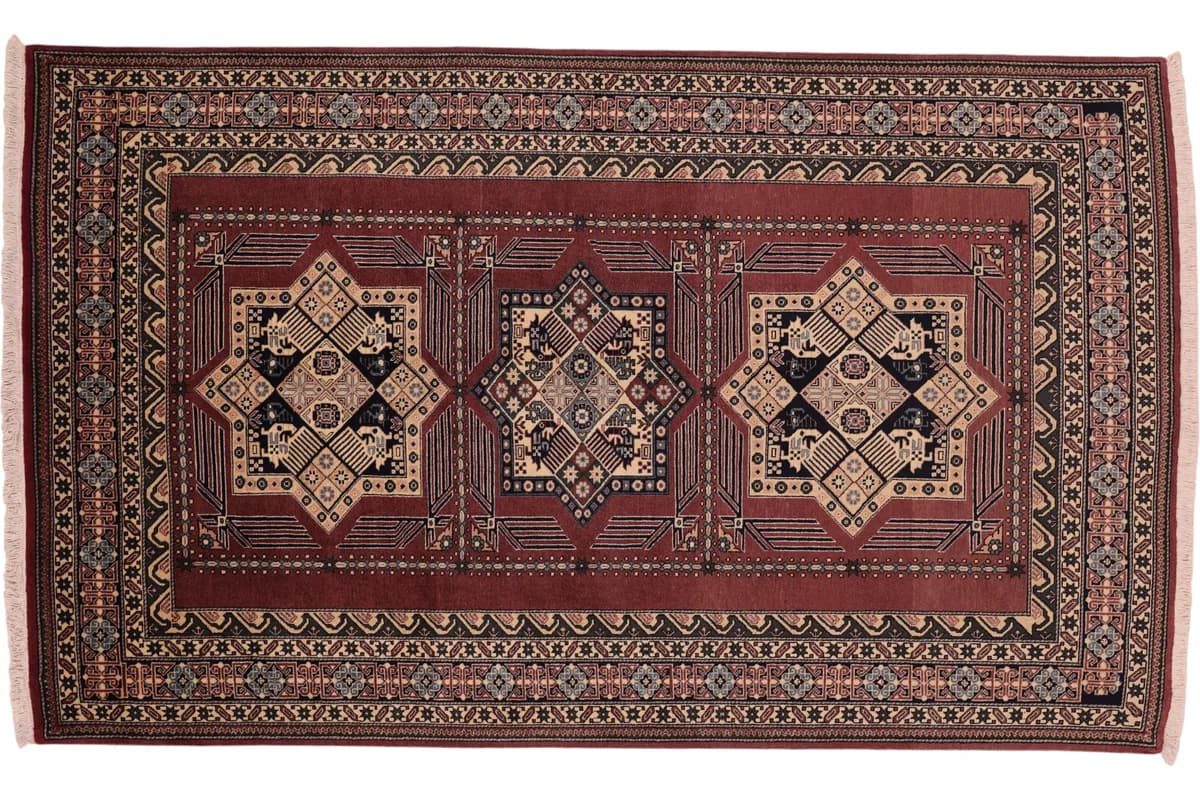
Ardabil lies in the far north-west, closer to Baku than to Tehran, and the design language shows it. The drawing is predominantly geometric — stepped medallions, angular borders, stars and hooks — closer to the neighbouring Caucasian traditions than to the floral centres of the south.
At around 250,000 knots per square metre on a cotton warp the fineness sits in the middle range: enough for clean geometric edges, short of the manufacturing cities.
The pile is sheared flat at around ten millimetres. That keeps the edges sharp, gives a smooth surface and builds up very little — a rug that fits under doors closing close to the floor.
- Geometric drawing with a Caucasian inflection.
- Flat pile of around ten millimetres.
- Cotton warp, light smooth fringes.
- Around 250,000 knots — clean edges without manufactory effort.
- The name of the city, not of the museum piece.
Which room an Ardabil suits
The flat pile makes it practical: chairs run over it rather than sinking in, and it builds up little.
The geometric drawing is strong and sets an accent. Beside dark wood and leather it looks self-evident; in a very light, very pared-back room it dominates.
It takes traffic. A short-sheared pile on a cotton warp is a normal working construction — no reason to spare it.
Care
Vacuum along the pile, without a rotating brush. On a short pile there is no deep dirt for a brush to work loose.
Blot spills at once with clear water and a light cloth, working from the outside in, without rubbing.
Turn it once or twice a year so light and footfall reach it evenly.
Ardabil or Tabriz?
Both lie in north-western Iran, a few hours apart. The difference is geometric regional work against city manufactory.
| Criterion | Ardabil | Tabriz |
|---|---|---|
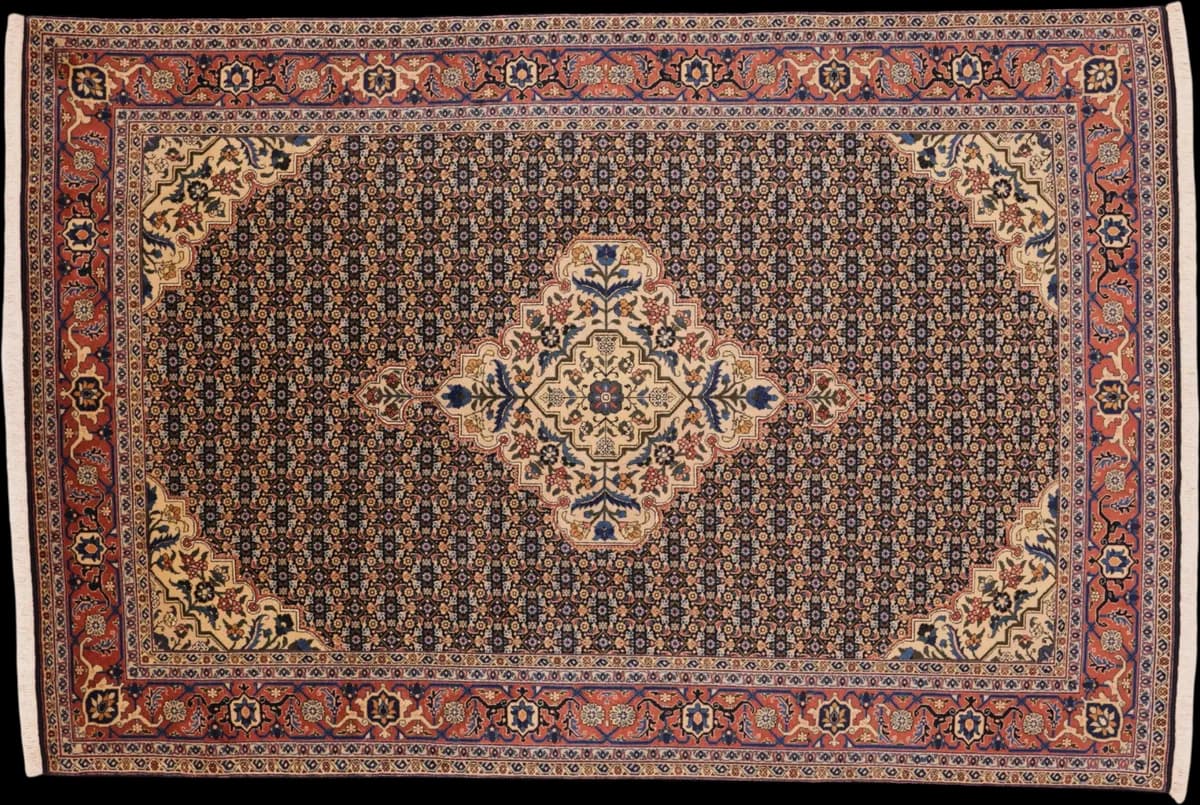
| Drawing | geometric, Caucasian inflected | fine, floral, flowing |
| Knot density | around 250,000 / m² | typically 441,000–500,000 / m² |
| Pile height | around 10 mm | 7–11 mm |
| Type | city and regional work | manufactory to a cartoon |
| Price level | moderate | higher |
Common questions
Is my Ardabil a copy of the famous carpet?
No. The Ardabil Carpet of 1539–40 is a museum piece in the Victoria & Albert Museum. A rug traded as an Ardabil today comes from the city and its surroundings and does not claim to reproduce that design.
Why is the Ardabil Carpet so famous?
For its quality and for its inscription. It carries a date and a name — a rarity among historical carpets — and therefore serves as a fixed point against which other pieces can be dated. Beyond that, a fineness still regarded as exceptional after nearly five hundred years.
Why is the drawing geometric rather than floral?
Ardabil lies in the far north-west, next to the Caucasian weaving traditions, whose vocabulary is angular: stepped medallions, stars, hooks. The floral centres lie further south.
Does an Ardabil suit a dining table?
The flat pile argues for it — chairs run over it rather than sinking in. What decides it is the size: around 80 centimetres of clearance beyond the table edge, so a chair does not tip over the edge when pushed back.
How fine is an Ardabil?
Around 250,000 knots per square metre — the solid middle. Enough for clean geometric edges, well below the manufacturing cities at half a million and above. For the drawing of this type it is exactly right.