The lobed medallion
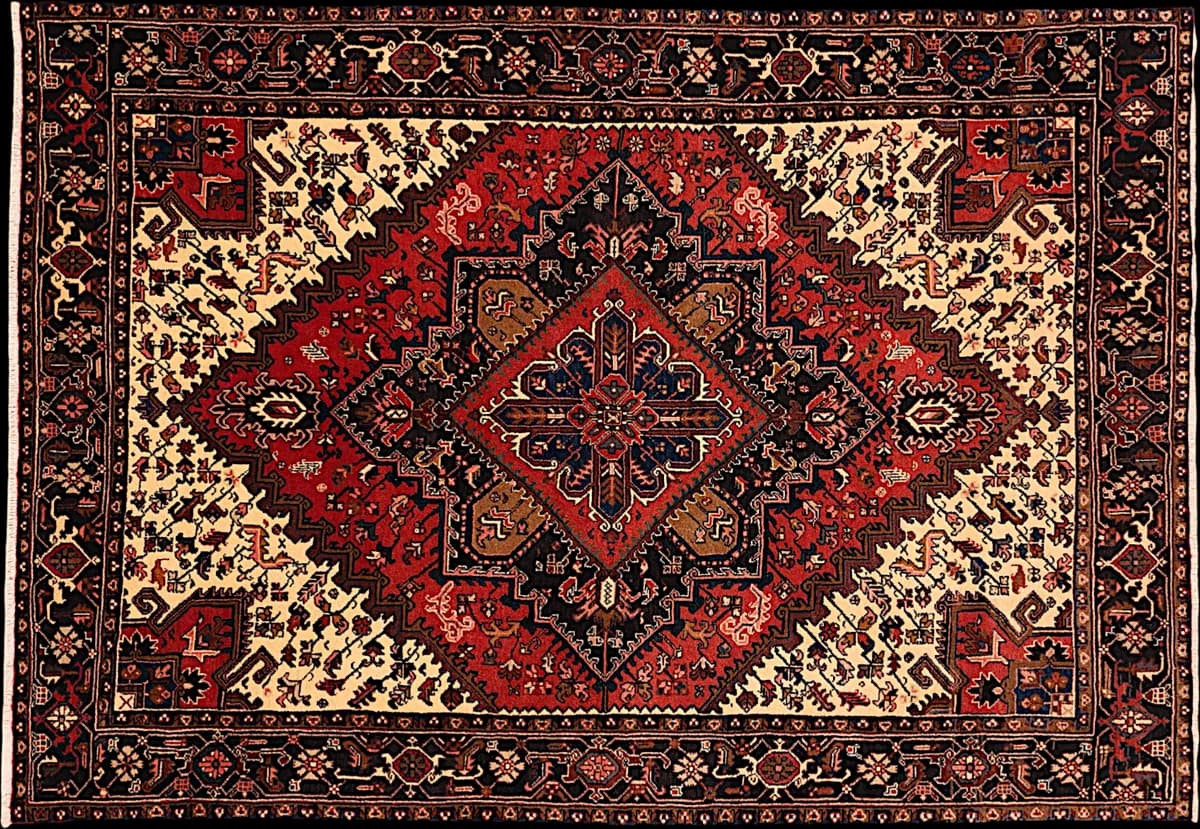
A Heriz is recognisable by a single feature: the large lobed medallion occupying the centre of the field. It is neither round nor oval but repeatedly indented — an angular, stepped form that reads almost like a star or a coat of arms.
Around this medallion bold, straight-edged arabesques fill the field, and large corner spandrels echo the medallion’s shape. Everything is built geometrically: straight edges, stepped transitions, no flowing vines.
This design language is a direct consequence of the knot count. At around 90,000 knots per square metre each knot sits large, and fine curves could not be drawn cleanly. Rather than treat that as a limitation, the weavers of Heris made a style out of it — and turned it into one of the best known in the world.
Why coarse knotting is an advantage here
Heriz rugs have a reputation for being indestructible, and there is a technical reason. A coarsely knotted pile of thick handspun wool absorbs footfall and springs back instead of laying over the way a finely sheared one does.
Add the wool of the region. On the slopes of Sabalan the sheep carry a particularly robust, lanolin-rich fleece, considered among the most hard-wearing in Persia. It takes dye well, holds it for a long time and resists abrasion.
Anyone looking for a Persian rug for a room that is genuinely lived in — with children, a dog, furniture that moves — will find in this combination of coarse knotting and robust wool the most durable thing the Persian tradition offers.
- Large lobed medallion with matching corner spandrels.
- Consistently geometric, straight-edged design language.
- Around 90,000 knots — deliberately coarse, therefore durable.
- Robust, lanolin-rich mountain wool from Sabalan.
- Large formats around six square metres and above.
Which room a Heriz suits
Six square metres and more is living-room size. A Heriz carries a whole seating group with every furniture leg on it, or a dining table with the chairs pushed back.
It is the rug for heavily used rooms. Hallway, living room, dining area — wherever a fine rug shows traffic marks after a few years, a Heriz holds.
The large medallion does want an open middle, though. Push half the rug under a sofa and you give away exactly the feature you bought a Heriz for.
Care
Vacuum along the pile, without a rotating brush. The substantial pile tolerates a great deal, but the brush pulls fibres out over time.
Blot spills at once with clear water and a light cloth, working from the outside in. The lanolin-rich mountain wool leaves liquid standing on the surface for a moment and buys time.
On a large rug a professional deep clean every few years is worth it. It lifts dust from the base of the pile that no vacuum reaches.
Heriz or Tabriz?
Both come from Iranian Azerbaijan and lie only a few dozen kilometres apart. Two rugs could hardly be more opposed.
| Criterion | Heriz | Tabriz |
|---|---|---|
| Type | village weaving | city manufactory to a cartoon |
| Knot density | around 90,000 / m² | considerably higher, often over 500,000 |
| Design language | geometric, angular | fine, floral, flowing |
| Typical size | around 6 m² and above | usually smaller |
| Character | robust working piece | precise draughtsmanship |
Common questions
Why is a Heriz so coarsely knotted?
Because it is built as a working rug. Around 90,000 knots per square metre give a substantial pile that absorbs footfall and springs back. The geometric design language with the lobed medallion grew out of that constraint — and became a style in its own right.
Heriz or Heris?
Both. Heris is the current spelling of the place name, Heriz the one established in the rug trade. The same village north-east of Tabriz is meant.
Is a Heriz suitable for underfloor heating?
Only partly. Twelve millimetres of substantial wool pile insulate noticeably and slow the heat. For a room heated through the floor, a flatter rug is the better choice.
What makes the wool from Sabalan special?
The sheep of the mountain region carry a particularly robust, lanolin-rich fleece. It takes dye well, holds it for a long time and resists abrasion — one of the reasons for the Heriz reputation for being practically indestructible.
Does a Heriz suit a modern living room?
The strong geometric drawing sets a clear accent and reads as dominant in a very pared-back room. In a room with character — dark wood, leather, high ceilings — it plays to its strength. Anyone wanting something quieter should choose a flatter, more even type.