
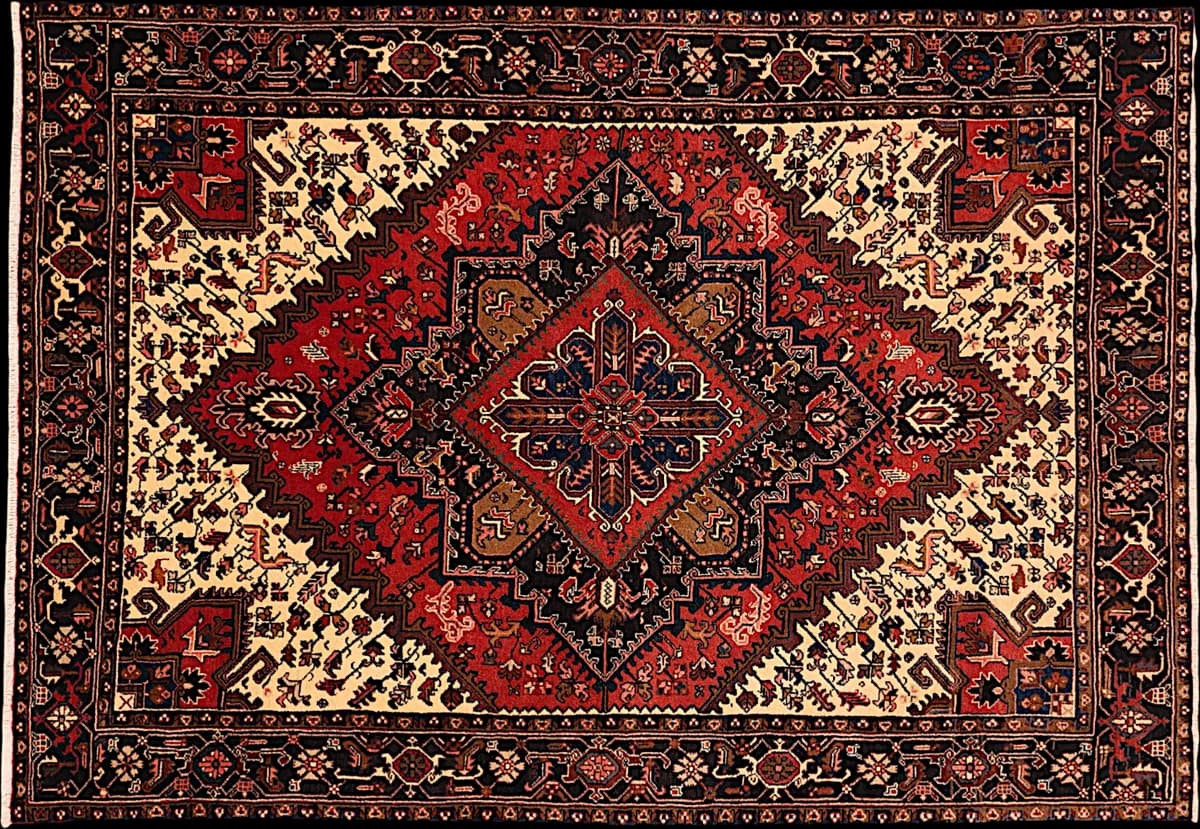
Heriz
297 × 209 cm
2.515 €






2.410 €
Incl. VAT
In Stock · Ready to Ship
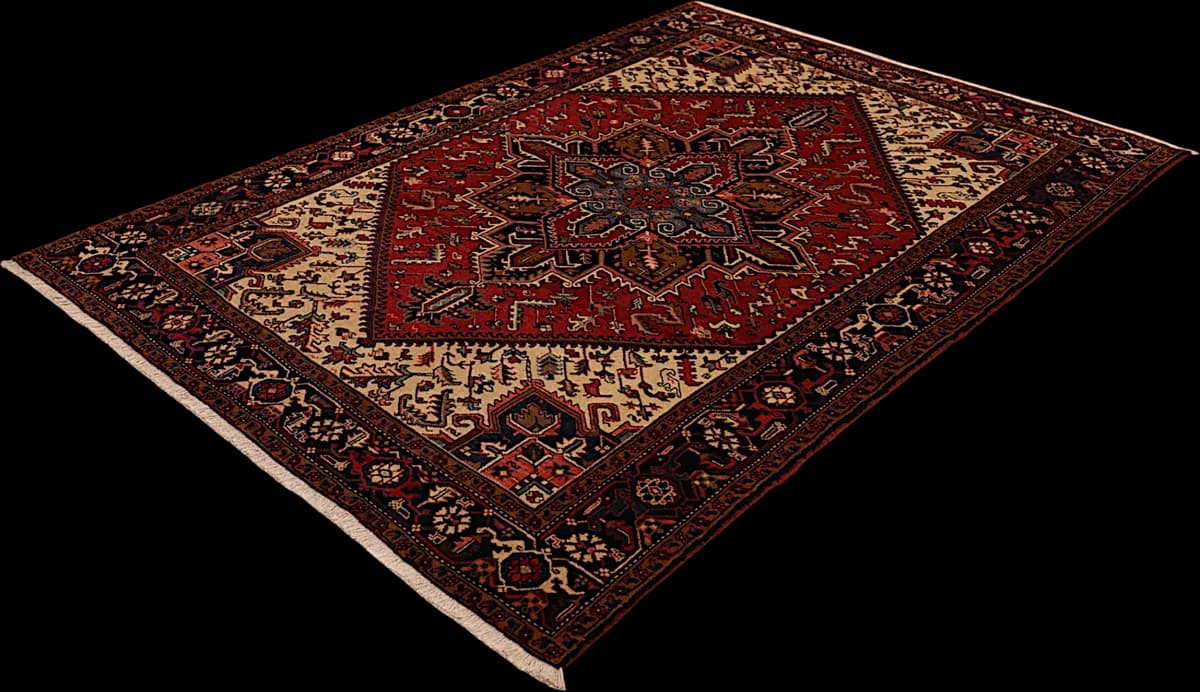
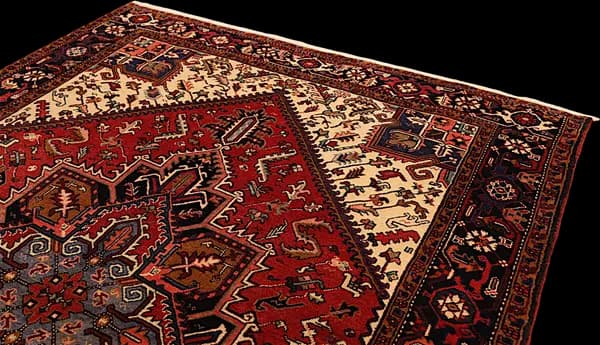
This is a Heriz, also written Heris, a village rug from Heris in northwest Iran, woven on the slopes below Mount Sabalan northeast of Tabriz. At 289 x 206 cm (9'6" x 6'9"), it carries the pattern the type is known for worldwide: a large geometric medallion set against a bold, angular field, adapted by village weavers from designs first supplied by Tabriz merchants.
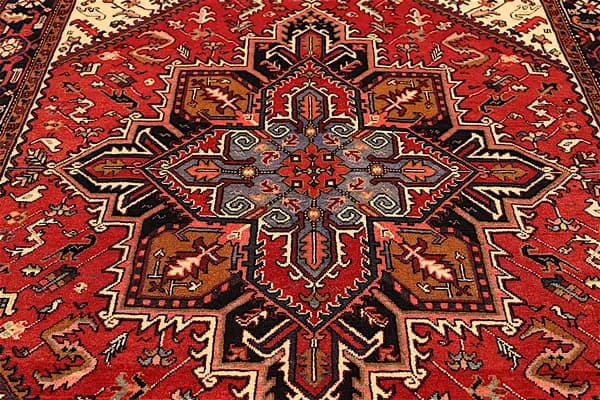
A deep brick-red field grounds the design, and rising from its centre is a stepped star medallion worked in cool slate-blue and camel, rather than the usual red or ivory. The cooler tone gives it real graphic weight, set against ivory spandrels and a red diamond ground scattered with angular botanical motifs in terracotta pink and dark navy. A wide navy-black border, filled with ivory rosettes and small stylised figures, closes the design and takes up close to a fifth of the rug's width.
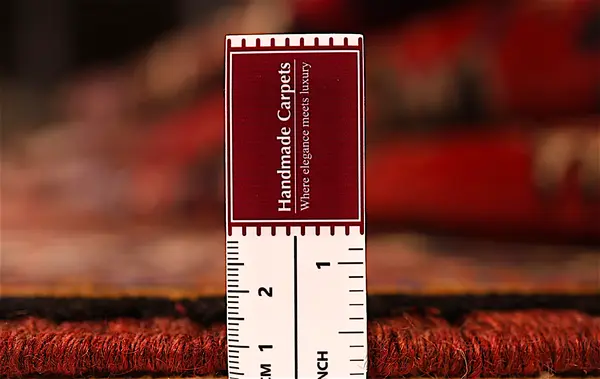
The design travelled from Tabriz as a workshop cartoon, but village weavers redrew it freehand in their own bolder hand, which is why the medallion is faceted and squared rather than curved. It is hand-knotted with hand-spun wool rich in copper from local water, giving Heriz rugs their reputation for lasting decades in daily use. At 72,000 to 90,000 knots per square metre, the weave is looser than a city rug, and that openness is what lets the pattern read in such large, confident shapes.
A rug this size suits a living or dining room, under a table or by a sofa. The brick-red field holds its own against dark wood and warms a pale floor, while the slate-blue medallion keeps it from tipping into pure heat. Underfoot the wool is dense, firm, and made for daily use. As the afternoon light crosses it, that blue centre is what keeps catching the eye.
More on Heriz rugs: origin, making and how to recognise a genuine piece
Artisan crafted
At 289 × 206 cm (5.95 m²) this is a large rug. It sits under a seating group with the front legs of sofa and chairs on it, or under a dining table for four. A table for six wants about 80 cm of clearance all round, and needs more.
Yes, knotted by hand — knot by knot on a loom, not machine-made. The density is 72,000 to 90,000 knots per square metre; across 5.95 m² that is roughly 430,000 to 540,000 individual knots, every one of them tied by hand.
Hand-spun wool still carries its own lanolin, which keeps liquid sitting on the surface for a moment: blot quickly, with clear water and a light cloth, working inwards and without rubbing. Otherwise regular vacuuming along the pile is enough. Turn the rug once or twice a year so light and footfall reach it evenly.
We are in the Hamburg Speicherstadt. Come and see this rug in daylight, or write to us — a person answers.
Certificate included verifying origin, materials, and craftsmanship.
Ref: 543415


