Heriz
293 × 206 cm
2.446 €




2.300 €
Incl. VAT
In Stock · Ready to Ship
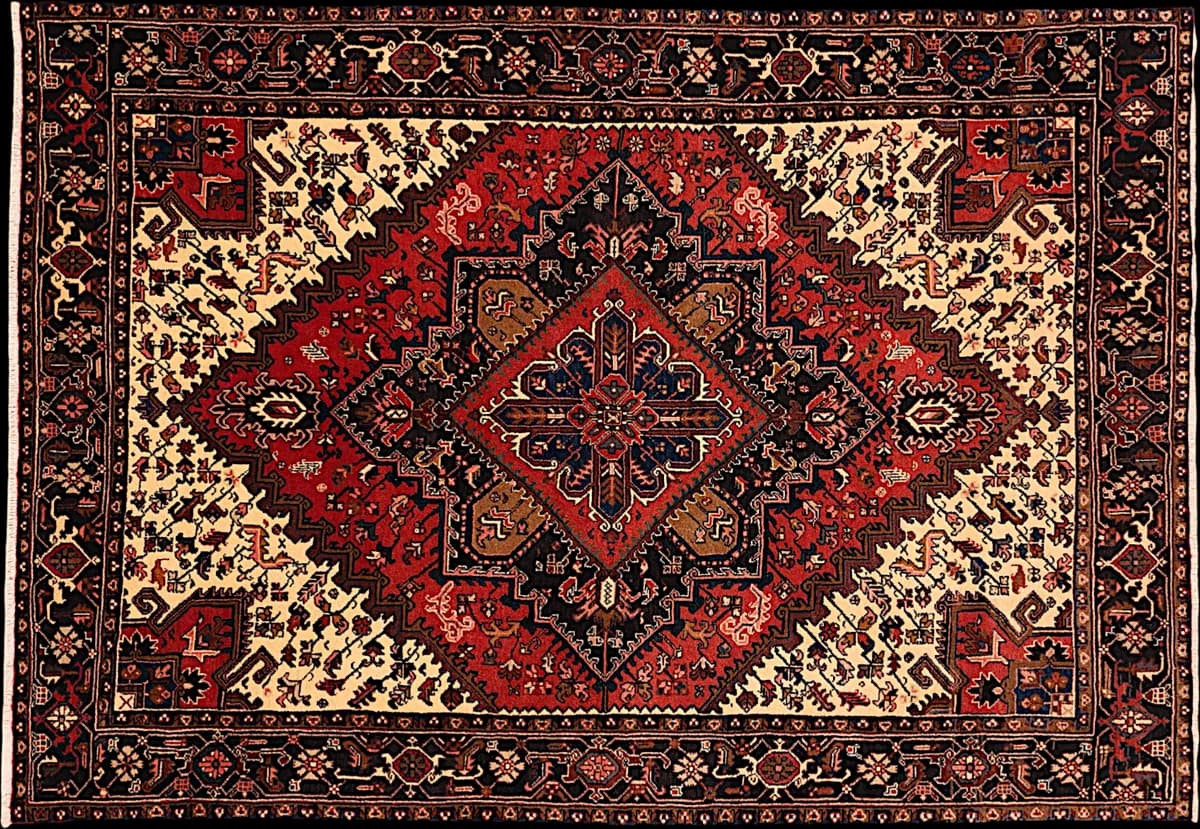
This is a Heriz, a village weaving from the town of Heris in the hills below Mount Sabalan, north-east of Tabriz, measuring 277 x 205 cm (9'1" x 6'9"). The style began when Tabriz merchants brought city cartoons out to village weavers, who reworked the elegant urban medallion into something bolder and more angular. Heriz rugs are known above all for that graphic confidence, and this one is drawn with unusual precision for a tradition that usually favours a freer hand.
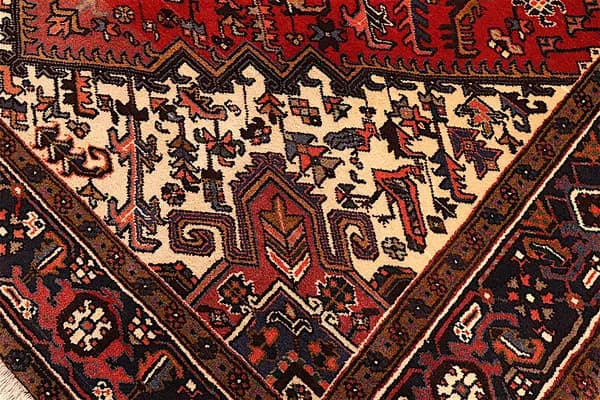
The field is a deep brick red, scattered with small angular botehs and hooked motifs, and across it floats a large stepped octagonal medallion with a cross-shaped pendant core picked out in camel-brown, its lobes set symmetrically and its outlines unusually crisp and clean. Ivory spandrels fill the corners with sprawling angular vine work, giving the whole field strong contrast rather than the softer blending some Heriz pieces show. A wide navy border, carrying small rosettes and hooked forms, frames the field and is set off by narrower cream, rust and camel guard stripes, taking up roughly a fifth of the rug's width. The overall effect is bold, high-contrast and immediately readable from across a room.
This rug is hand-knotted with hand-spun wool over a cotton foundation, at a density of 72,000 to 90,000 knots per square metre, which is the range village weavers worked in rather than the far finer counts of a city workshop. That coarser yarn is normally what gives Heriz medallions their rugged, slightly loose look, which makes the sharpness of the drawing here worth noticing: the weaver has kept every stepped edge of the medallion under tight control despite the thicker wool. The wool itself is rich in copper from the local water, the trait that gives Heriz rugs their long working life, and at 12 mm the pile has been clipped firm and even, with the matte, slightly flat surface typical of the type.
At 277 x 205 cm this rug is sized for a dining table or a living room seating group, somewhere it will be seen in full rather than glimpsed at the edges. The brick red holds its own against dark wood and deepens a pale floor, while the ivory corners keep the whole field from feeling heavy. Underfoot it is dense and firm, a rug built for daily footsteps rather than careful protection. As daylight moves across it through the day, the crisp lines of that medallion catch the eye again and again, never quite the same twice.
More on Heriz rugs: origin, making and how to recognise a genuine piece
Artisan crafted
At 277 × 205 cm (5.68 m²) this is a large rug. It sits under a seating group with the front legs of sofa and chairs on it, or under a dining table for four. A table for six wants about 80 cm of clearance all round, and needs more.
Yes, knotted by hand — knot by knot on a loom, not machine-made. The density is 72,000 to 90,000 knots per square metre; across 5.68 m² that is roughly 410,000 to 510,000 individual knots, every one of them tied by hand.
Hand-spun wool still carries its own lanolin, which keeps liquid sitting on the surface for a moment: blot quickly, with clear water and a light cloth, working inwards and without rubbing. Otherwise regular vacuuming along the pile is enough. Turn the rug once or twice a year so light and footfall reach it evenly.
We are in the Hamburg Speicherstadt. Come and see this rug in daylight, or write to us — a person answers.
Certificate included verifying origin, materials, and craftsmanship.
Ref: 993223