Heriz
289 × 206 cm
2.410 €





2.398 €
Incl. VAT
In Stock · Ready to Ship
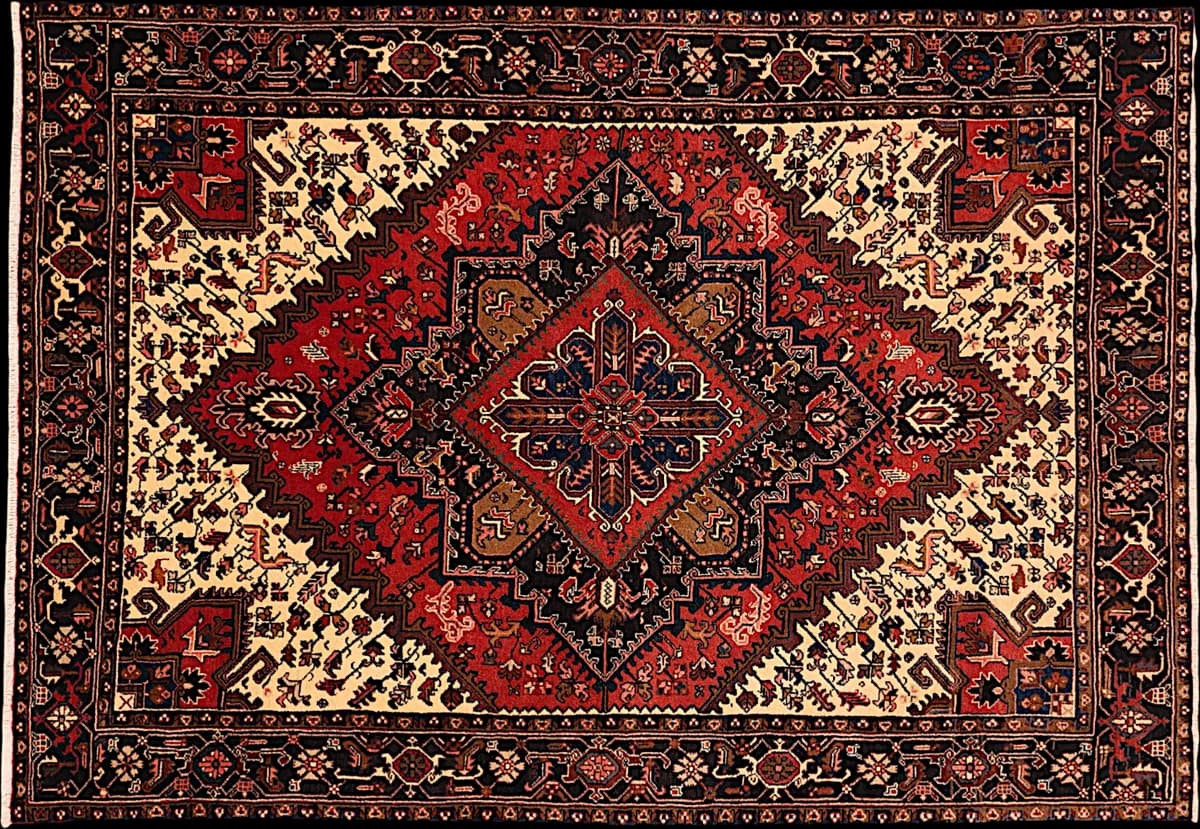
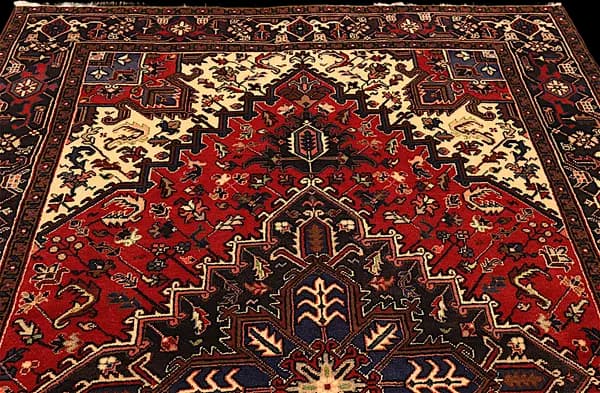
This is a Heriz, a village rug from the slopes of Sabalan in Iranian Azerbaijan, north-east of Tabriz, measuring 293 x 202 cm (9'7" x 6'7"). Heriz rugs are among the most recognised of all Persian weavings, prized for a bold central medallion and a wool so hardwearing that nineteenth-century pieces are still walked on today. This one carries that boldness with unusual clarity.
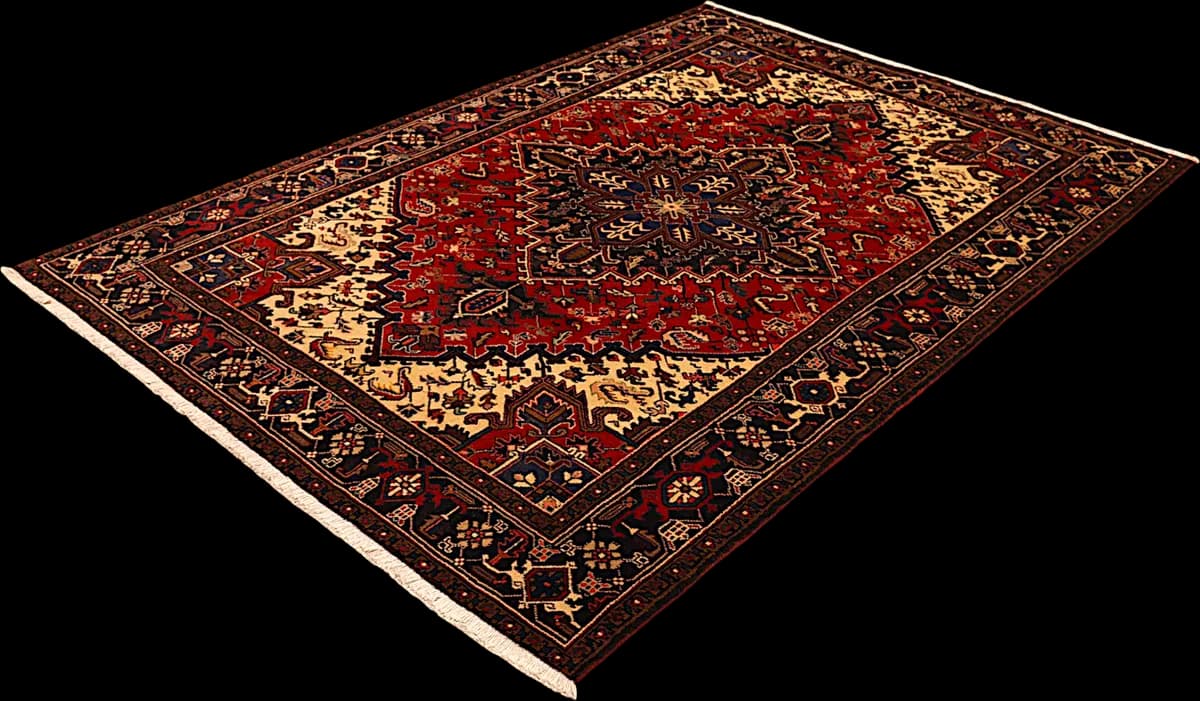
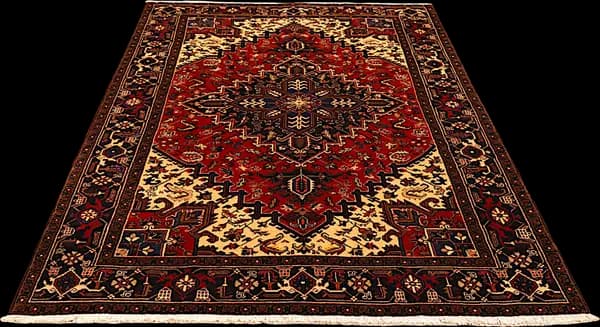
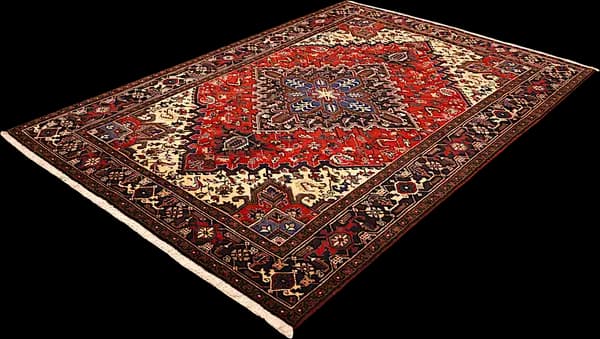
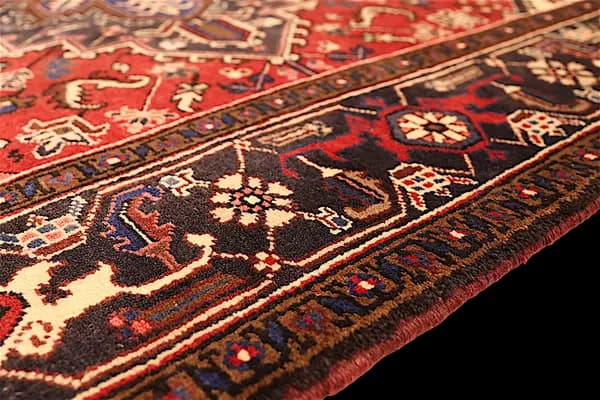
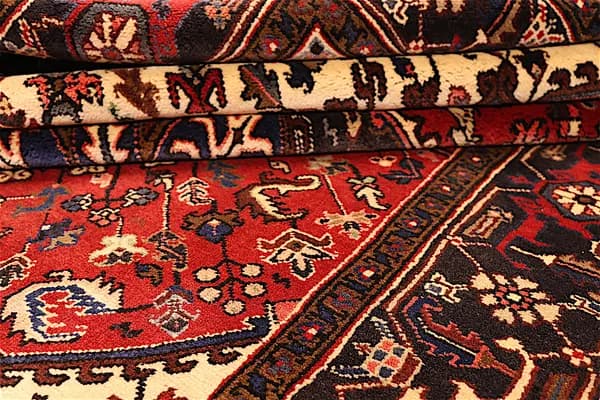
The first impression is a navy stepped-star medallion floating on a deep, saturated red field. Ivory corner spandrels frame it, each filled with dense floral vinework fine enough to read, at a glance, almost as small creatures before resolving into leaf and blossom. Around the whole runs a wide navy-black border, filled with ivory and rust cartouches of hooked geometric and floral shapes, darker and denser than the field, closing the composition like a firm frame.
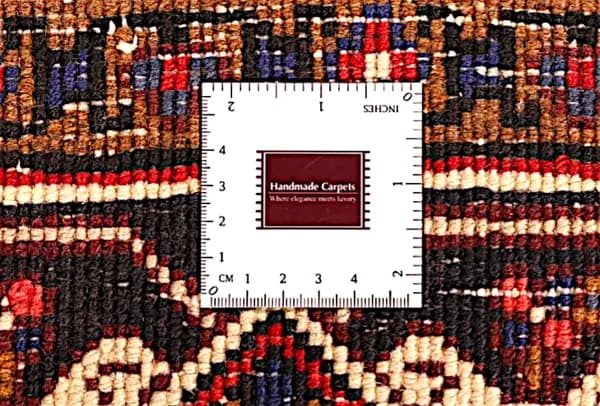
Heriz weaving began when Tabriz merchants sent city cartoons to village looms, and weavers redrew them freehand, trading fine detail for graphic weight. That is what gives this rug its sharp, high-contrast drawing: at 72,000 to 90,000 knots per square metre, each line of the medallion and border reads bold rather than blurred. The wool is hand-spun and rich in copper from local water, the quality behind a Heriz's long working life, knotted over a cotton warp to a pile twelve millimetres deep.
This size suits a dining table or a living room seating group rather than a small corner. The red warms a pale floor and holds its own against dark wood, while the navy medallion keeps its shape across the room. Underfoot the pile is dense and firm, wool built for daily footsteps rather than careful preservation. As light shifts through the day, the crisp line between navy and red is what keeps catching the eye.
More on Heriz rugs: origin, making and how to recognise a genuine piece
Artisan crafted
At 293 × 202 cm (5.92 m²) this is a large rug. It sits under a seating group with the front legs of sofa and chairs on it, or under a dining table for four. A table for six wants about 80 cm of clearance all round, and needs more.
Yes, knotted by hand — knot by knot on a loom, not machine-made. The density is 72,000 to 90,000 knots per square metre; across 5.92 m² that is roughly 430,000 to 530,000 individual knots, every one of them tied by hand.
Hand-spun wool still carries its own lanolin, which keeps liquid sitting on the surface for a moment: blot quickly, with clear water and a light cloth, working inwards and without rubbing. Otherwise regular vacuuming along the pile is enough. Turn the rug once or twice a year so light and footfall reach it evenly.
We are in the Hamburg Speicherstadt. Come and see this rug in daylight, or write to us — a person answers.
Certificate included verifying origin, materials, and craftsmanship.
Ref: 459362