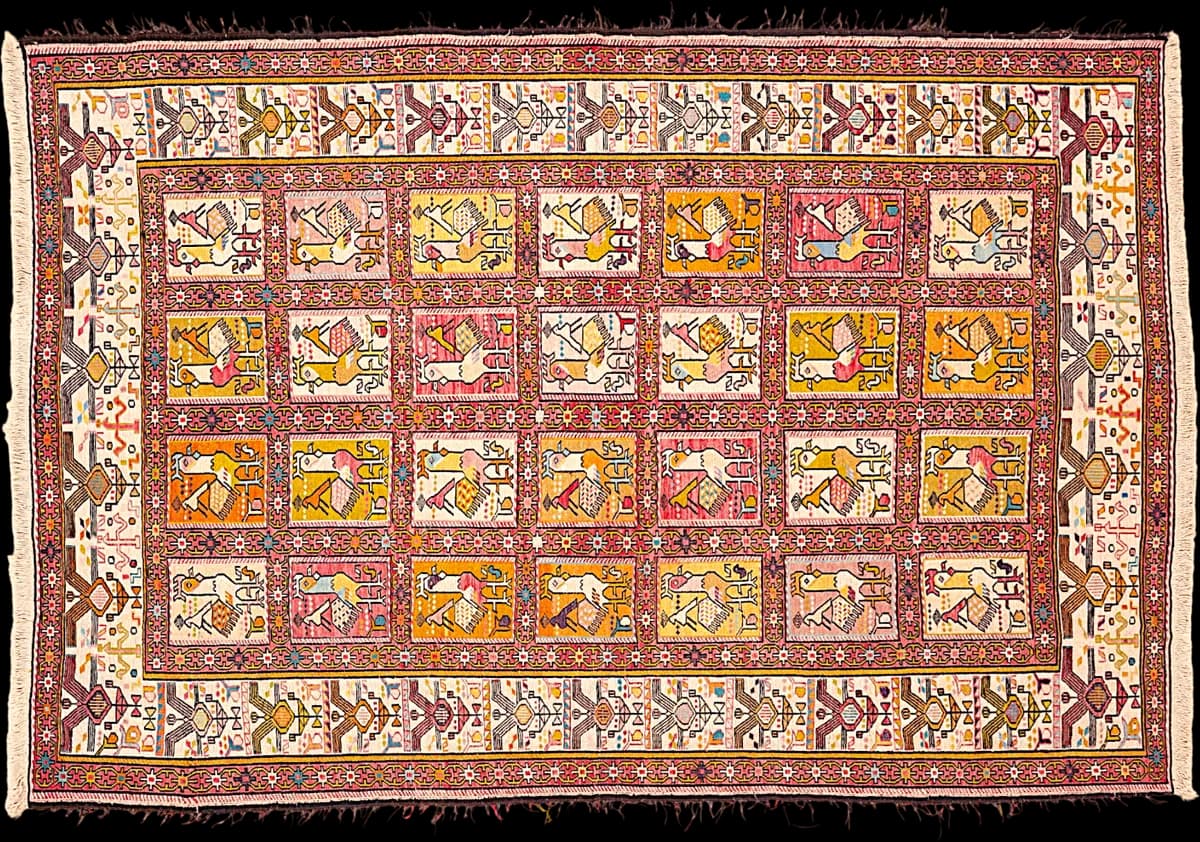
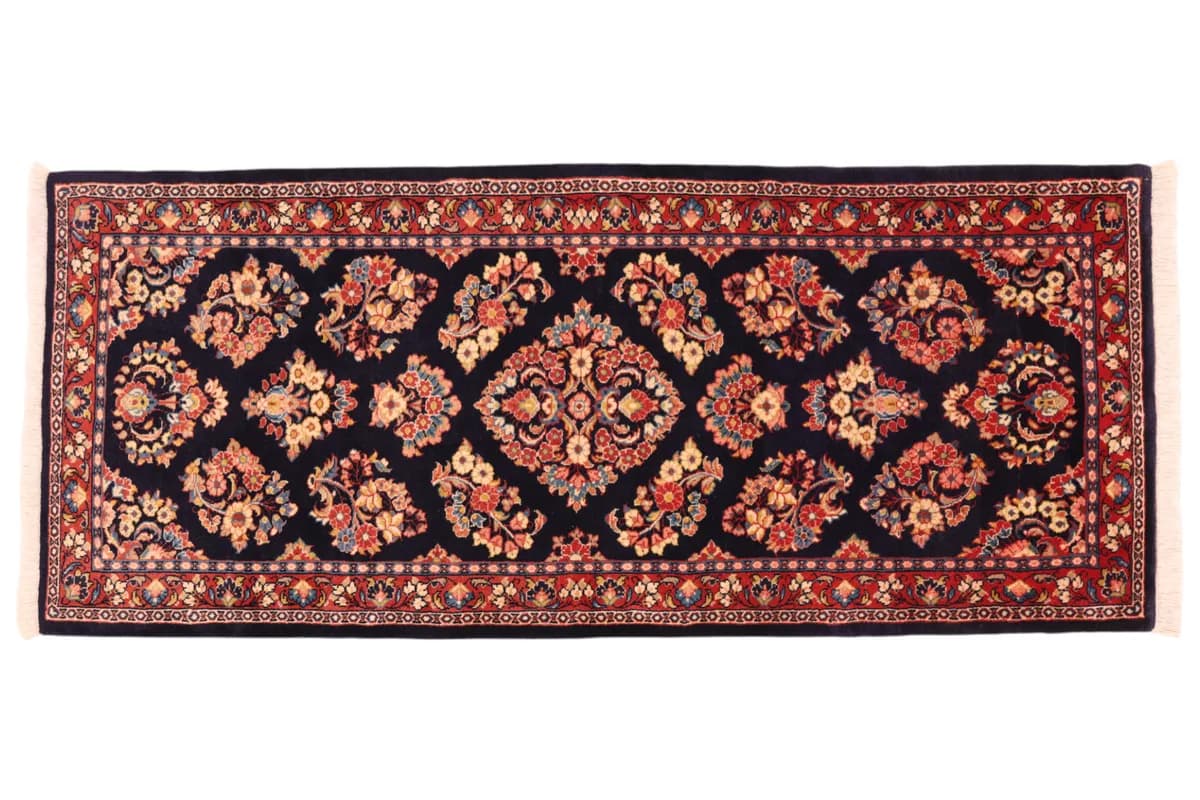
How soumak works
In a kilim the weft simply passes over and under the warp threads. The pattern comes from where the thread changes colour, and because the same thread shows on both faces, front and back are identical.
In soumak the weft is instead wrapped around pairs of warp threads — usually four forward, two back — and then carried to the next pair. Each wrap lies diagonally on the surface and forms a small, slanted rib.
Two things follow. The front gains a palpable texture, almost like very flat embroidery. And the loose ends of the wraps hang on the back — so unlike a kilim, a Verni has only one face.
What that means in practice
At around four millimetres of total thickness a Verni builds up almost nothing. It fits under any door, chairs run over it, and a desk chair on castors does it no harm.
The soumak technique allows bolder, clearer drawing than a plain kilim: the wraps can set contours that would step in pure flatweave. That is why Verni pieces read as more graphic than a kilim of the same size.
The drawback against a kilim is the loss of reversibility. A kilim can be turned over and spreads its wear across two faces; a Verni cannot. Anyone who wants that property should choose the kilim.
- Diagonal ribs on the front — the soumak mark.
- Back with loose ends, not intended as a face.
- Around four millimetres of total thickness.
- Clearer contours than a plain kilim.
- Not reversible, unlike a kilim.
Which room a Verni suits
Anywhere build-up is a problem: under doors, under a desk chair, in a hallway with a door that closes close to the floor.
The surface is firm and textile, not soft. On a cold stone floor a Verni warms little — that is not what it is built for.
The graphic drawing suits modern rooms where a strongly patterned knotted rug would be too much.
Care
Vacuum without a rotating brush. The wraps lie on the surface and a brush can lift them.
Do not turn it over — the back is not a working face. At most rotate a Verni by 180 degrees so light and footfall reach it evenly.
Blot spills at once with clear water and a light cloth, working from the outside in, never rubbing. On a textured surface a roughened patch stays visible.
Verni or kilim?
Both are flatweaves without pile. The difference lies in how the weft is carried — and that decides texture and reversibility.
| Criterion | Verni (soumak) | Kilim |
|---|---|---|
| Weft | wrapped around warp pairs | simply passed through |
| Surface | raised, diagonal ribs | flat and smooth |
| Usable both sides | no | yes |
| Contours | clearer, less stepped | stepped, geometric |
| Thickness | around 4 mm | around 3–5 mm |
Read the full guide: Kilim or knotted rug: what is the difference?
Common questions
Where is Verni?
Nowhere. Verni is not an origin but the name of a weaving technique — soumak weft wrapping. Anyone searching for the place is searching for the wrong thing.
Is a Verni a kilim?
Related but not the same. Both are flatweaves without pile. In a kilim the weft passes straight through the warp; in a Verni it is wrapped around pairs of warp threads. Hence the raised texture — and hence a Verni has only one face.
Can I turn a Verni over?
No. The loose ends of the wraps hang on the back; it is not intended as a working face. That is the essential practical difference from a kilim, which can be turned and so used twice as long.
Does a Verni keep a room warm?
Barely. At around four millimetres of total thickness it insulates little — on a cold stone floor the difference from a pile is clear. In exchange it fits under any door and lets chairs run.
How do I recognise the soumak technique?
By the diagonal ribs on the surface. They arise because each wrap lies at a slant, and they are clearly felt with a finger. A glance at the back confirms it: the loose ends hang there.