Kelim Verni
188 × 127 cm
968 €





1.031 €
Incl. VAT
In Stock · Ready to Ship
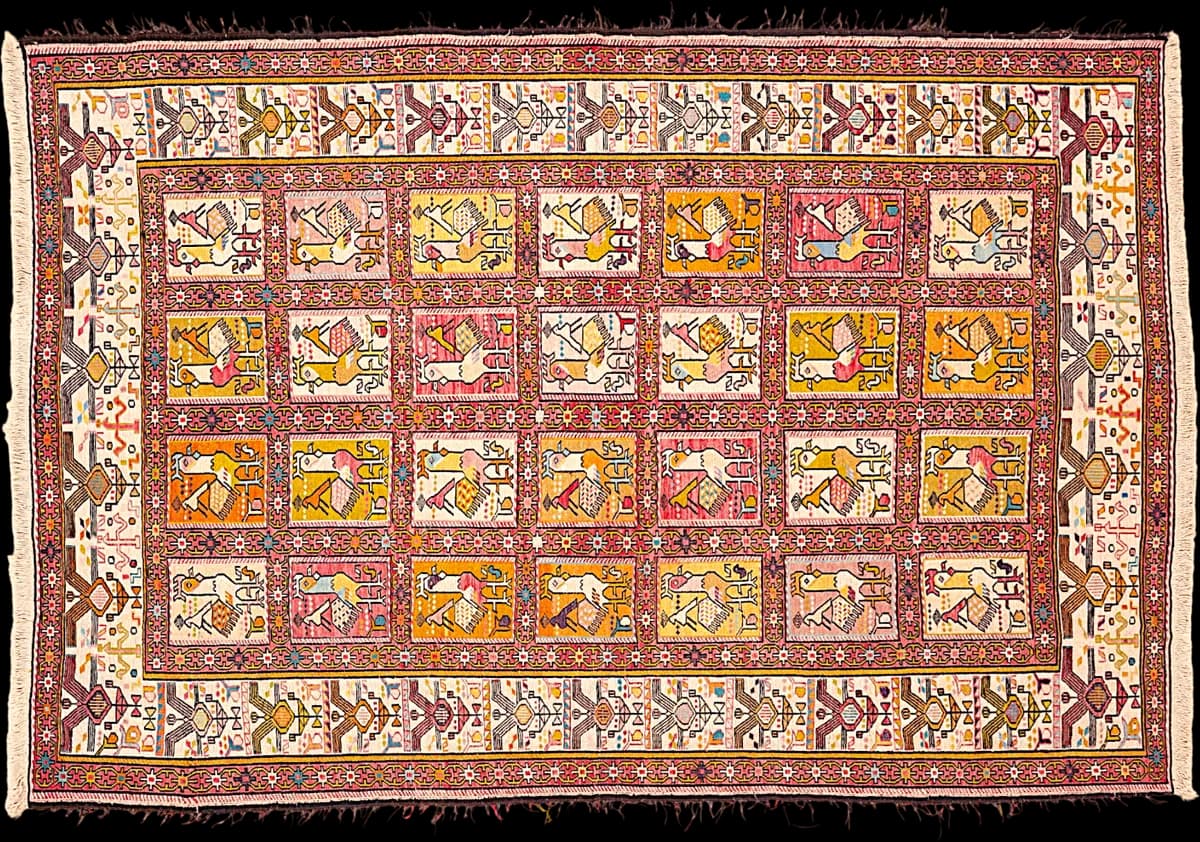
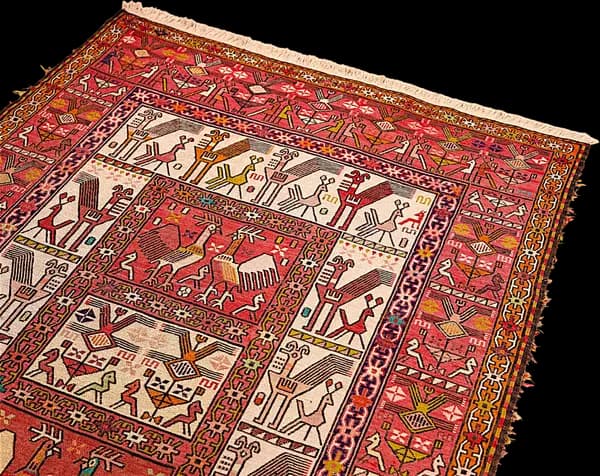
This is a Verni, also written Verneh, a hand-woven flatweave from the tribal weaving traditions of the Caucasus and northwest Iran, made using the Sumak weft-wrapping technique rather than knotted. It measures 193 x 123 cm (6'4" x 4'0"). Vernis sit between a kilim and a piled rug: stronger and more textured than a flat kilim, without the height of a knotted pile, and known for bold, graphic patterning.
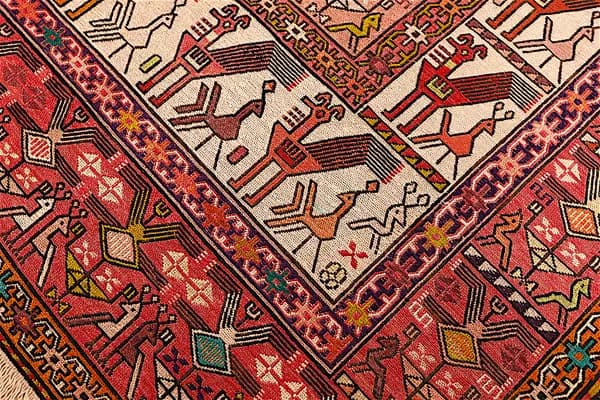
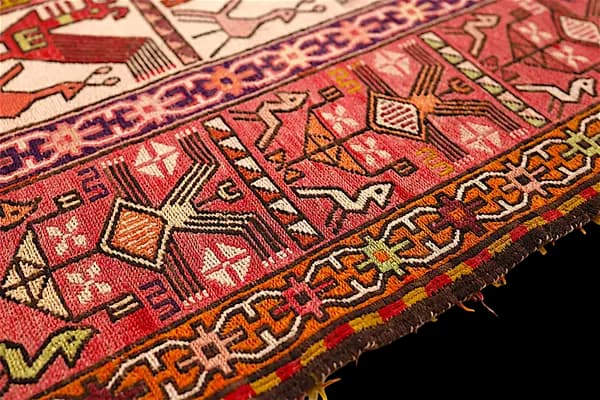
The field reads first as a grid of warm coral red and ivory rectangles, set side by side across the rug. Each ivory panel holds its own stylized bird or four-legged animal, a deer or goat-like figure on thin drawn legs, so the eye moves from panel to panel reading a menagerie rather than one repeated motif. Rust-orange, mustard gold, teal and dark aubergine mark the small figures and the narrow guard stripes. A wide rust-orange border of hooked diamond lattice frames the whole grid.
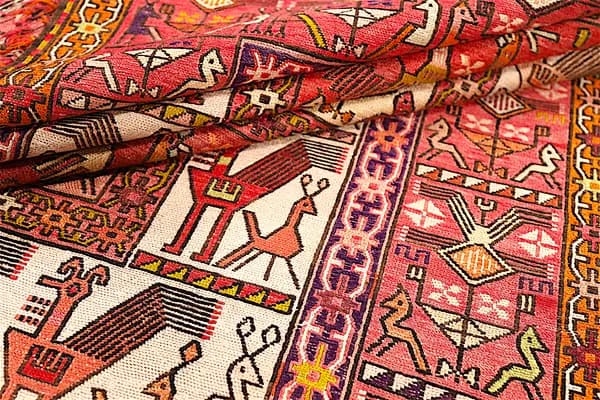
Verni is woven, not knotted: the weft is wrapped around paired warp threads in the Sumak method, building a slightly raised, ribbed surface rather than a flat weave. Wool blended with a little silk in that weft lets the small figures keep sharp outlines without knots, since the finer yarn sits precisely where it is wrapped. A cotton warp keeps each compartment square and its edges crisp. The result stays matt, textured rather than glossy, closer to a low relief than a printed pattern.
This Verni suits a hallway, a small study, or the floor beside a bed, somewhere it is seen underfoot rather than hidden by furniture. The coral red warms a pale floor and holds its own against dark wood, while the ivory panels keep it open rather than heavy. Flat and dense, it takes daily footsteps well. Morning light catches the ribbed sumak texture, picking out the animals one at a time.
More on Vernis: origin, making and how to recognise a genuine piece
At 193 × 123 cm (2.37 m²) this is a small rug. It works beside a bed, in a reading corner, in front of a fireplace or as a mat by a door. It does not furnish a room; it makes a point in one.
No — this piece is hand-woven, not knotted. A flatweave has no pile: the pattern comes from warp and weft alone. That makes it thin, light and usable on both sides, and it is a technique in its own right rather than a simpler version of a knotted rug.
Vacuum regularly, ideally along the weave and without a rotating brush. A flatweave can be turned over, which spreads the wear — flip it once or twice a year. Blot spills at once with clear water and a light cloth, working inwards, and never rub.
We are in the Hamburg Speicherstadt. Come and see this rug in daylight, or write to us — a person answers.
Certificate included verifying origin, materials, and craftsmanship.
Ref: 586291