Kelim Verni
193 × 123 cm
1.031 €




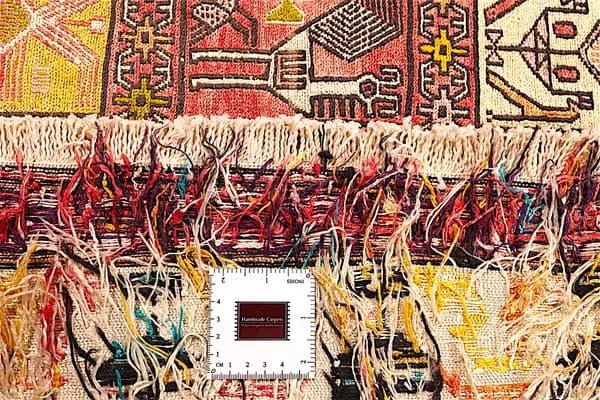
1.004 €
Incl. VAT
In Stock · Ready to Ship
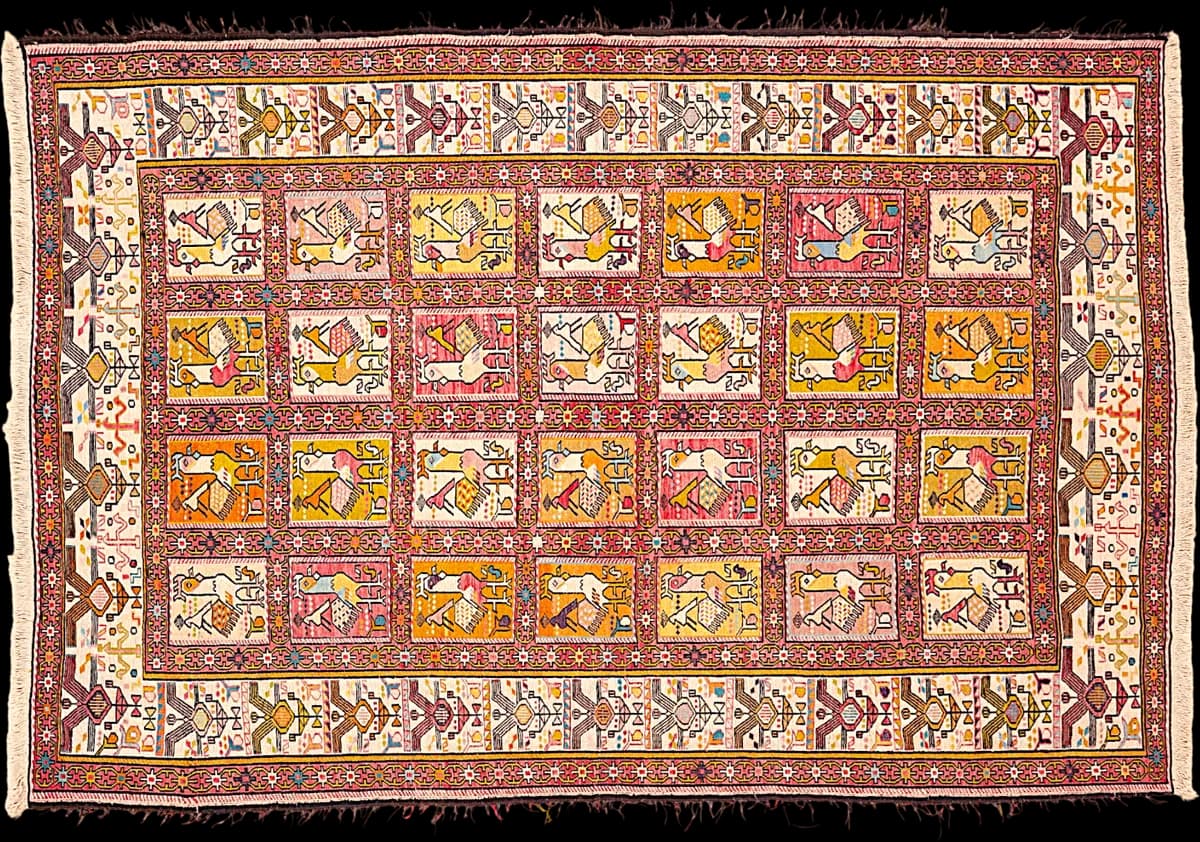
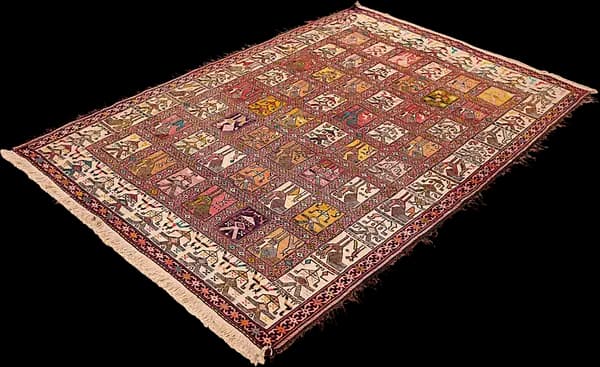
This is a Verni, a hand-woven flatweave from the tribal traditions of the Caucasus and northwest Iran, measuring 191 x 130 cm (6'3" x 4'3"). Verni is not a place but a technique: the sumak method, in which the weft is wrapped rather than simply passed through the warp, producing patterns bolder and more precisely drawn than a plain kilim usually allows. What follows from that technique is a rug built entirely from small, separate pictures.
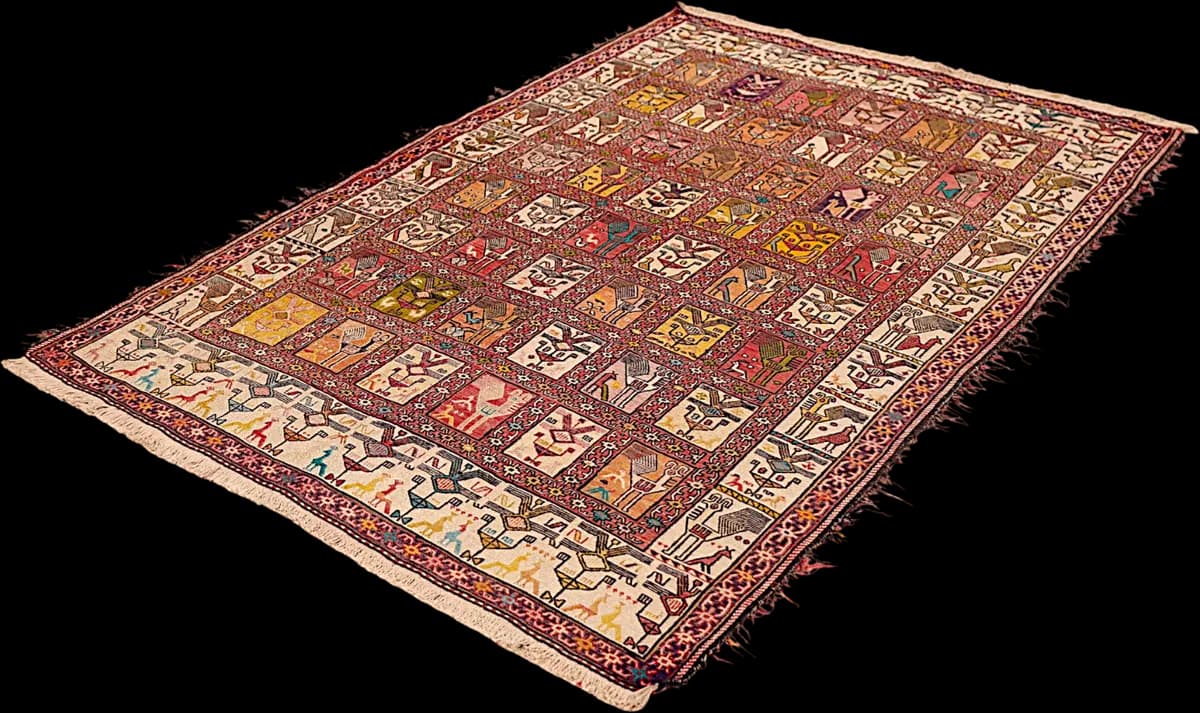
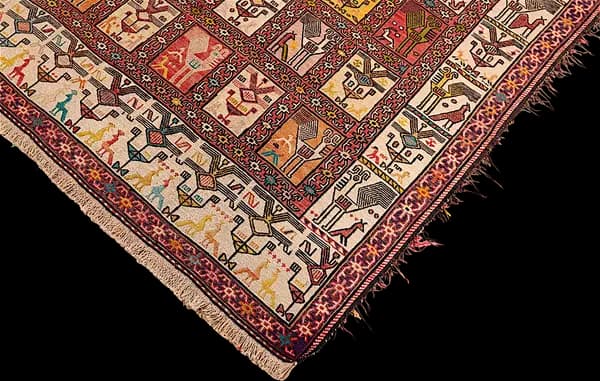
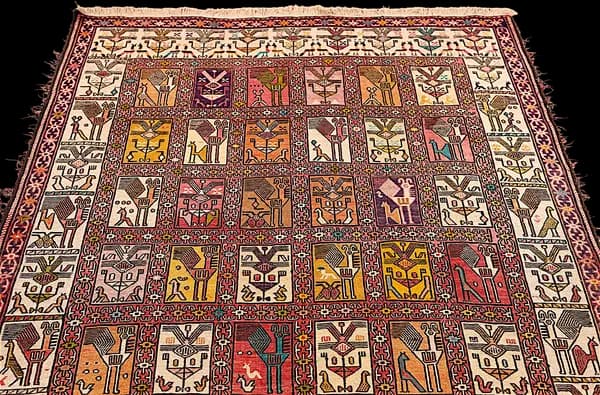
The first impression is of a dense grid, a garden of small rectangular compartments, each one carrying its own tribal figure, animal or plant on a ground of its own colour. No compartment shares its background with the one beside it: pink sits against purple, ochre against olive, cream against aubergine, so the field reads less as a repeating pattern than as a collection of individual panels set side by side. The muted old-rose red that anchors the whole is bordered, not filled, by this patchwork. A wide ivory band frames it, filled with rows of small stylised animals and human figures in rust, mustard, turquoise and olive, held in by narrow dark indigo guard stripes.
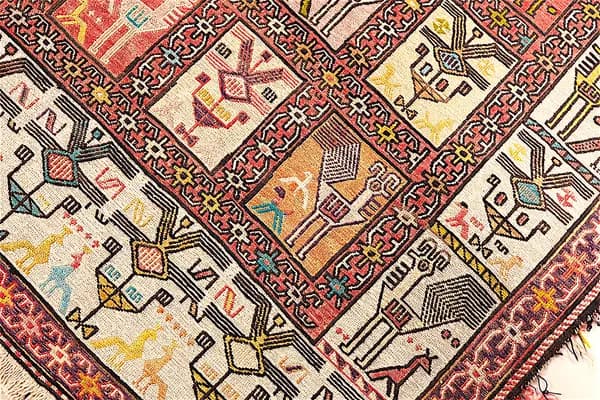
That patchwork clarity comes directly from how the rug was made. In sumak weaving the weft is wound around pairs of warp threads rather than woven straight across, building the surface up in small wrapped stitches that sit slightly proud of the base. This gives the weaver far more control over a small compartment than a flat tapestry weave would allow, which is why each figure here holds its shape and colour so distinctly from its neighbour. The wool weft is handspun and left matte, with a thread of silk worked through to sharpen the edges of the smaller figures rather than to add shine. A cotton warp and a compact 4 mm construction keep the whole piece supple rather than stiff.
A rug this size sits naturally in a study, by a favourite chair, or at the foot of a bed, somewhere it can be looked at as much as walked on. The old-rose field warms a pale wooden floor, and the ivory border keeps the piece legible rather than busy against darker furniture. Underfoot it is firm and close, a flatweave rather than a deep pile, entirely at home in a room used every day. Sit with it a while and you keep finding another small figure you had not noticed before.
More on Vernis: origin, making and how to recognise a genuine piece
At 191 × 130 cm (2.48 m²) this is a small rug. It works beside a bed, in a reading corner, in front of a fireplace or as a mat by a door. It does not furnish a room; it makes a point in one.
No — this piece is hand-woven, not knotted. A flatweave has no pile: the pattern comes from warp and weft alone. That makes it thin, light and usable on both sides, and it is a technique in its own right rather than a simpler version of a knotted rug.
Vacuum regularly, ideally along the weave and without a rotating brush. A flatweave can be turned over, which spreads the wear — flip it once or twice a year. Blot spills at once with clear water and a light cloth, working inwards, and never rub.
We are in the Hamburg Speicherstadt. Come and see this rug in daylight, or write to us — a person answers.
Certificate included verifying origin, materials, and craftsmanship.
Ref: 319801