Kelim Verni
191 × 130 cm
1.004 €



968 €
Incl. VAT
In Stock · Ready to Ship
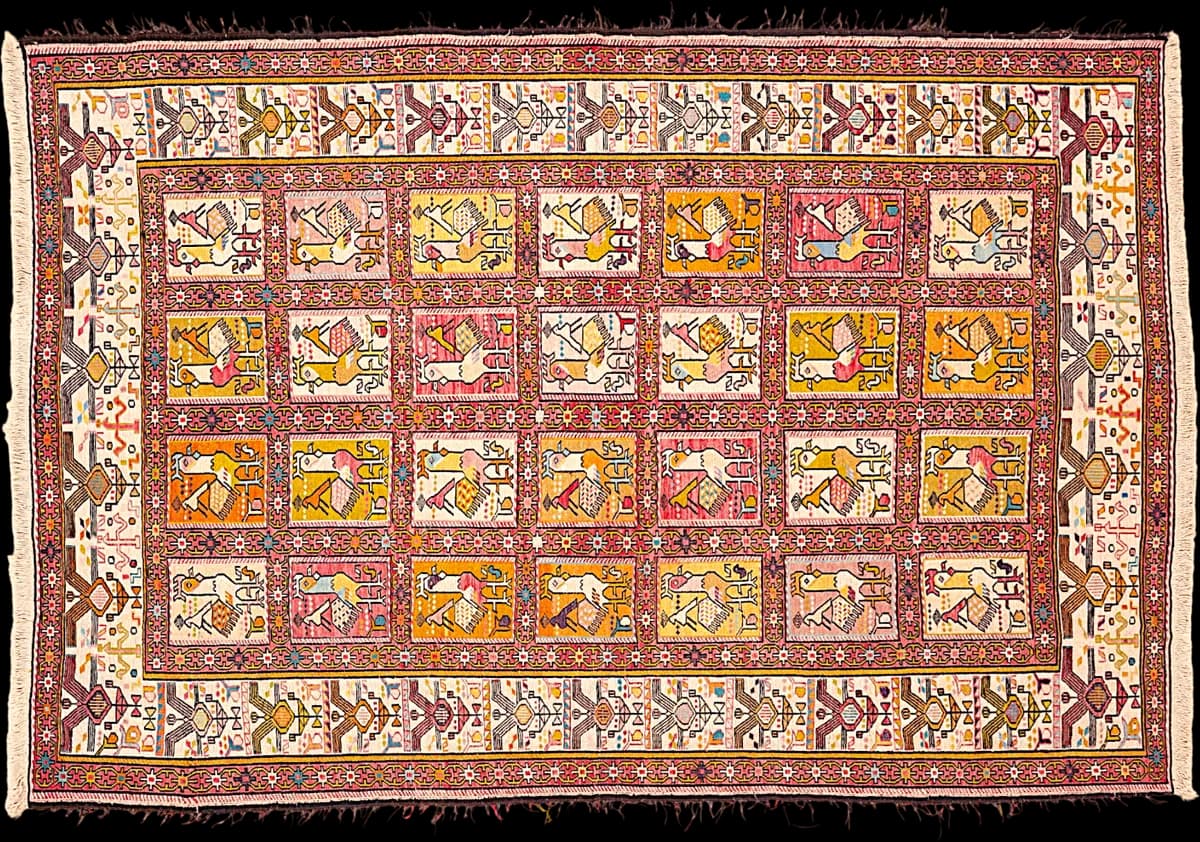
A Verni, also written Verneh, is the sumak-wrapped flatweave of the Caucasus and northwest Iran, made in Iran and measuring 199 x 120 cm (6'6" x 3'11"). Bolder than a flat kilim yet lighter than a knotted rug, the technique is known for clear, graphic pattern. Here it turns a garden grid into a sequence of individual small pictures rather than one repeated motif.
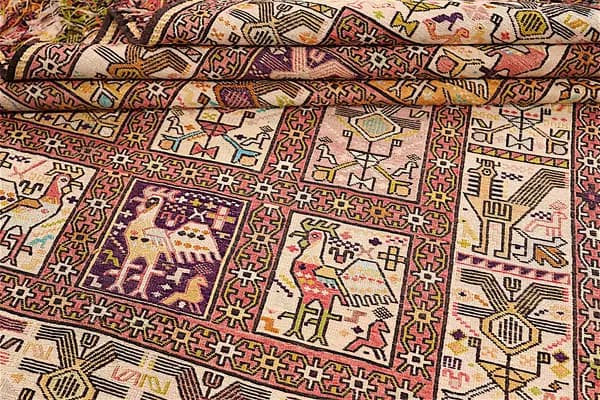
The ground is cream, divided into some two dozen compartments, each in its own colour: rust orange, aubergine, olive green, with turquoise and mustard scattered through. Each square holds its own drawing, a bird or an animal traced in a few confident lines, or a small floral diamond where the weaver chose a medallion instead. A wide dusty-pink border, patterned with cross and diamond shapes on cream, closes the field around it.
Verni is woven, not knotted: the weft is wrapped around paired warps in the sumak technique, building a surface with a slight, textured relief rather than a flat kilim's smoothness. That wrapping lets the weaver draw with real precision, and here the weft carries silk alongside wool, a finer fibre that holds a sharper line, which is how a bird's head or an animal's legs stay legible in a square only a few centimetres across. A cotton warp keeps the whole grid stable and square.
At under two metres, this suits a hallway, a landing, or a small reading corner, seen up close rather than crossed at a stride. The cream ground lifts a dim entrance, and the rust and aubergine panels hold their own against dark floorboards. Thin and firm underfoot, it takes daily use easily, the light picking out a different panel each time, so there is always another creature to notice.
More on Vernis: origin, making and how to recognise a genuine piece
At 199 × 120 cm (2.39 m²) this is a small rug. It works beside a bed, in a reading corner, in front of a fireplace or as a mat by a door. It does not furnish a room; it makes a point in one.
No — this piece is hand-woven, not knotted. A flatweave has no pile: the pattern comes from warp and weft alone. That makes it thin, light and usable on both sides, and it is a technique in its own right rather than a simpler version of a knotted rug.
Vacuum regularly, ideally along the weave and without a rotating brush. A flatweave can be turned over, which spreads the wear — flip it once or twice a year. Blot spills at once with clear water and a light cloth, working inwards, and never rub.
We are in the Hamburg Speicherstadt. Come and see this rug in daylight, or write to us — a person answers.
Certificate included verifying origin, materials, and craftsmanship.
Ref: 189496