Belutsch
205 × 104 cm
479 €






418 €
Incl. VAT
In Stock · Ready to Ship
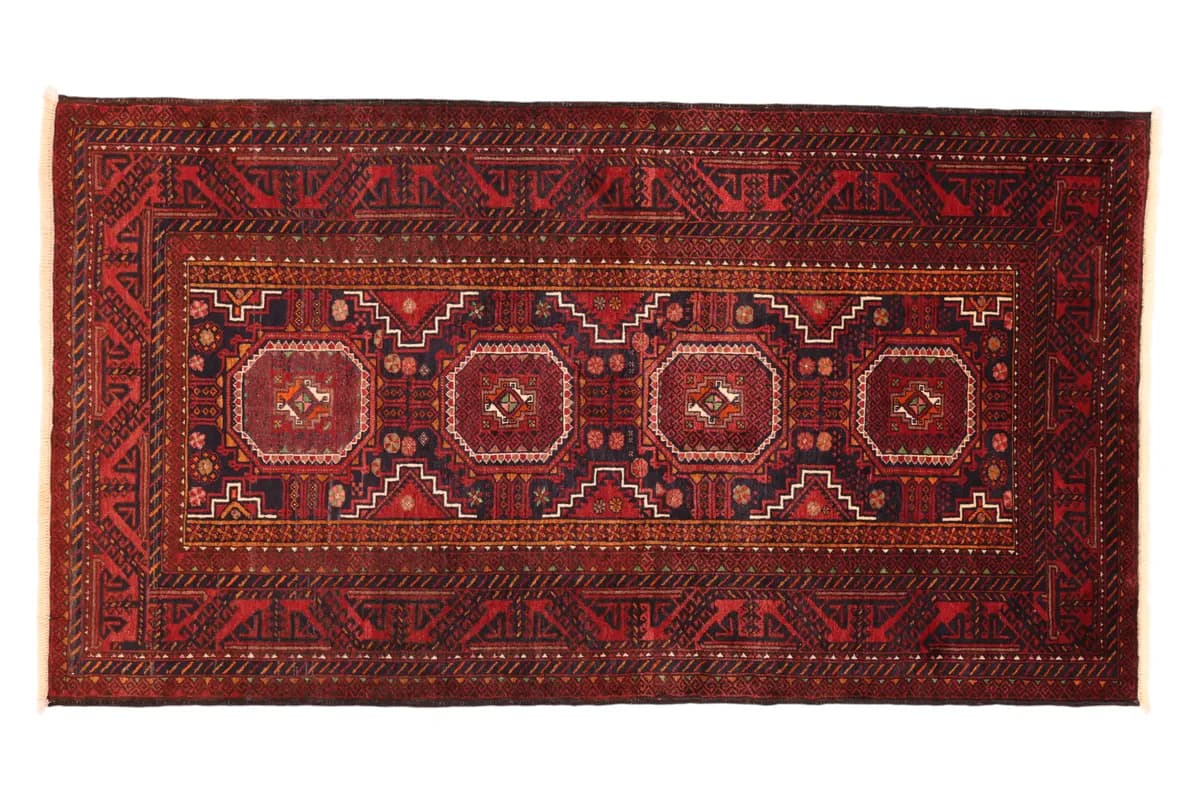
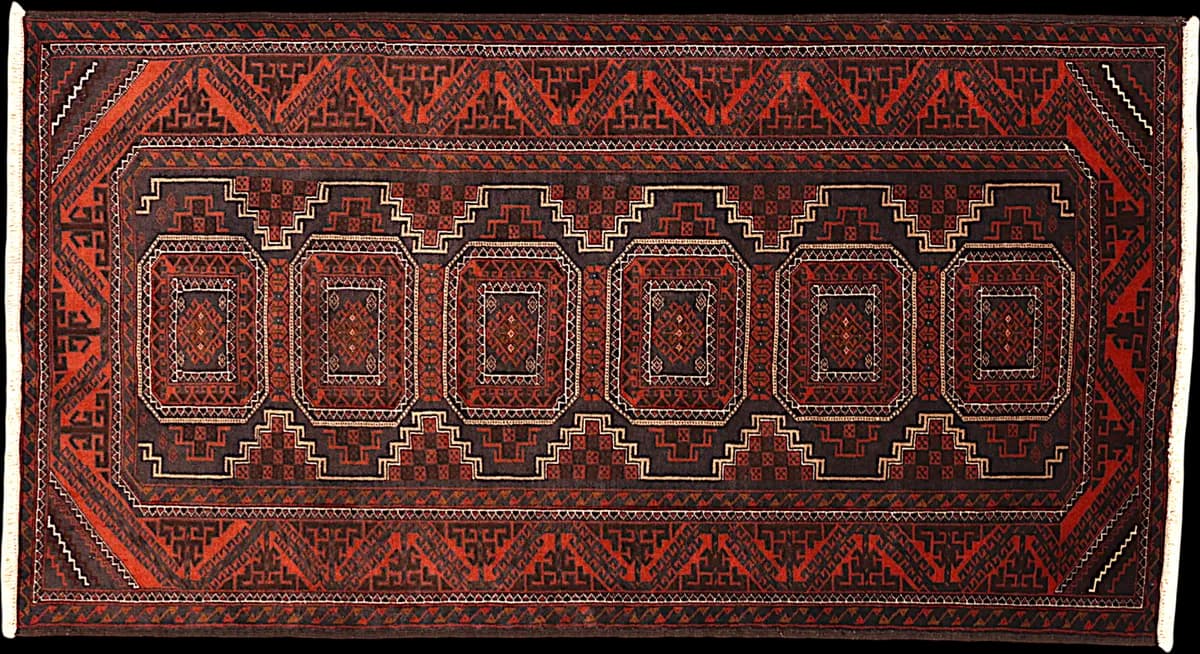
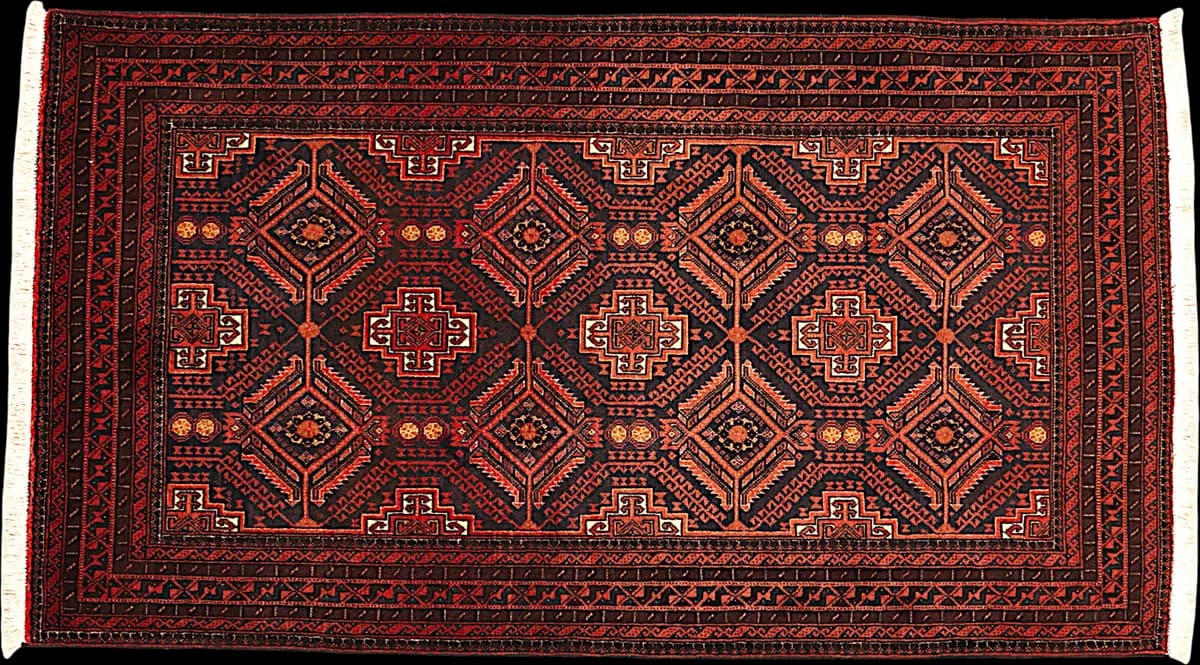
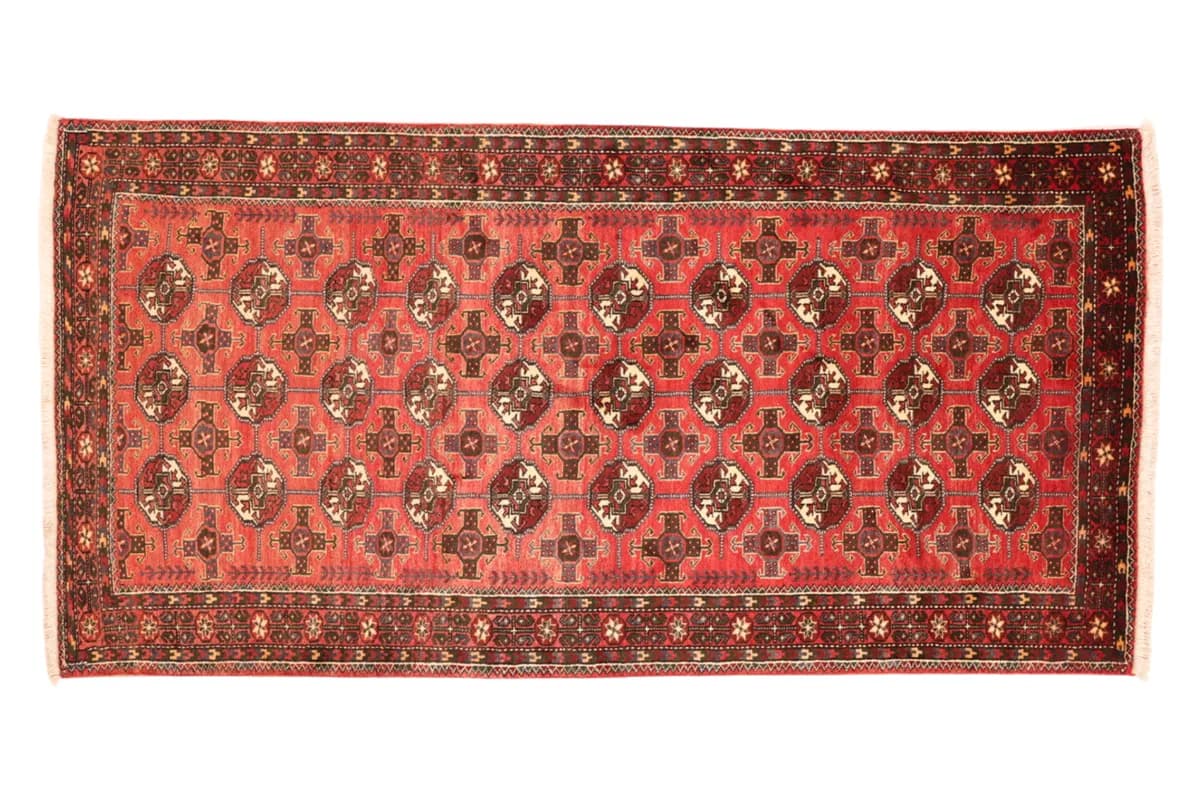
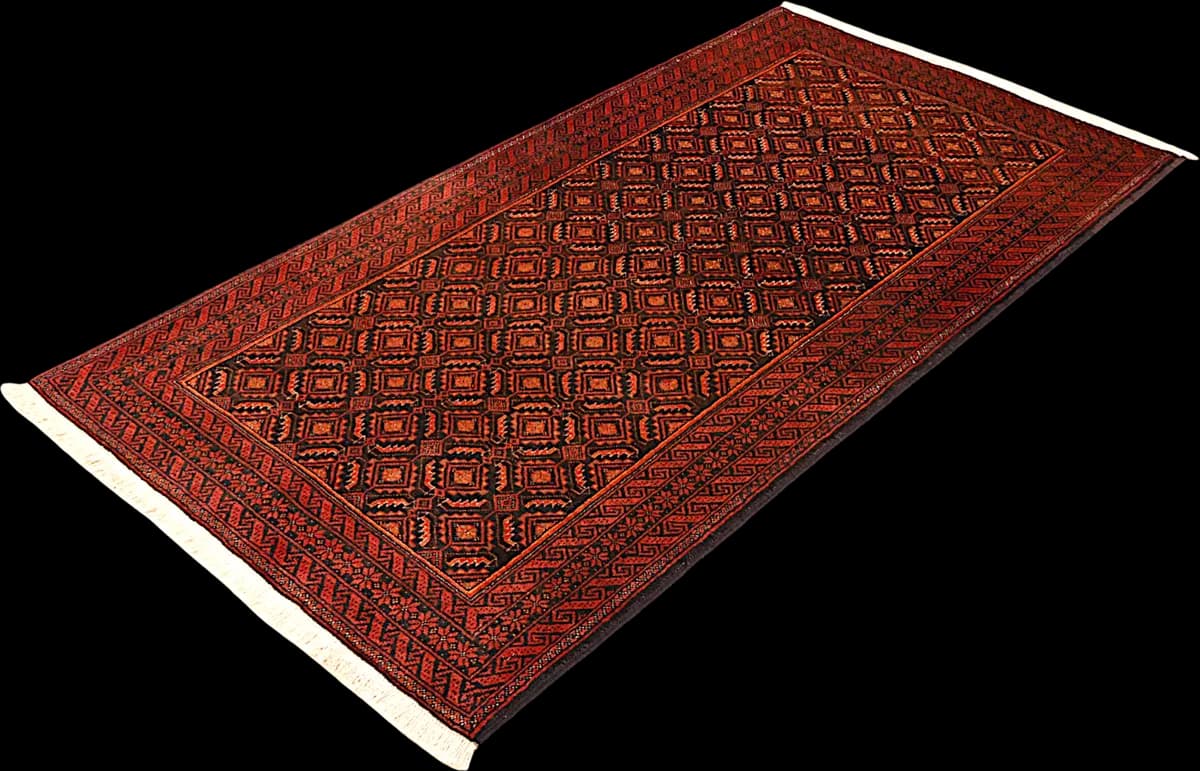
This is a Baluch rug, also written Belouch, a tribal weaving from the borderlands of southeastern Iran, measuring 179 x 94 cm (5'11" x 3'1"). Baluch weavers are known for bold, angular geometry and a deep, earthy palette built on rust reds and indigo, often arranged around a prayer-niche form. This piece carries none of that central focus at all — instead, an unbroken lattice runs from edge to edge.
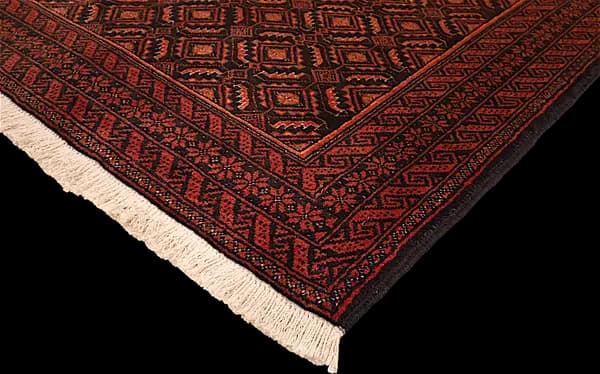
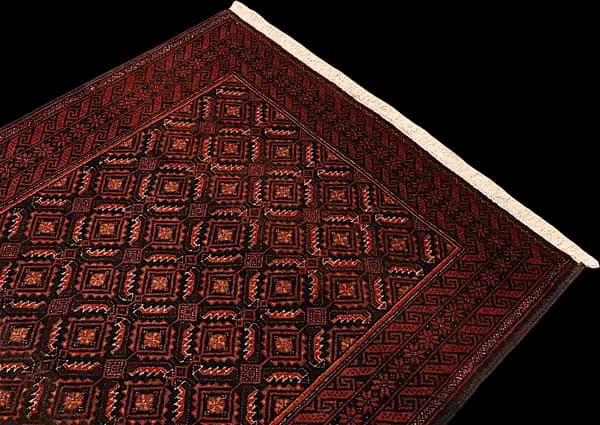
The field reads first as a dark, almost blackish brown, crossed everywhere by a tight rust-red diamond trellis. There is no medallion to catch the eye, so the pattern behaves as one continuous rhythm rather than a design with a middle and a frame. Looking closer, the trellis breaks into small hooked and serrated cells, picked out with cream outlines and flecks of dark orange, each one a variation on the last. Around this, a wide rust-red border is built up from several narrower bands — a cream zigzag, a key-fret, a floret stripe — stacked against black grounds, giving the frame more internal structure than the field it surrounds.
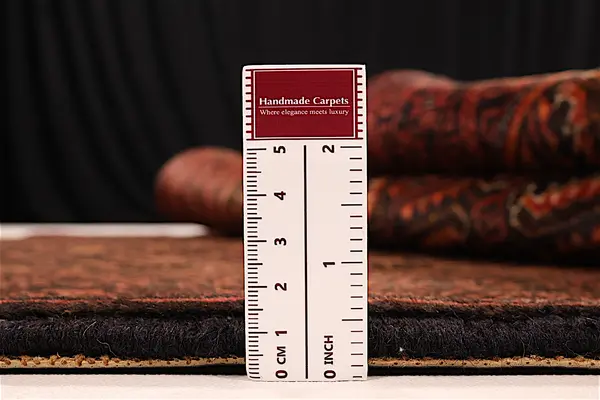
Handspun wool, knotted by hand onto a cotton warp, is what gives that lattice its life: the yarn varies slightly in thickness from one pass to the next, so no two diamonds sit quite true, and the pattern gains a hand-made irregularity rather than a printed evenness. At a density of 128,000 to 160,000 knots per square metre, the weaver could still hold the fine hooks and outlines clearly, which is why the design resolves into detail rather than blur even at this small scale. Twenty to forty years of use have kept the flat, six-millimetre pile tight, with no slack in the weave anywhere across the surface.
At this size the rug suits a hallway, a landing, or a spot beside a bed rather than a large open floor, and its dark ground is well suited to a passage with little daylight, where the rust and cream will catch the eye without needing sun to do it. Underfoot it is firm and dense, built for a well-used stretch of floor rather than a room kept for best. Morning or lamp light will bring the terracotta and orange up out of that near-black field, so the piece keeps changing character through the day without ever losing the quiet order of its pattern.
More on Baluch rugs: origin, making and how to recognise a genuine piece
Traditional weave
At 179 × 94 cm (1.68 m²) this is a small rug. It works beside a bed, in a reading corner, in front of a fireplace or as a mat by a door. It does not furnish a room; it makes a point in one.
Yes, knotted by hand — knot by knot on a loom, not machine-made. The density is 128,000 to 160,000 knots per square metre; across 1.68 m² that is roughly 220,000 to 270,000 individual knots, every one of them tied by hand.
Hand-spun wool still carries its own lanolin, which keeps liquid sitting on the surface for a moment: blot quickly, with clear water and a light cloth, working inwards and without rubbing. Otherwise regular vacuuming along the pile is enough. Turn the rug once or twice a year so light and footfall reach it evenly.
We are in the Hamburg Speicherstadt. Come and see this rug in daylight, or write to us — a person answers.
Certificate included verifying origin, materials, and craftsmanship.
Ref: 132633