Belutsch
184 × 100 cm
458 €





342 €
Incl. VAT
In Stock · Ready to Ship
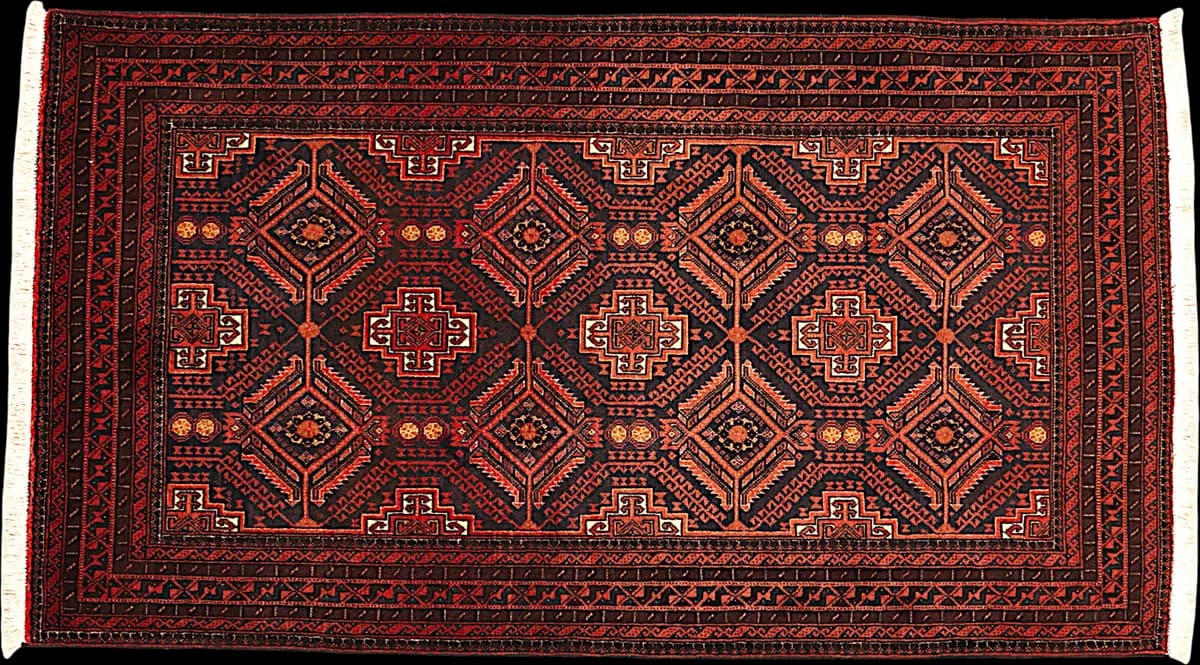
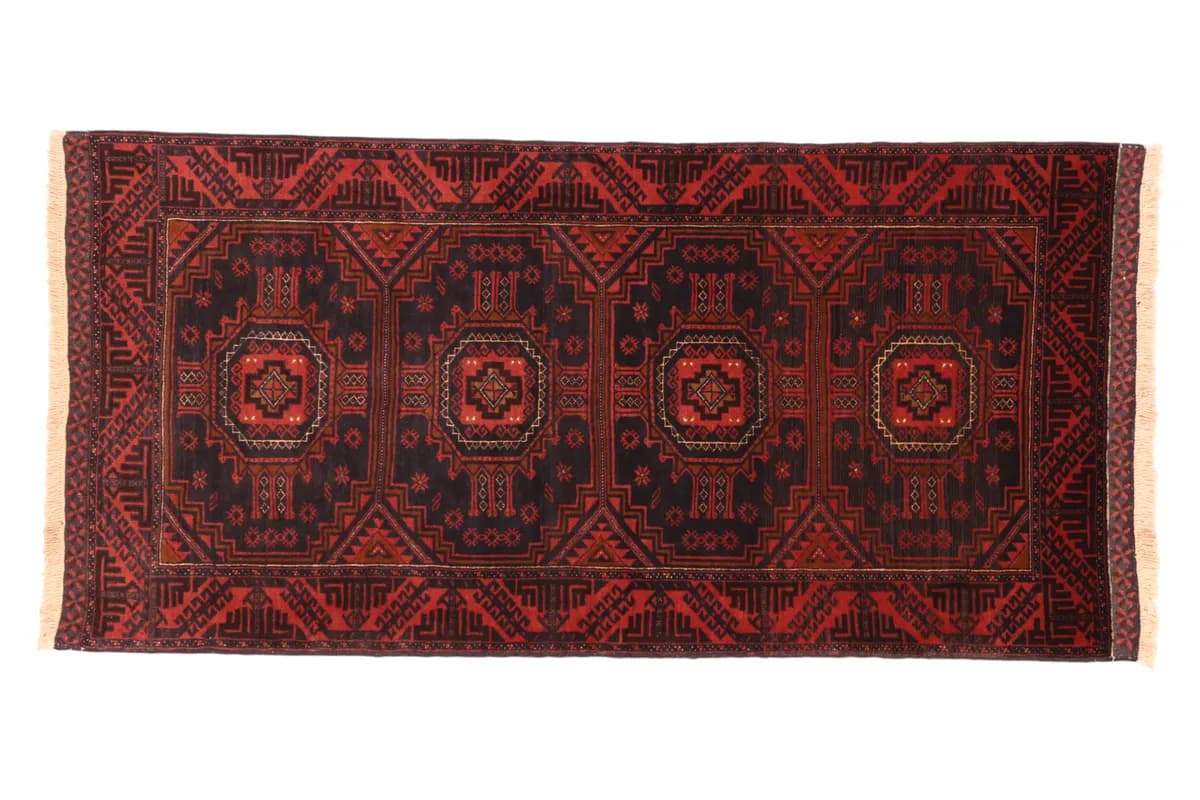
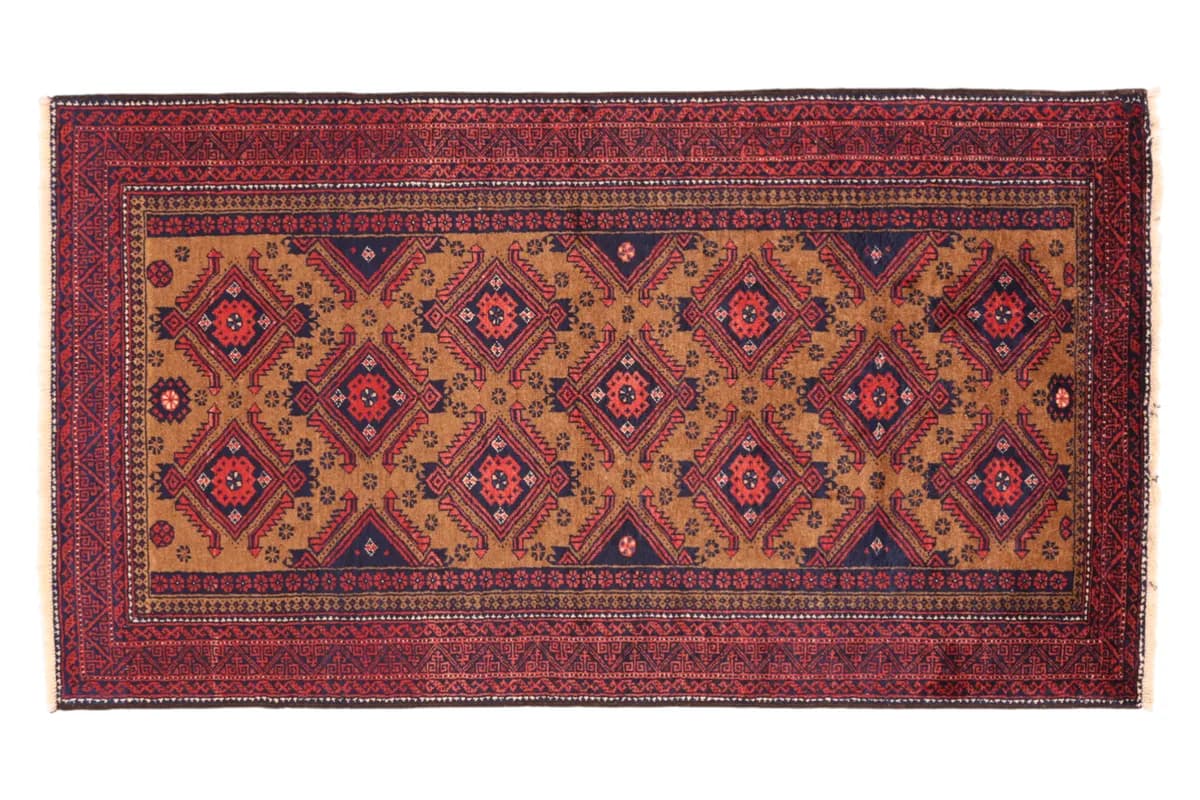
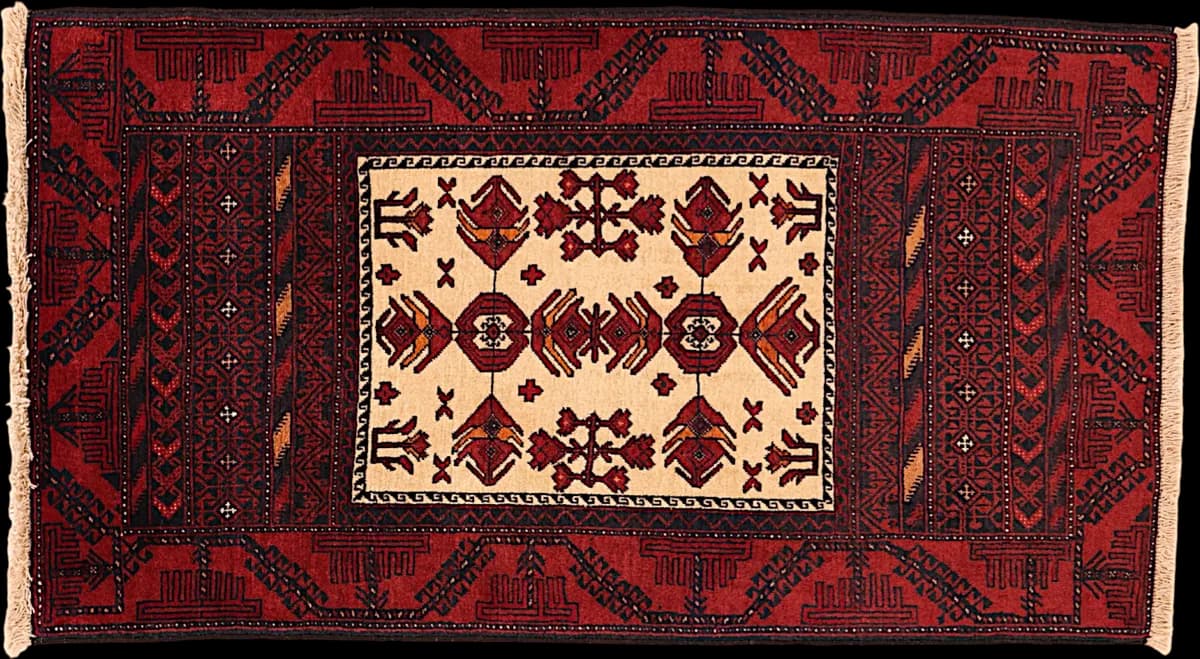
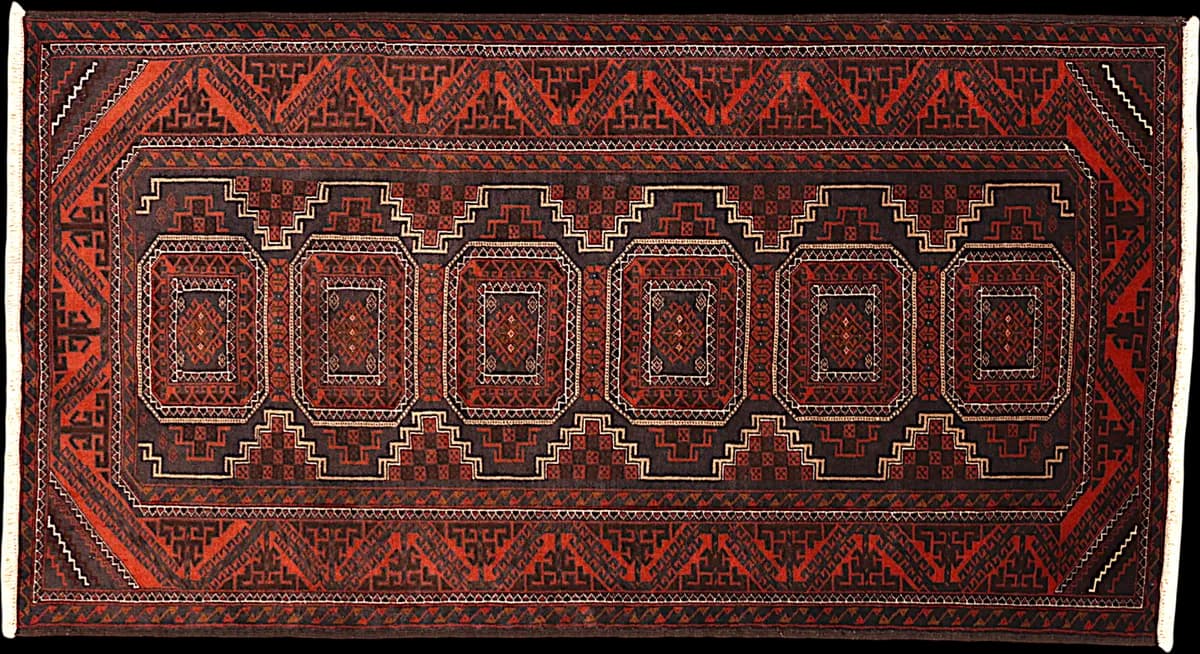
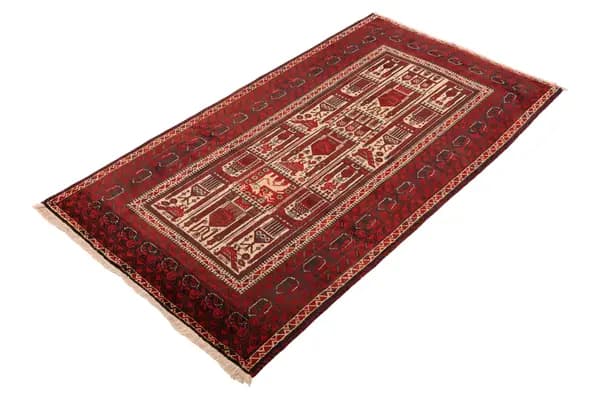
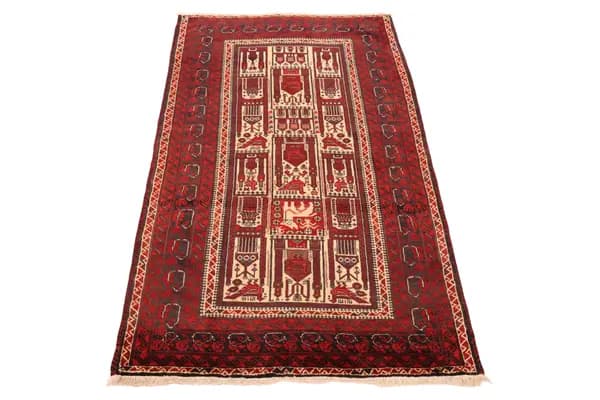
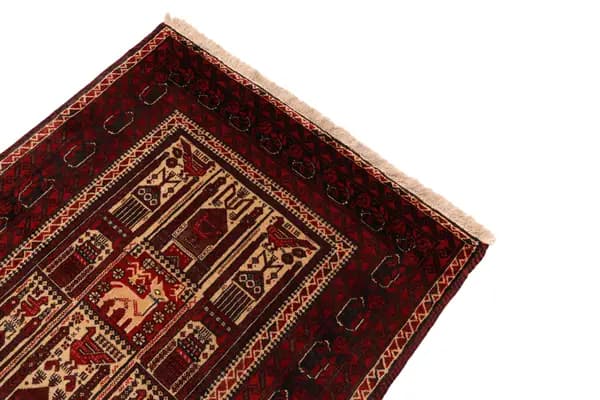
A Baluch rug — also written Belouch — a tribal weaving from the borderlands of southeastern Iran, 150 x 80 cm (4'11" x 2'8"). The type is known for deep, earthy colour and bold angular geometry, carried from memory rather than a drawn plan. This piece takes an unusual turn: instead of one running pattern, the field is broken into a dozen separate compartments.
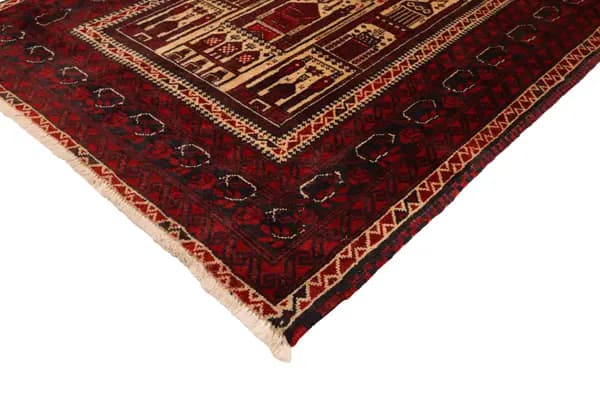
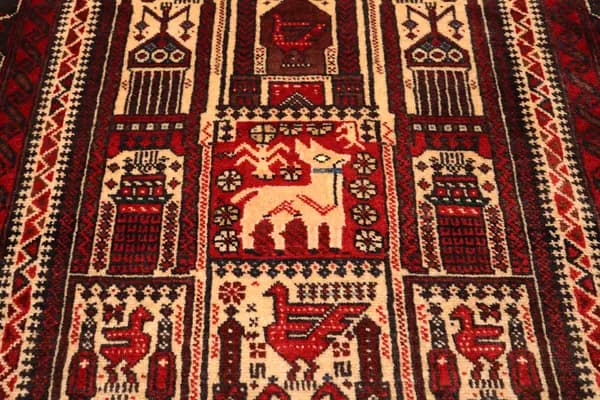
The field reads first as a rhythm of deep brick red and cream, alternating along the rug's length in upright panels. Within each cream panel stands a stylised tree, candelabra-like in shape, and among the branches sit small figures that could be four-legged animals, though the tribal drawing leaves them just short of literal. There is no medallion to gather the eye toward a centre; each panel holds its own small scene instead. Around it all runs a border almost black, carrying a chain of hooked rosettes in red and cream, which holds the paler field firmly inside a dark frame.
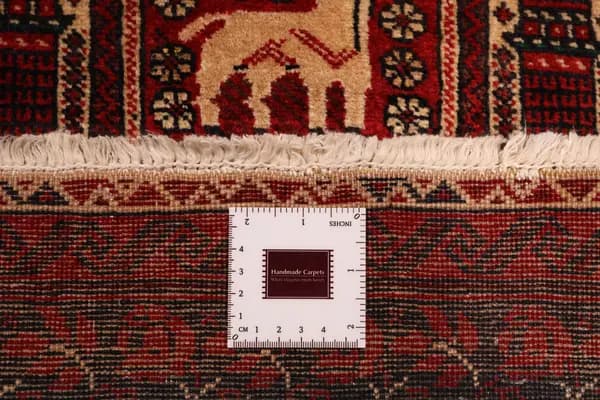
The wool was spun by hand and knotted onto a cotton warp at roughly 128,000 to 160,000 knots per square metre — modest beside the finest city workshops, but right for this kind of drawing. Hand-spun yarn does not allow fine shading, so the weaver worked in bold blocks of colour rather than gradation, which is exactly why each compartment reads as a distinct scene instead of blurring into the next. The pile sits at 6mm, tight and flat, with a matte surface and no workshop sheen, the mark of a rug built for the floor rather than for looking at.
At this size the rug belongs in a hallway, on a landing, or beside a bed — somewhere it will be seen close and often, rather than across a room. Its brick red and cream hold their own against a dark floor and warm a pale one, while the near-black border keeps it grounded in a space with little daylight. Underfoot it is dense and flat, wool worked hard rather than kept precious, so it takes the traffic of a passage without complaint. What stays interesting is the sequence of panels: walk past it often enough and you start to notice which tree, which figure, sits in which compartment, so the rug keeps a small private set of scenes rather than showing everything at once.
More on Baluch rugs: origin, making and how to recognise a genuine piece
Traditional weave
At 150 × 80 cm (1.20 m²) this is a small rug. It works beside a bed, in a reading corner, in front of a fireplace or as a mat by a door. It does not furnish a room; it makes a point in one.
Yes, knotted by hand — knot by knot on a loom, not machine-made. The density is 128,000 to 160,000 knots per square metre; across 1.20 m² that is roughly 150,000 to 190,000 individual knots, every one of them tied by hand.
Hand-spun wool still carries its own lanolin, which keeps liquid sitting on the surface for a moment: blot quickly, with clear water and a light cloth, working inwards and without rubbing. Otherwise regular vacuuming along the pile is enough. Turn the rug once or twice a year so light and footfall reach it evenly.
We are in the Hamburg Speicherstadt. Come and see this rug in daylight, or write to us — a person answers.
Certificate included verifying origin, materials, and craftsmanship.
Ref: 176699