Kerman
156 × 87 cm
408 €
240 €
Incl. VAT
In Stock · Ready to Ship
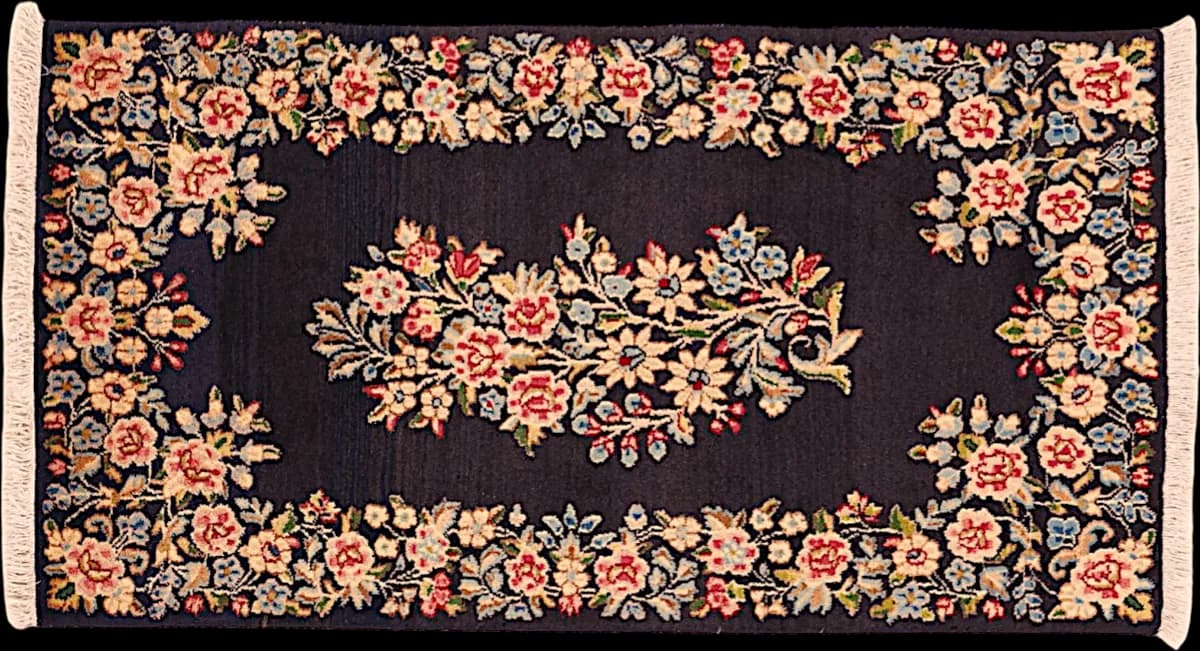
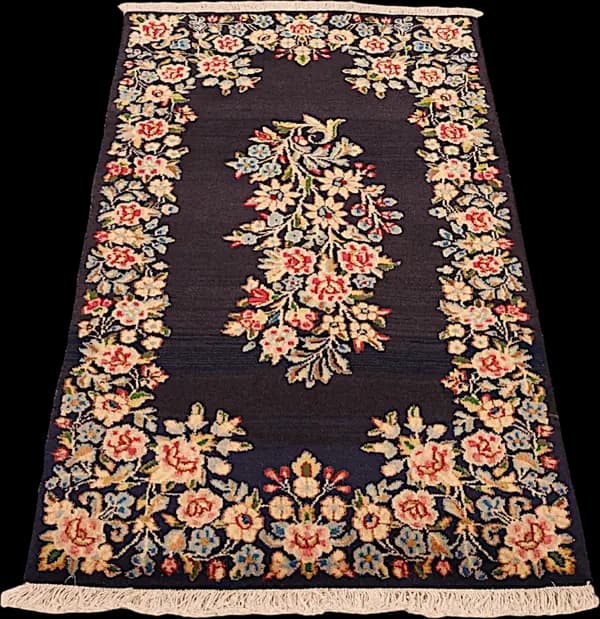
Kerman is one of the great weaving cities of Iran, an oasis workshop in the south-east whose looms trace back to the royal ateliers of the Safavid court. Its rugs are known above all for dense, curling floral fields that fill every centimetre of ground. This one measures 123 x 65 cm (4'0" x 2'2"), and rather than following that crowded convention, it takes the opposite path.
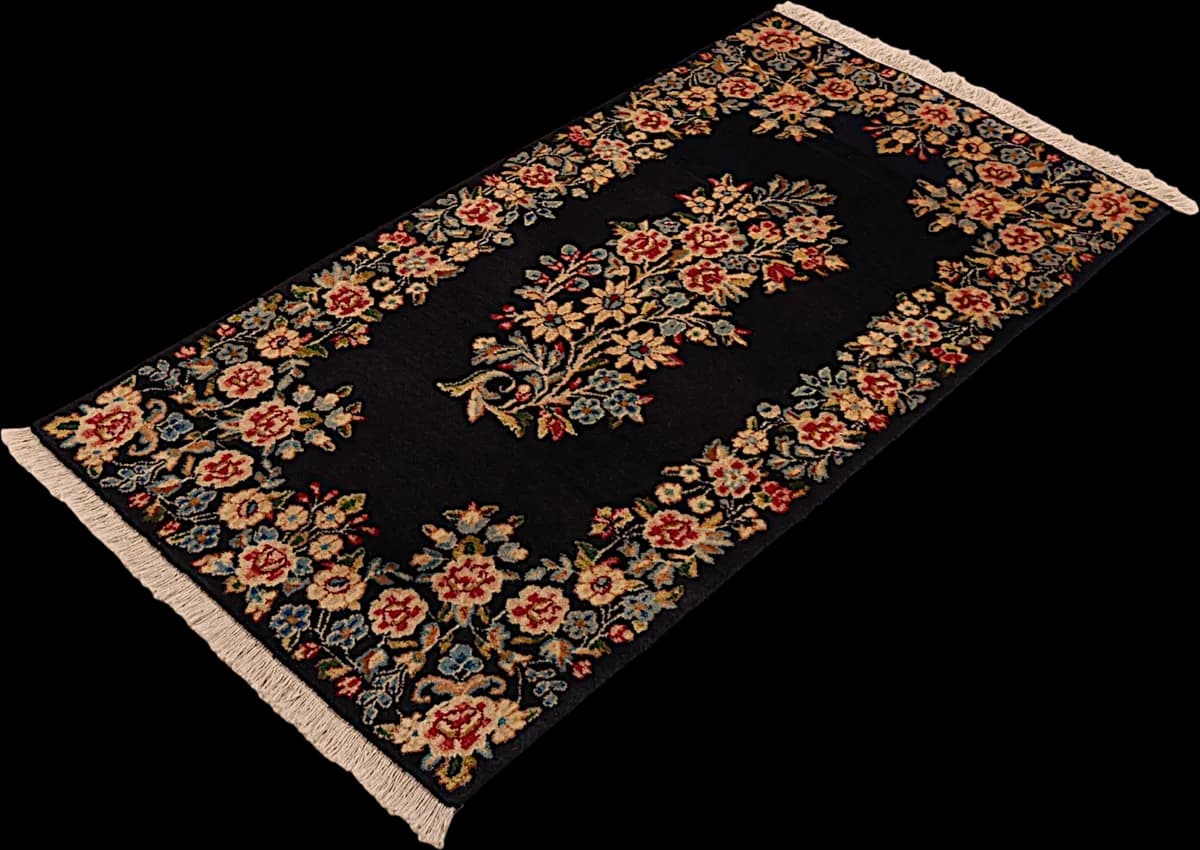
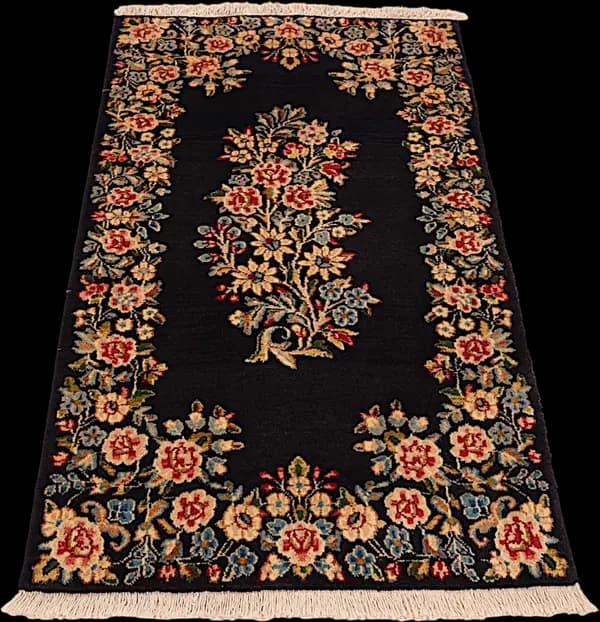
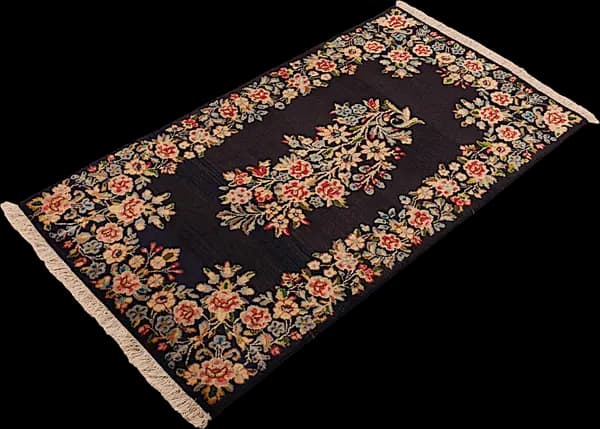
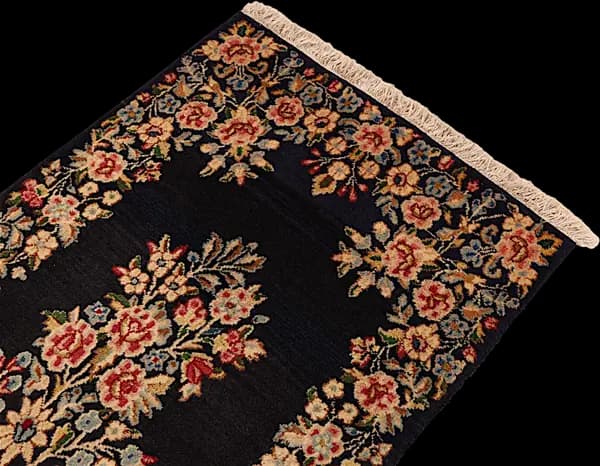
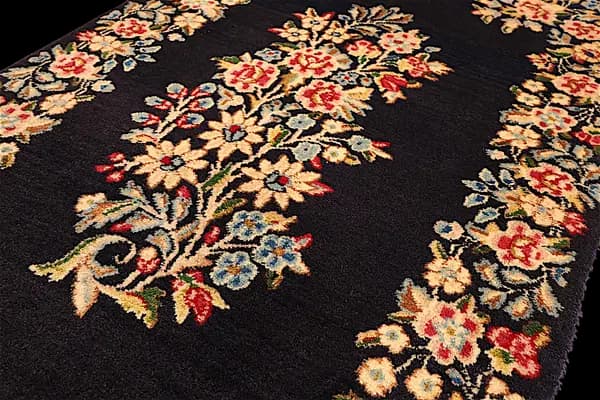
The field is a deep, near-black navy, and against it a single floral bouquet stands alone, cream and rose pink, dusty blue, touches of mustard gold, green and red caught in the petals. There is no medallion, no repeat pattern pressing in from the edges — just that one spray of flowers held on open dark ground. The border does the work of framing it: a wide band of floral garland in the same palette, running to roughly a fifth of the rug's width, with a small bouquet gathered into each corner that echoes the centre almost exactly. The effect is quietly mirrored, a composition built to balance rather than to fill.
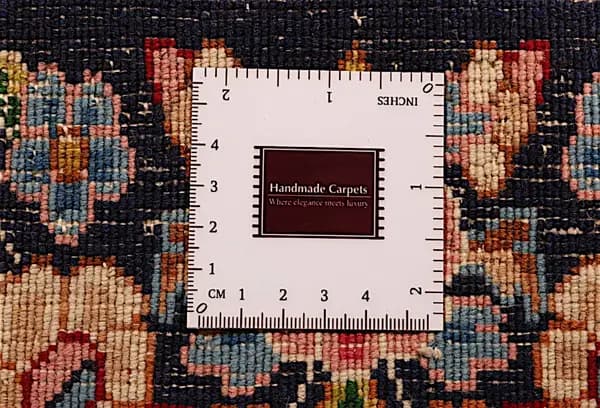
That restraint is the product of a fine, disciplined hand. The pile is hand-spun wool, knotted onto a cotton warp with the asymmetrical Persian knot, at a density of 128,000 to 160,000 knots per square metre — enough to keep every petal edge sharp rather than blurred, which matters more here than in a busy field, since there is so little else on the rug to look at. The pile itself is kept low, around 12 mm, and sheared to a smooth, faintly lustrous surface, so the wool catches a light sheen rather than a deep shadow.
A rug this size finds its place in a hallway, by a bedside, or under a chair in a study rather than anchoring a large room, and that is exactly where this one earns its keep. The near-black field sits comfortably against dark floorboards or furniture without disappearing into them, and against a pale floor it reads as a deliberate note of depth rather than a heavy block. Underfoot it is dense, firm and smooth, suited to a spot that sees people pass rather than settle, and it wears without complaint. Where the light falls across it at an angle, the sheen lifts the bouquet gently off the dark ground, and that single spray of flowers is what the eye returns to, every time.
More on Kerman rugs: origin, making and how to recognise a genuine piece
Traditional weave
At 123 × 65 cm (0.80 m²) this is a small rug. It works beside a bed, in a reading corner, in front of a fireplace or as a mat by a door. It does not furnish a room; it makes a point in one.
Yes, knotted by hand — knot by knot on a loom, not machine-made. The density is 128,000 to 160,000 knots per square metre; across 0.80 m² that is roughly 100,000 to 130,000 individual knots, every one of them tied by hand.
Hand-spun wool still carries its own lanolin, which keeps liquid sitting on the surface for a moment: blot quickly, with clear water and a light cloth, working inwards and without rubbing. Otherwise regular vacuuming along the pile is enough. Turn the rug once or twice a year so light and footfall reach it evenly.
We are in the Hamburg Speicherstadt. Come and see this rug in daylight, or write to us — a person answers.
Certificate included verifying origin, materials, and craftsmanship.
Ref: 169709