A desert city with a court history
Kerman sits in an oasis in south-eastern Iran, far from the north-western centres. Despite that — or because of it — the city is among the oldest and most respected weaving addresses in the country. Its workshops were already producing for the Safavid court in the fifteenth century.
From that period come the vase carpets, a group of pieces with a distinctive construction: vessels from which flowering vines rise through several superimposed lattices. They are among the best known products of Persian weaving and now hang in museums.
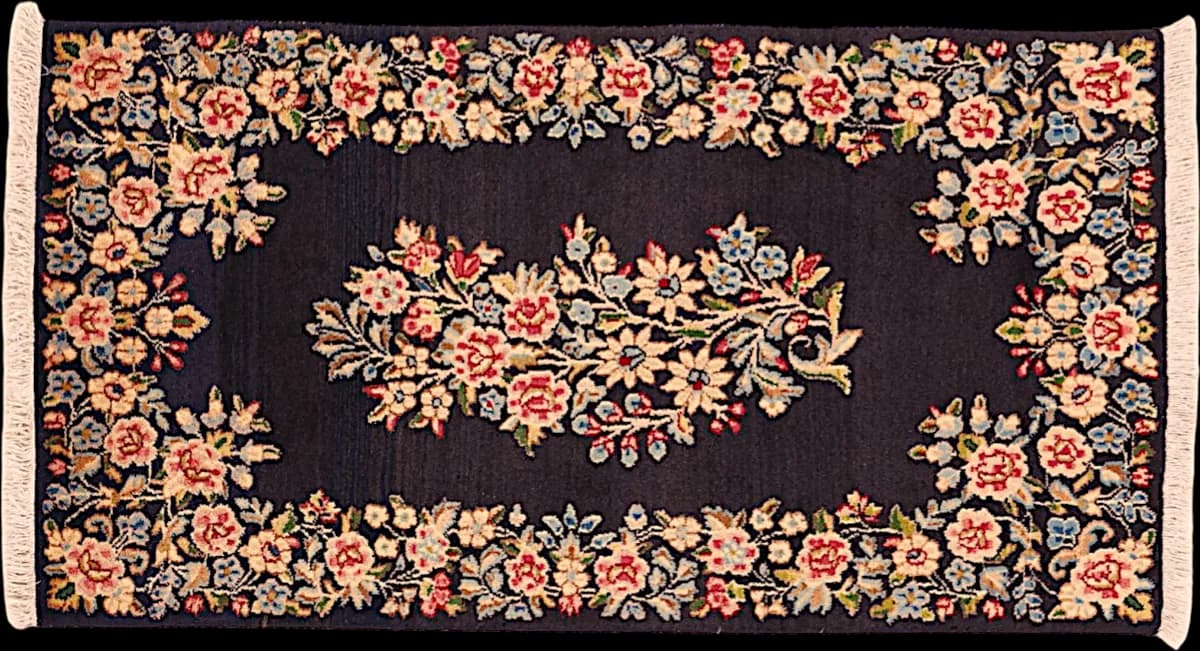
For a buyer today what remains of that is above all the handwriting. Kerman draws floral and curved, never geometric, and works with light grounds where other centres go deep. That makes the city an exception in the Persian canon.
The light palette
Tabriz, Kashan, Bidjar — most of the great names work with deep madder red and indigo. Kerman goes the other way: ivory, old rose, a soft blue, and greens rarely seen in the Persian tradition.
This is not a modern adaptation but the historical hand of the city. It has a practical advantage: a light rug swallows less light and makes a room read as larger, where a dark one draws it in.
The price is sensitivity. On a light ground a mark has nothing to hide behind. In a formal sitting room that is rarely a problem; in a hallway in daily use it is.
- Light grounds — ivory, old rose, soft blue.
- Consistently curving floral drawing with no geometric edges.
- Cotton warp with light, smooth fringes.
- Around 190,000 knots at about 12 mm of pile.
- Ravar and Rafsanjan name places in the same province.
Which room a Kerman suits
The floral, formal character suits rooms with a certain order — a seating group, a dining table, framed pictures. In a deliberately raw interior it reads as foreign.
The light ground opens a room. In a north-facing space or beside dark furniture that is a difference you feel.
Because many pieces carry a medallion, the middle wants to stay visible. A sofa covering half the rug takes from a medallion composition exactly what defines it.
Care
Vacuum along the pile, without a rotating brush.
Blot spills at once with clear water and a light cloth, working from the outside in. On a light ground speed matters more than on a dark rug.
Turn it once or twice a year. Light rugs show one-sided fading more clearly than dark ones.
Kerman or Ravar?
Both belong to the Kerman weaving landscape and share its floral hand. Ravar is the fine line of the same province.
| Criterion | Kerman | Ravar |
|---|---|---|
| Designation | city and province | a place within the province |
| Knot density | around 190,000 / m² | typically 321,000–380,000 / m² |
| Field | filled, floral | often open around the medallion |
| Palette | light: ivory, old rose | light, restrained |
| Recognition | one of the great names | the fine line for those who know |
Common questions
What is a vase carpet?
A group of Safavid carpets from Kerman in which flowering vines rise from vessels through several superimposed lattices across the field. They date from the sixteenth century onward and count among the high points of Persian weaving. Museum pieces, not trade goods.
Why are Kerman rugs so much lighter than other Persians?
It is the historical hand of the city. Where Tabriz and Kashan work with deep madder and indigo, Kerman uses ivory, old rose and soft blue. For light rooms that is an advantage; on a light ground, though, every mark shows.
How does it differ from Ravar and Rafsanjan?
All three belong to the Kerman weaving landscape. Kerman is city and province at once and the best-known name; Ravar is historically the fine line with an open field; Rafsanjan also lies in the province and knots considerably more densely.
Is a Kerman suitable for heavily used rooms?
Less so. The light ground shows traffic marks and spills earlier than a dark rug. In a formal sitting or dining room it is right; in a hallway in daily use, less so.
How do I recognise the Kerman drawing?
By the curve. Kerman works consistently curved and floral: flowing vines, palmettes, soft transitions. Where edges are stepped and medallions angular, you are looking at village or tribal work, not the Kerman tradition.