Exclusive
Bidjar | Exclusivewith silk
327 × 219 cm
16.500 €








1.024 €
Incl. VAT
In Stock · Ready to Ship
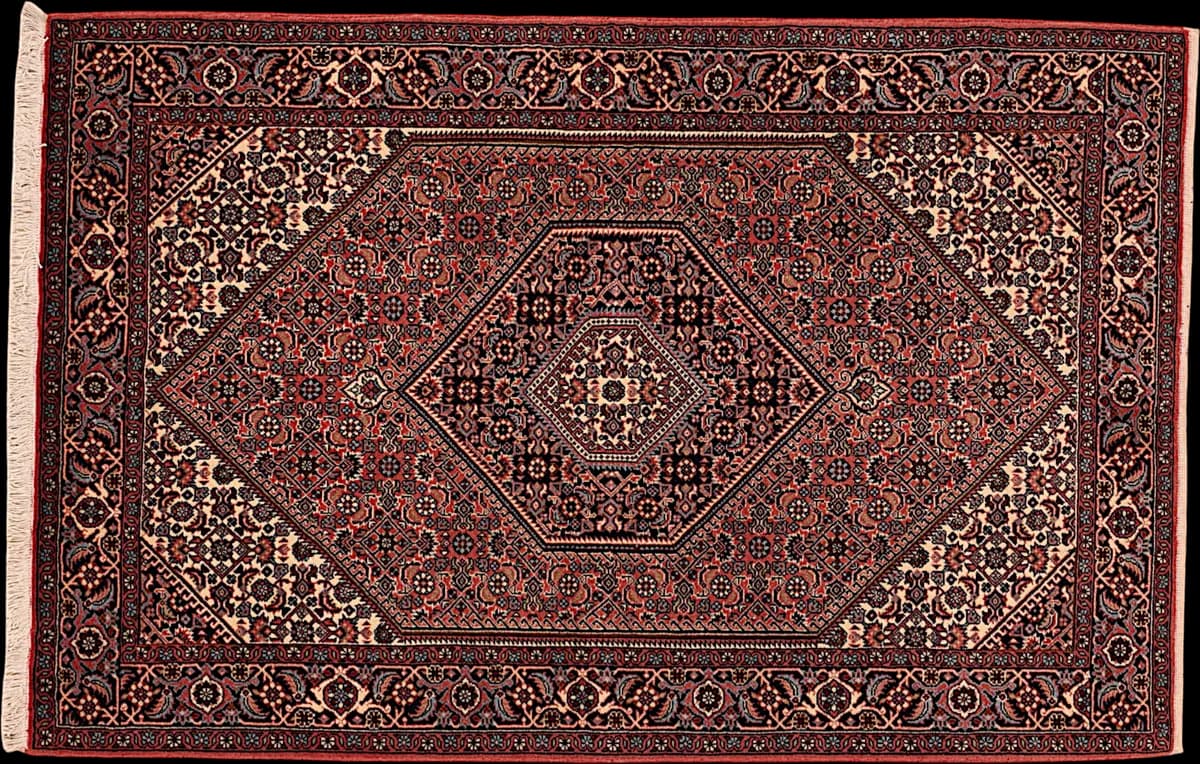
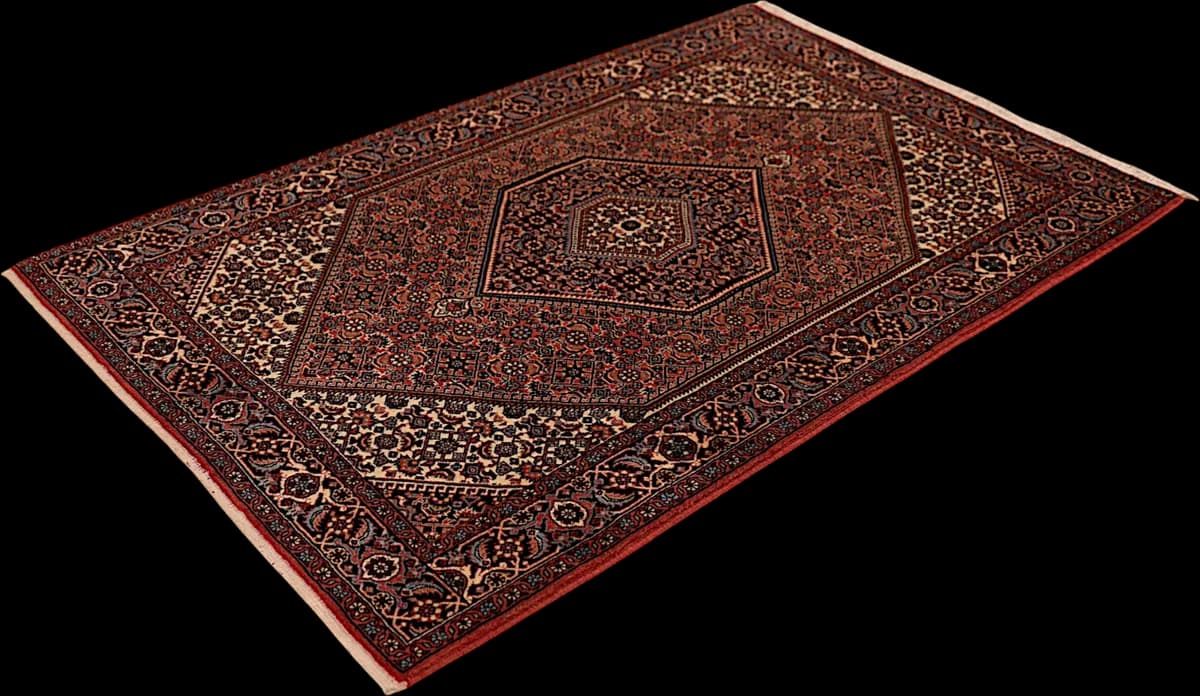
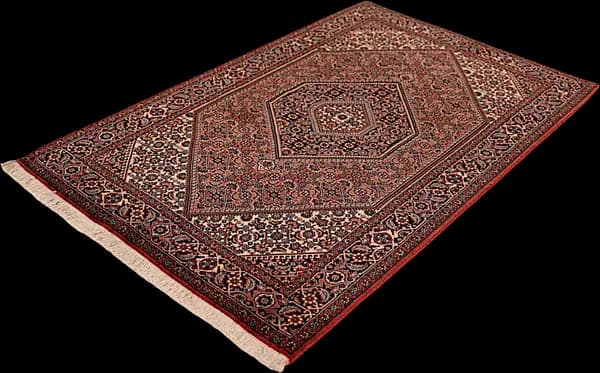
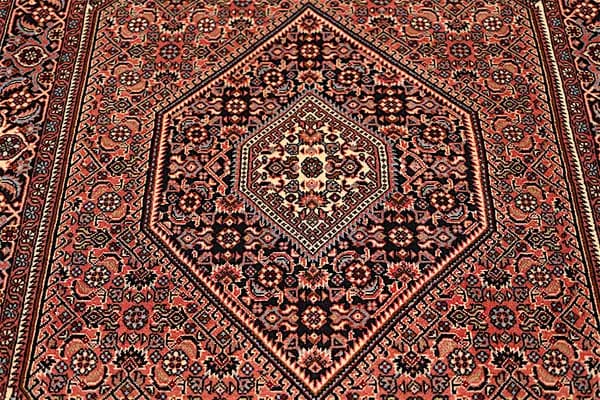
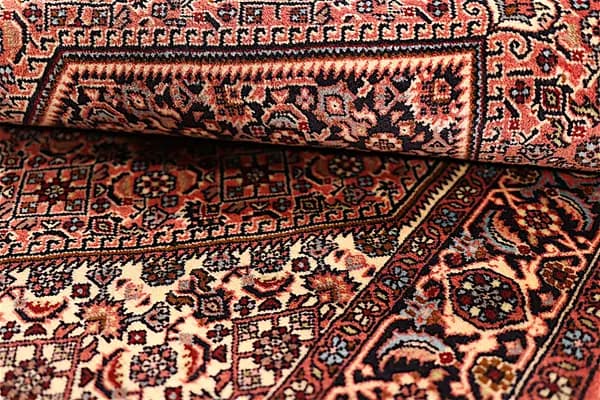
A Bidjar, hand-knotted in the Kurdish regions of western Iran, 173 x 113 cm (5'8" x 3'8"). The type is known across the Persian tradition as the iron rug, for a weave pressed so tight it can be rolled but never folded. What that density gives this particular piece is precision: a stepped hexagonal medallion drawn with an edge closer to architecture than to embroidery.
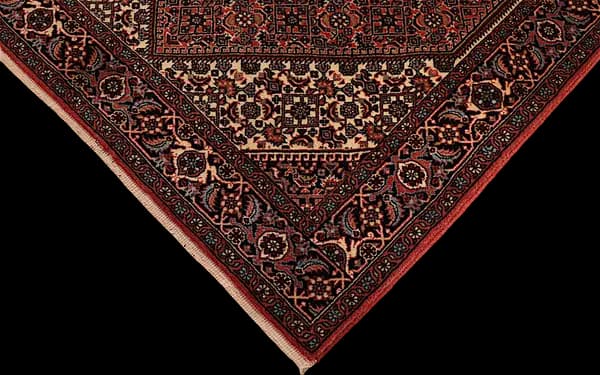
The field is a deep brick red, filled edge to edge with a fine Mahi lattice of fish and rosettes, so dense that the ground colour reads more as a texture than a flat wash. Out of that lattice rises the medallion, three hexagons nested one inside the other in alternating navy and cream, each step drawn square and clean rather than softened into a curve. Ivory pendant corners answer it at the four spandrels. Around the whole field runs a wide navy-black border of floral vine and rosette, held in by narrow guard stripes in red and cream, and against that dark border the red field asserts itself rather than fading.
That crispness in the medallion is a direct result of how tightly the rug is knotted. At 251,000 to 320,000 knots per square metre, this sits toward the densest end of an already dense tradition, and it is that density which lets a stepped line hold its corners instead of rounding off, knot by knot, into something blurred. The pile itself is handspun wool over a cotton warp, set at 15 millimetres and sheared flat and even, which gives the surface a faint ribbing and a light sheen rather than a soft, plush depth. The result is a rug that feels firm and substantial to the hand well before it is laid on a floor.
A rug this size suits a study or a quiet reading corner, set beneath a chair and a small table rather than a full seating group. The red holds its own against dark wood or leather and needs no help from daylight to read as warm. Underfoot it is dense and firm rather than soft, built for a chair pulled in and out rather than for bare comfort, and it takes that use without losing its edges. As the light in the room shifts through the day, it is the stepped medallion that keeps catching it, its corners staying sharp long after softer rugs would have let them go.
More on Bidjar rugs: origin, making and how to recognise a genuine piece
Fine quality weave
At 173 × 113 cm (1.95 m²) this is a small rug. It works beside a bed, in a reading corner, in front of a fireplace or as a mat by a door. It does not furnish a room; it makes a point in one.
Yes, knotted by hand — knot by knot on a loom, not machine-made. The density is 251,000 to 320,000 knots per square metre; across 1.95 m² that is roughly 490,000 to 630,000 individual knots, every one of them tied by hand.
Hand-spun wool still carries its own lanolin, which keeps liquid sitting on the surface for a moment: blot quickly, with clear water and a light cloth, working inwards and without rubbing. Otherwise regular vacuuming along the pile is enough. Turn the rug once or twice a year so light and footfall reach it evenly.
We are in the Hamburg Speicherstadt. Come and see this rug in daylight, or write to us — a person answers.
Certificate included verifying origin, materials, and craftsmanship.
Ref: 245352