Exclusive
Bidjar | Exclusivewith silk
229 × 172 cm
6.300 €







16.500 €
Incl. VAT
In Stock · Ready to Ship
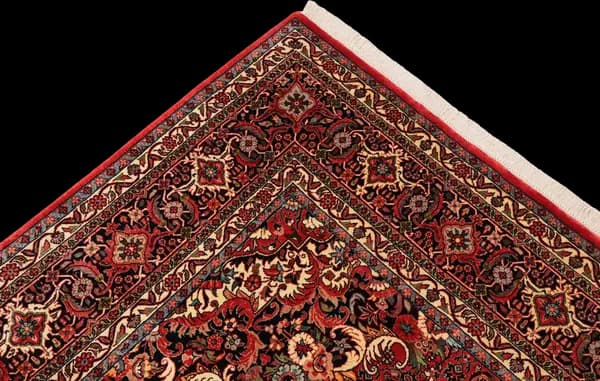
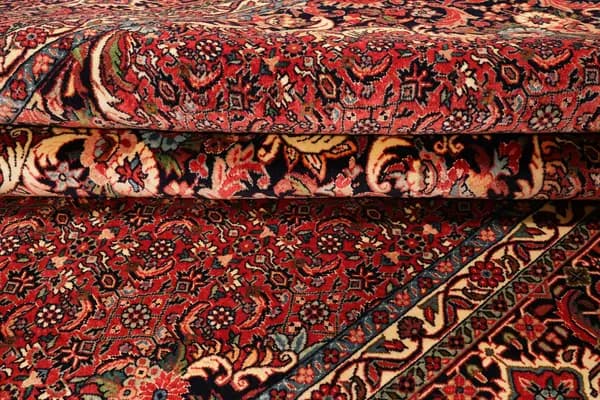
This is a Bidjar, also written Bijar, from the Kurdish region of western Iran, sized 327 x 219 cm (10'9" x 7'2"). It belongs to what the trade calls the iron rugs of Persia, named for a density of knotting no other Persian weaving matches and a structure too compact to fold, only to roll.
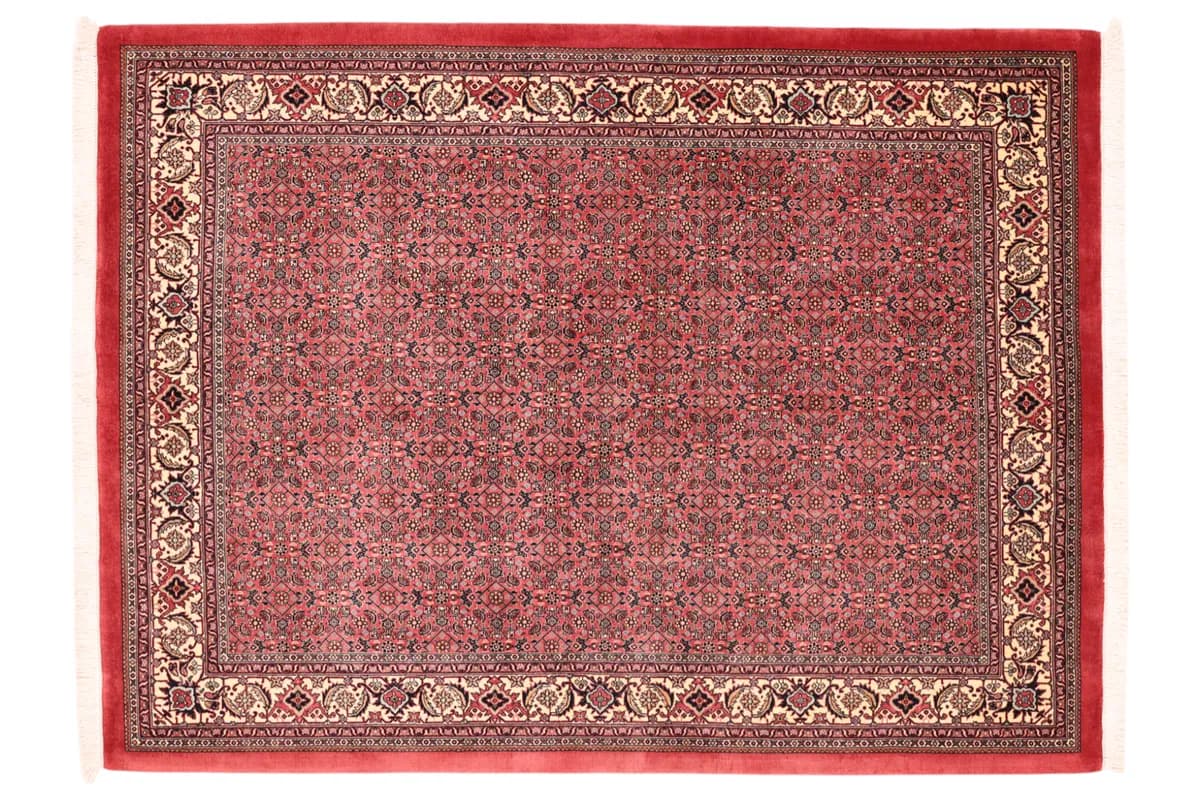
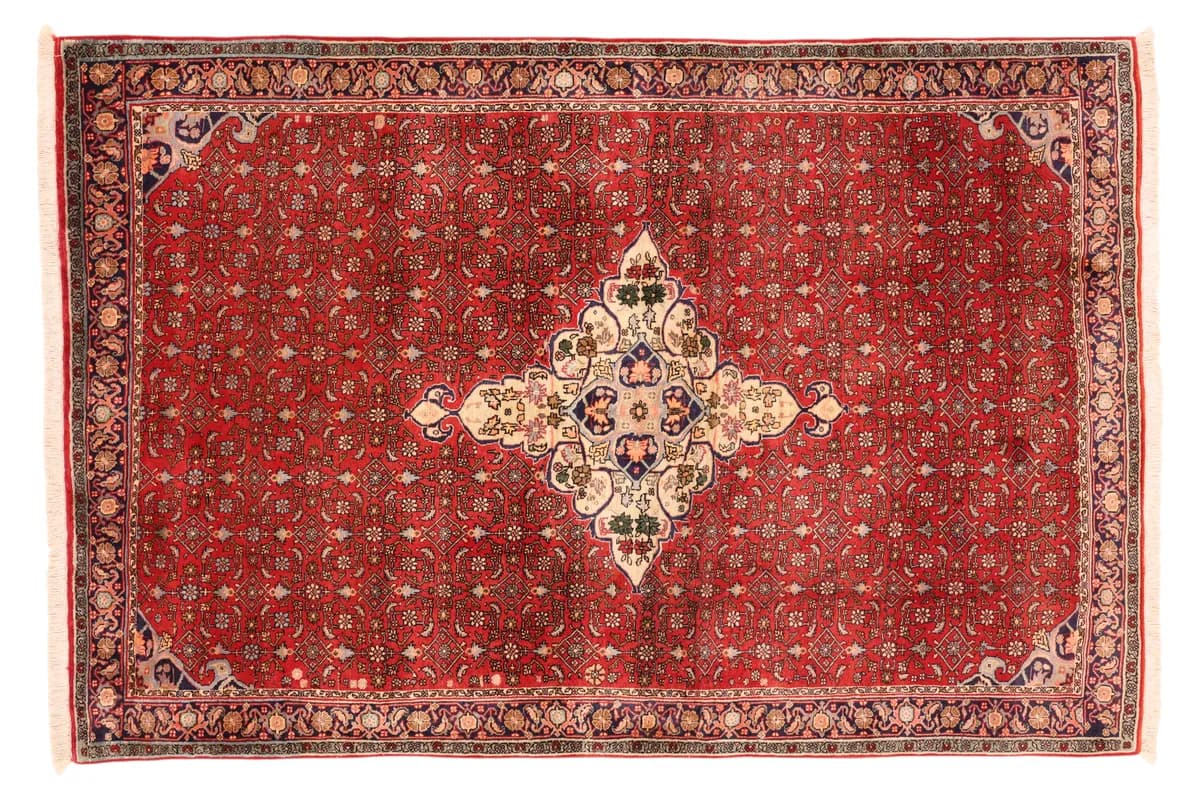
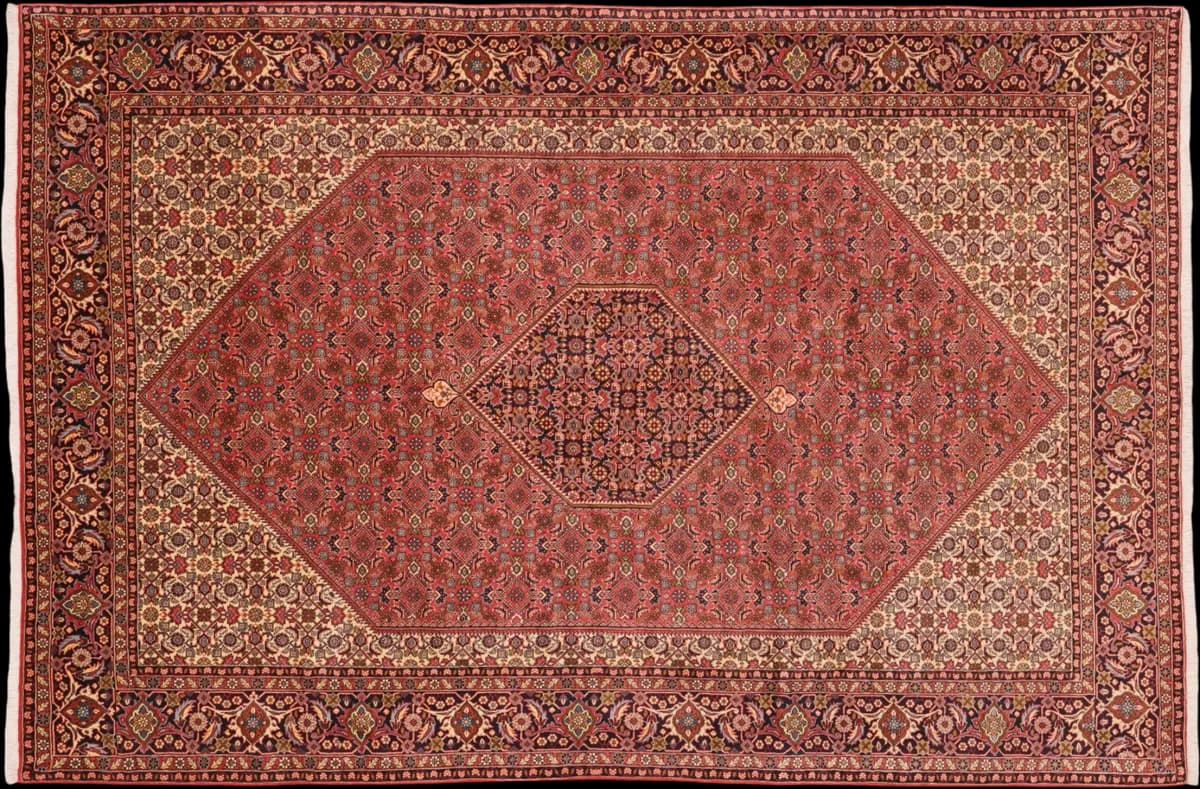
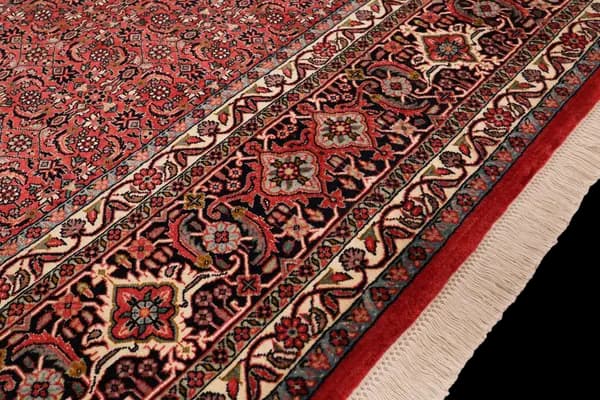
The ground is a deep brick red, covered edge to edge in a fine Mahi lattice, the fish-and-rosette pattern repeating without a break. At its centre sits a bold navy lozenge medallion, its outline traced in ivory floral scrollwork, with small touches of dusty teal, rose and green. The four corner spandrels answer it exactly, in the same navy and the same drawing, giving the layout a symmetry rare even for a classical medallion design. A wide navy border, its cream scrollwork echoing the field, closes the composition.
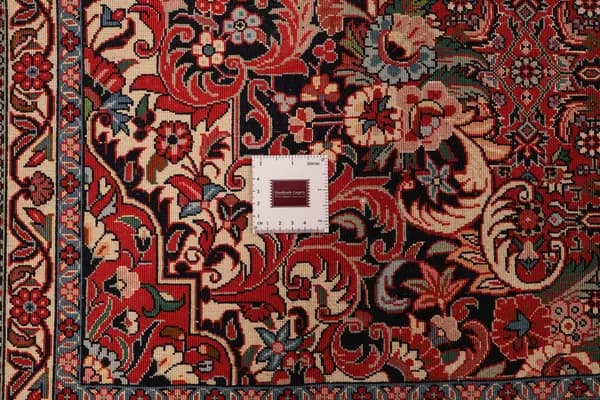
That symmetry is earned in the knotting. This piece carries between 441,000 and 500,000 knots per square metre, among the tightest counts in the Persian tradition, in a wool pile shot through with silk that takes a finer line than wool alone allows. On a cotton warp, clipped to a short, even 15 mm, that density keeps the lattice crisp and lets the corner spandrels match the medallion stroke for stroke. It is also what gives Bidjar its name: a structure pressed so firm it can only be rolled, never folded.
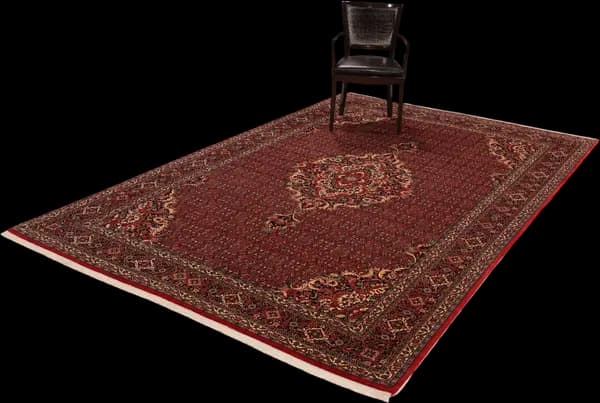
A piece this size suits a dining room or a living room, laid under a table or in front of a sofa rather than in a passage. The brick red holds its own against dark wood and warms a pale floor, while the ivory scrollwork keeps the medallion light. Underfoot it is dense and firm, built for daily use rather than careful preservation. Catch it in low afternoon light and the silk in the pile lifts the scrollwork into a soft, separate glow.
More on Bidjar rugs: origin, making and how to recognise a genuine piece
Superior craftsmanship
At 327 × 219 cm (7.16 m²) this is a large rug. It sits under a seating group with the front legs of sofa and chairs on it, or under a dining table for four. A table for six wants about 80 cm of clearance all round, and needs more.
Yes, knotted by hand — knot by knot on a loom, not machine-made. The density is 441,000 to 500,000 knots per square metre; across 7.16 m² that is roughly 3.2 to 3.6 million individual knots, every one of them tied by hand.
This pile contains silk and is more delicate than pure wool. Vacuum without a rotating brush and along the pile, do not beat it, and keep it out of permanent direct sun. Blot spills at once with a light cloth, never rub. For a proper clean a silk-blend rug belongs in expert hands — we handle that for pieces bought from us.
We are in the Hamburg Speicherstadt. Come and see this rug in daylight, or write to us — a person answers.
Certificate included verifying origin, materials, and craftsmanship.
Ref: 245389