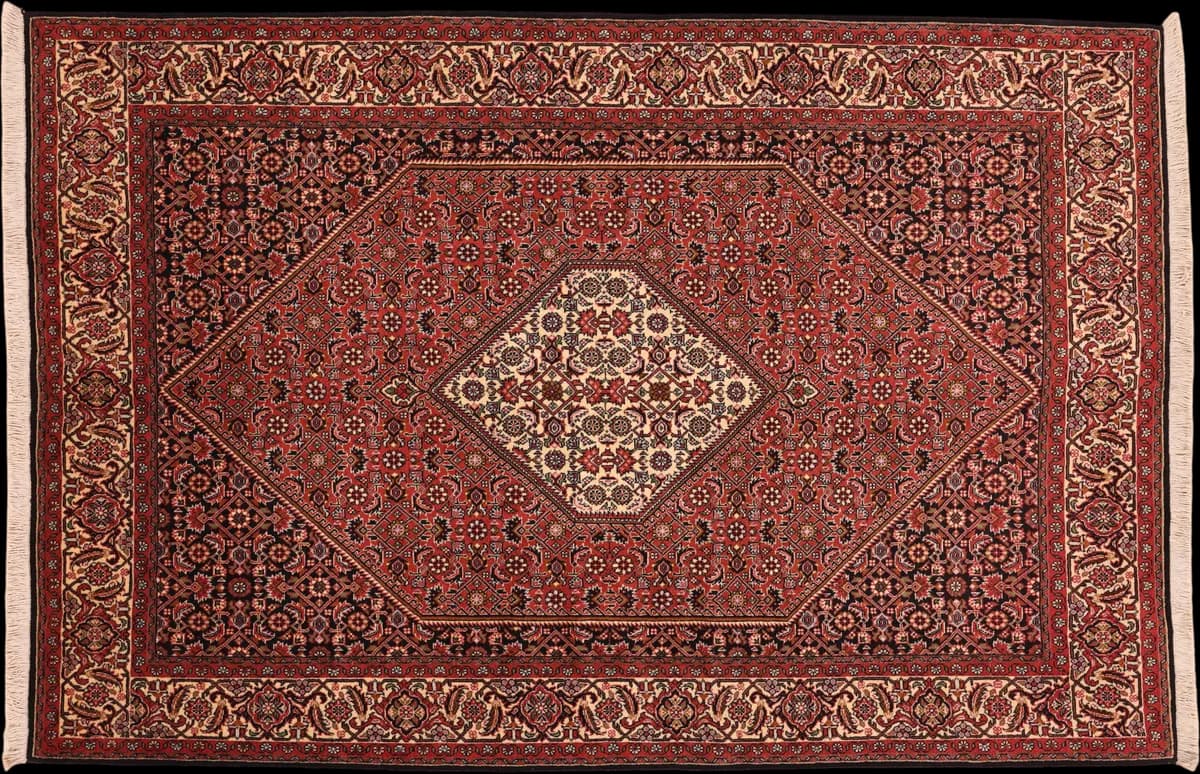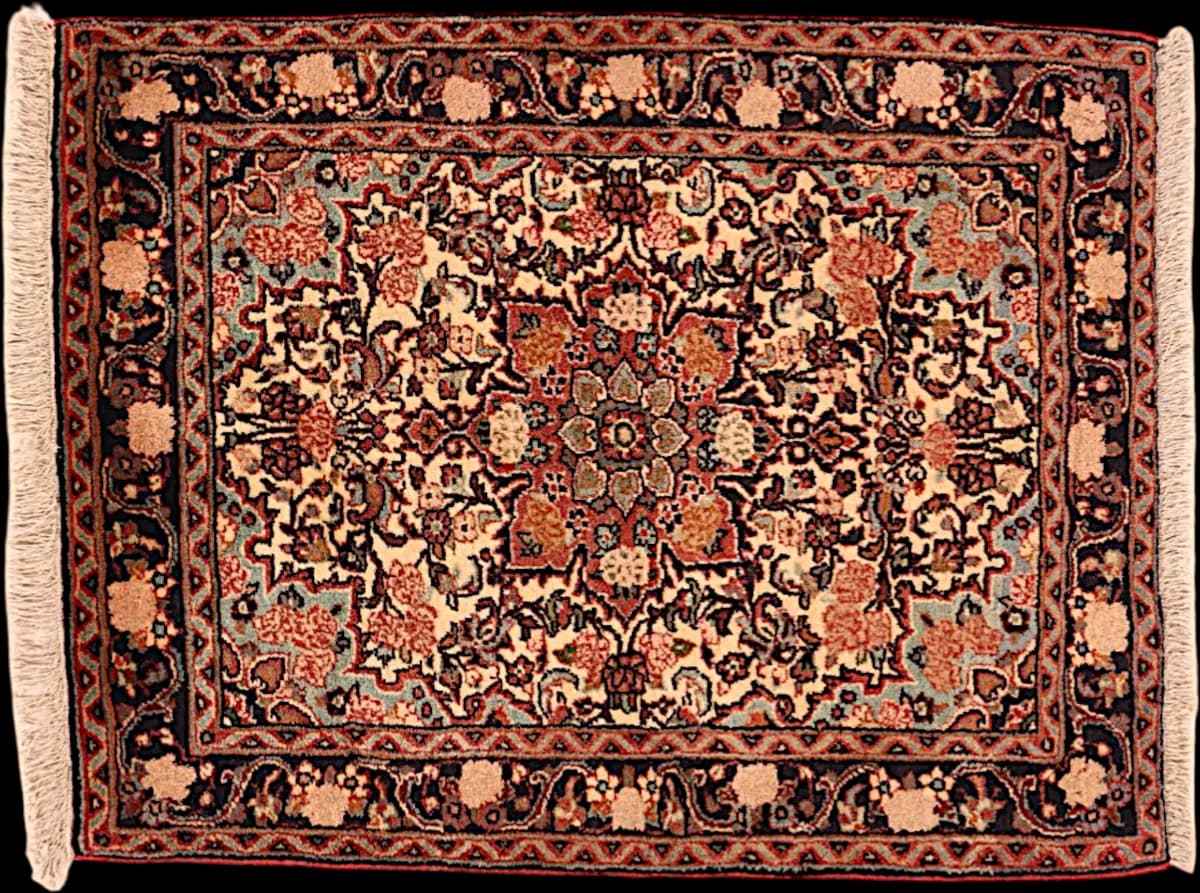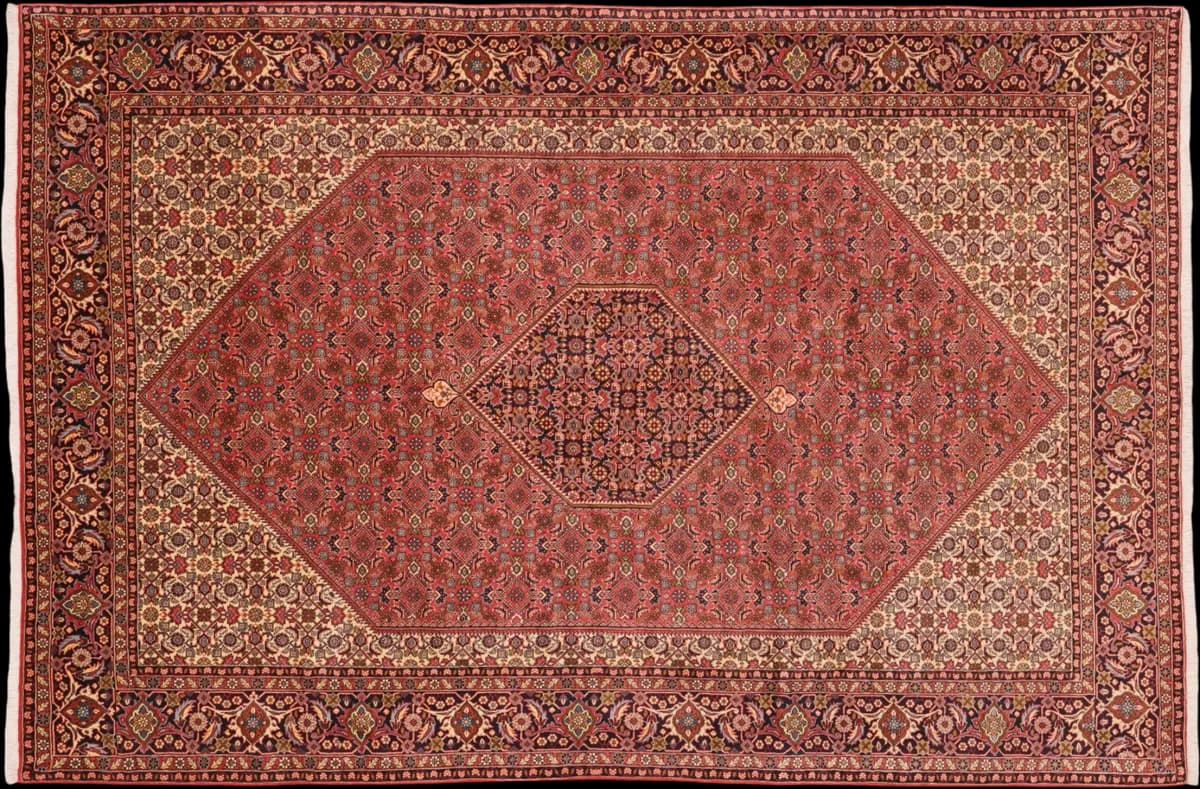
Bidjar
299 × 199 cm
4.500 €







3.000 €
Incl. VAT
In Stock · Ready to Ship
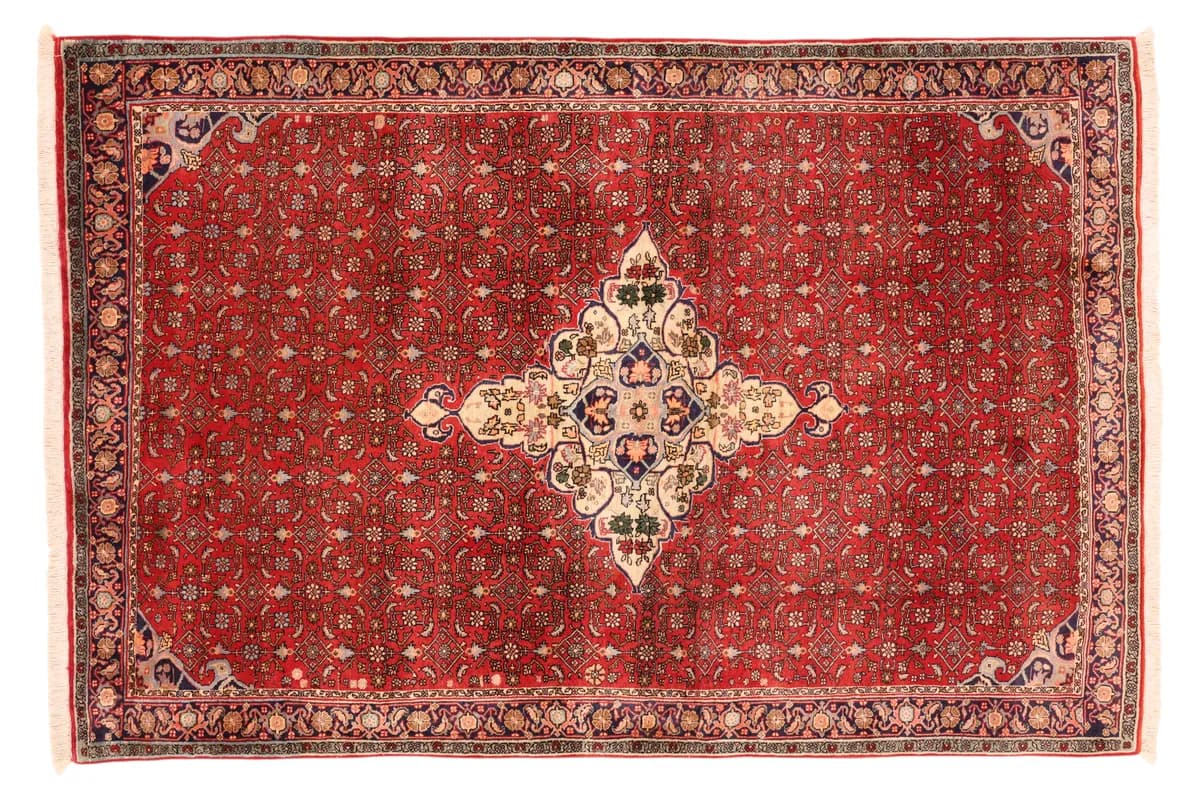
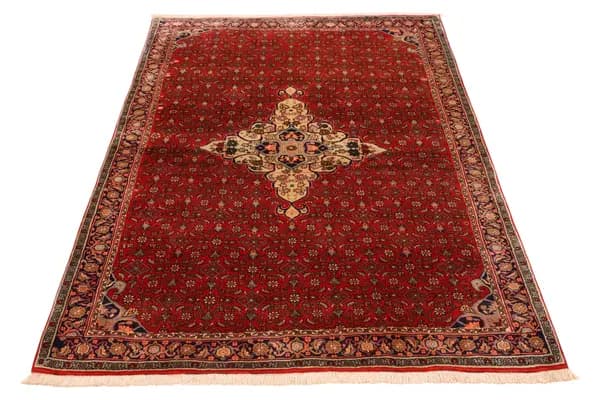
Bijar rugs — sometimes written Bidjar — come from the Kurdish regions of western Iran and have earned the name "the Iron Rugs of Persia" for a construction so dense that the finished piece can only be rolled, never folded. This one measures 217 x 144 cm (7'1" x 4'9"), a rectangular rug built for a room rather than a hallway, and it carries the type's reputation for substance in every centimetre.
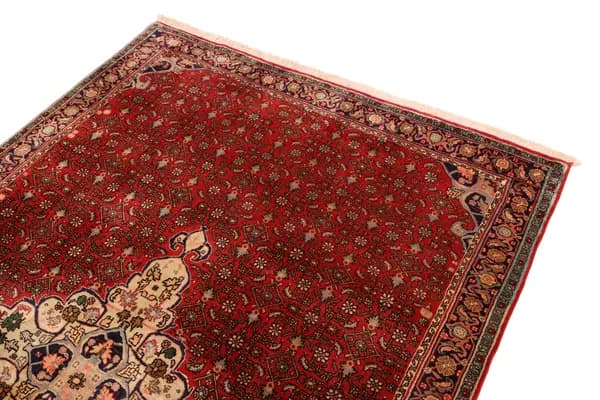
The field is a deep brick red, filled with a fine diamond lattice in the Mahi pattern that Bijar weavers are known for setting against strong colour. At its centre sits a lozenge-shaped medallion in ivory and navy, sharp-edged against the red, with ornate spandrels answering it in the corners. Around the whole runs a multi-band floral border, where dusty rose, sage green, camel and slate blue soften what is, underneath, a very disciplined structure. The surface catches a light sheen wherever those paler tones sit, so the pattern shifts gently as you move past it rather than staying flat.
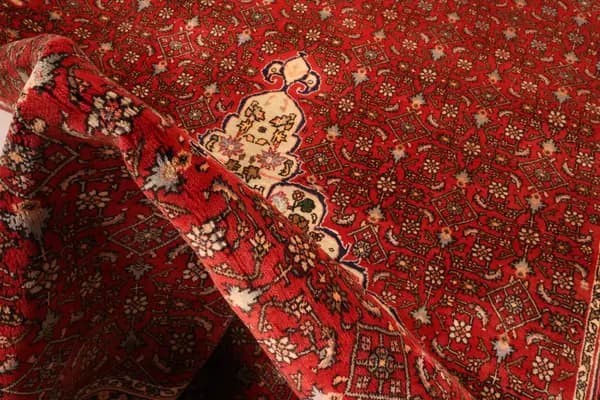
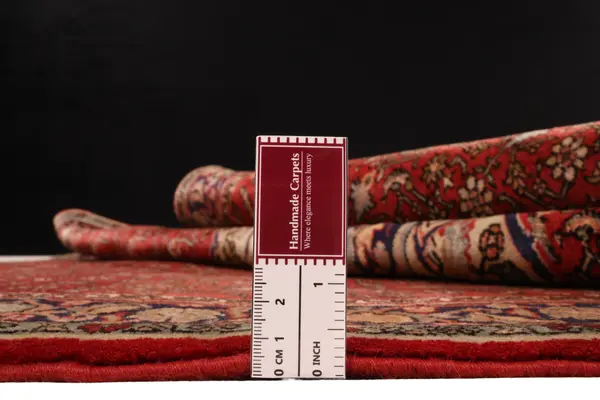
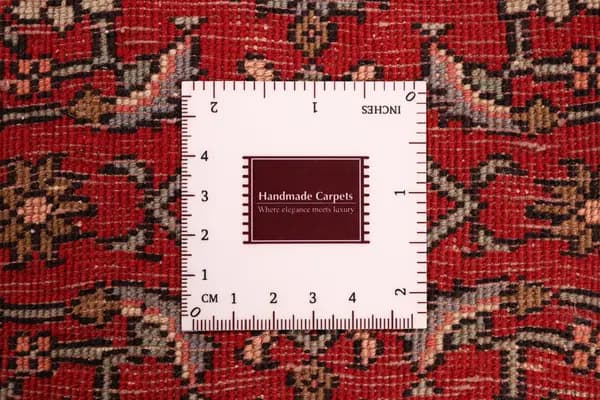
This is what gives a Bijar its legendary hold: knotted by hand at a density of 321,000 to 380,000 knots per square metre, the tightest of any Persian weaving tradition, on a cotton warp with a pile of hand-spun wool. That density is what fixes the pattern so precisely and what makes the rug press down firm and compact rather than yielding underfoot. A 15 mm pile sounds modest, but packed this tightly it reads as weight and depth rather than height, and it is the reason a Bijar this age still holds its edges sharp rather than softening at the medallion and the lattice.
A rug this size settles naturally into a bedroom, beside a bed or under a reading chair, where its weight and its warmth are both felt directly rather than glimpsed across a room. The brick red holds its own against dark wood furniture and lifts a pale floor without needing daylight to do it, while the rose, sage and camel in the border keep it from ever feeling heavy-handed. Underfoot it is dense and firm, built for daily use rather than careful stepping around. As the light in the room moves through the day, the sheen in the medallion and the florals catches differently, and the iron structure beneath it quietly does its work.
More on Bidjar rugs: origin, making and how to recognise a genuine piece
Superior craftsmanship
At 217 × 144 cm (3.12 m²) this is a medium rug. It works in front of a sofa, in front of a bed or in a study. It is too small for a dining table — there you want about 80 cm of clearance so a chair does not tip over the edge when pushed back.
Yes, knotted by hand — knot by knot on a loom, not machine-made. The density is 321,000 to 380,000 knots per square metre; across 3.12 m² that is roughly 1.0 to 1.2 million individual knots, every one of them tied by hand.
Hand-spun wool still carries its own lanolin, which keeps liquid sitting on the surface for a moment: blot quickly, with clear water and a light cloth, working inwards and without rubbing. Otherwise regular vacuuming along the pile is enough. Turn the rug once or twice a year so light and footfall reach it evenly.
We are in the Hamburg Speicherstadt. Come and see this rug in daylight, or write to us — a person answers.
Certificate included verifying origin, materials, and craftsmanship.
Ref: 263210