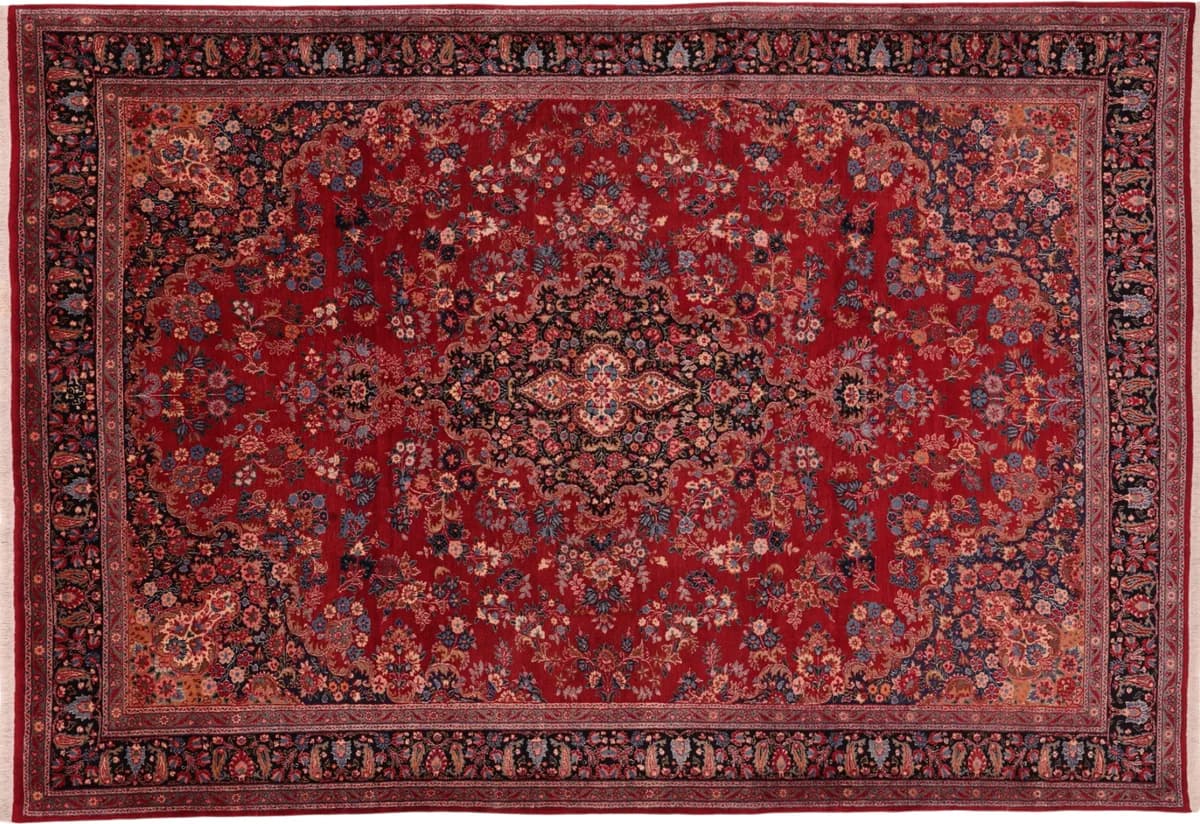
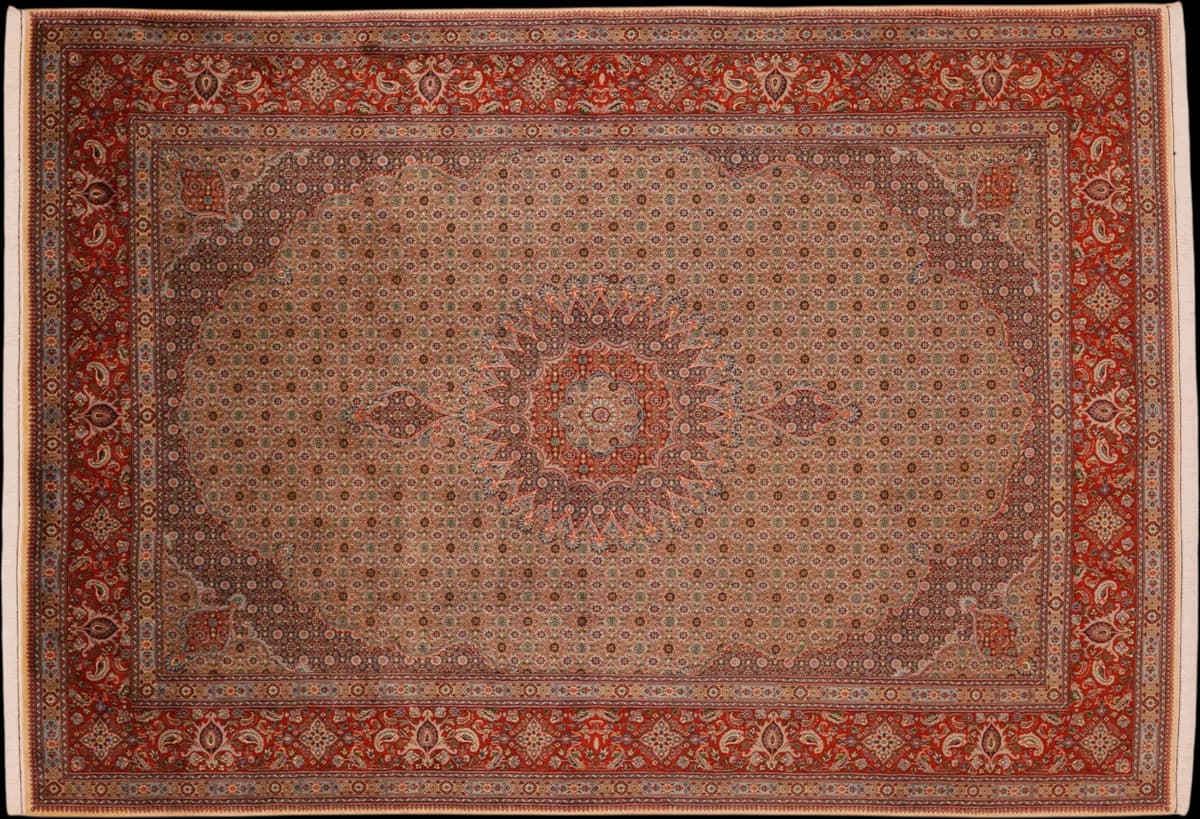
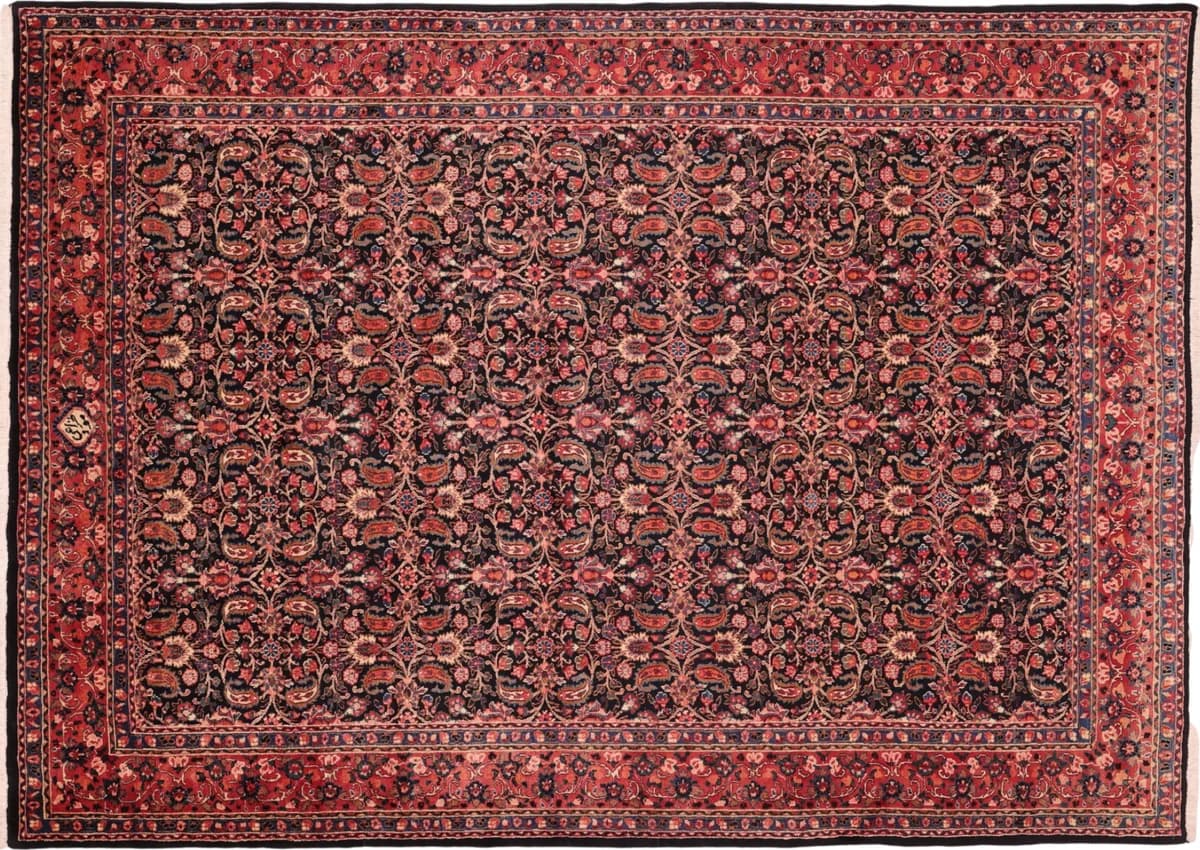
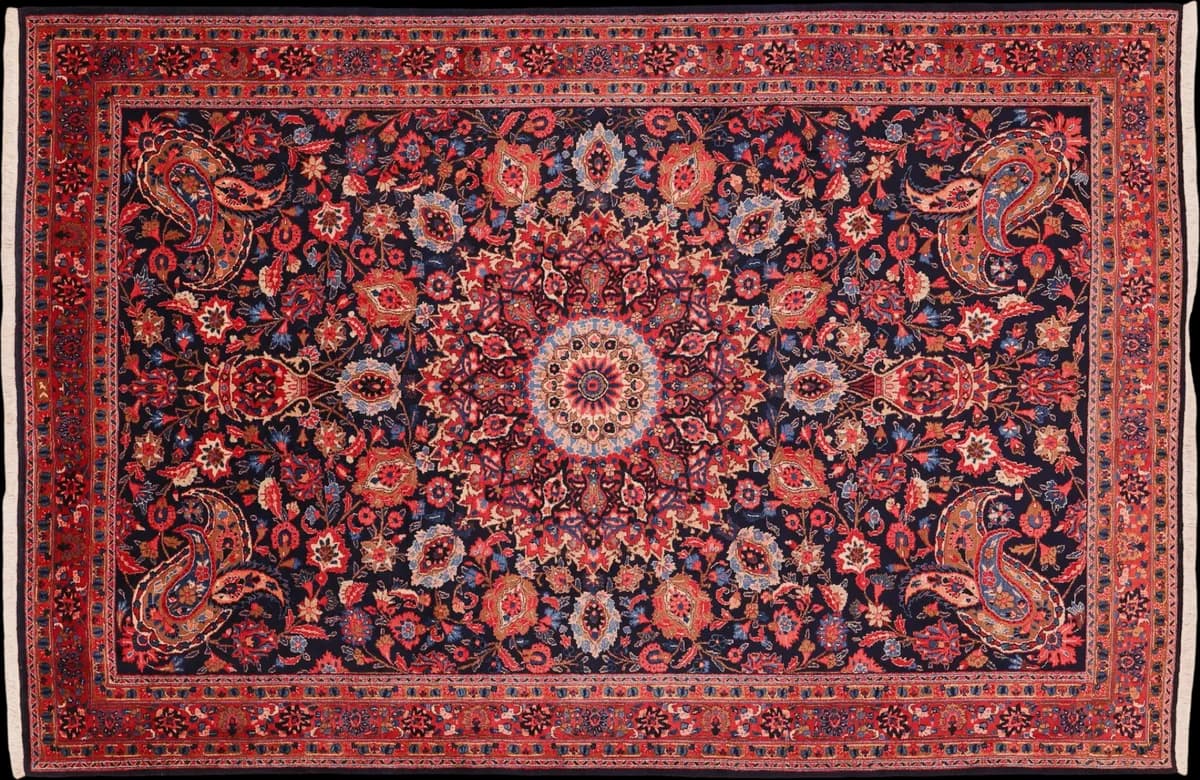
Moud Dorokhshwith silk
243 × 202 cm
3.450 €
5.070 €
Incl. VAT
In Stock · Ready to Ship
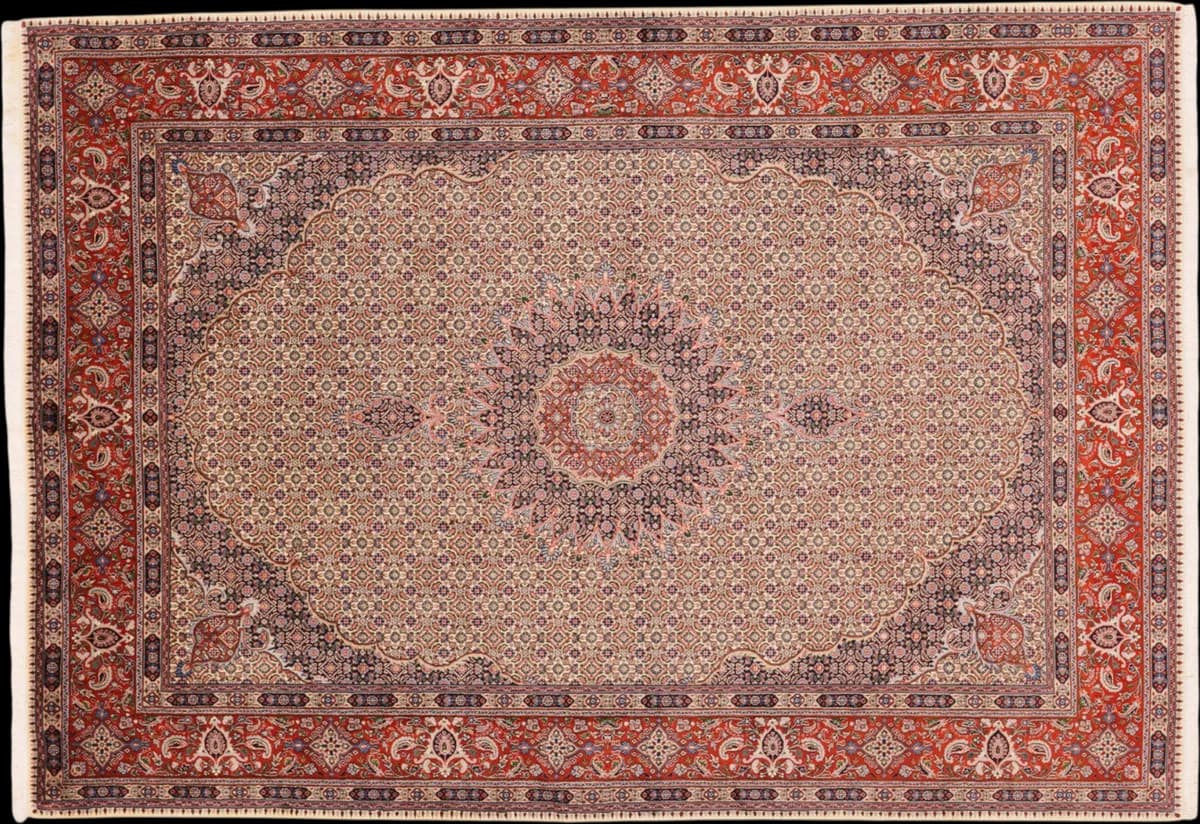
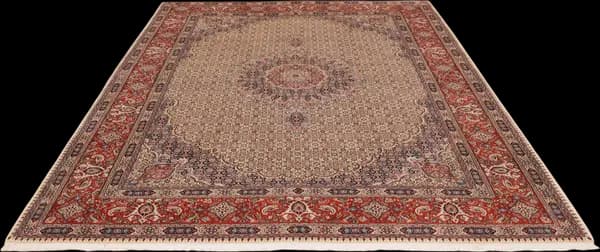
This is a Dorokhsh, from the Khorasan weaving villages of eastern Iran, 286 x 201 cm (9'5" x 6'7"). Dorokhsh sits alongside its better-known neighbour Moud in the trade, and the two are often spoken of together, but Dorokhsh has its own reputation for refined drawing and a surface that catches the light with a quiet gloss. It is the more polished of the pair, and this piece shows why.
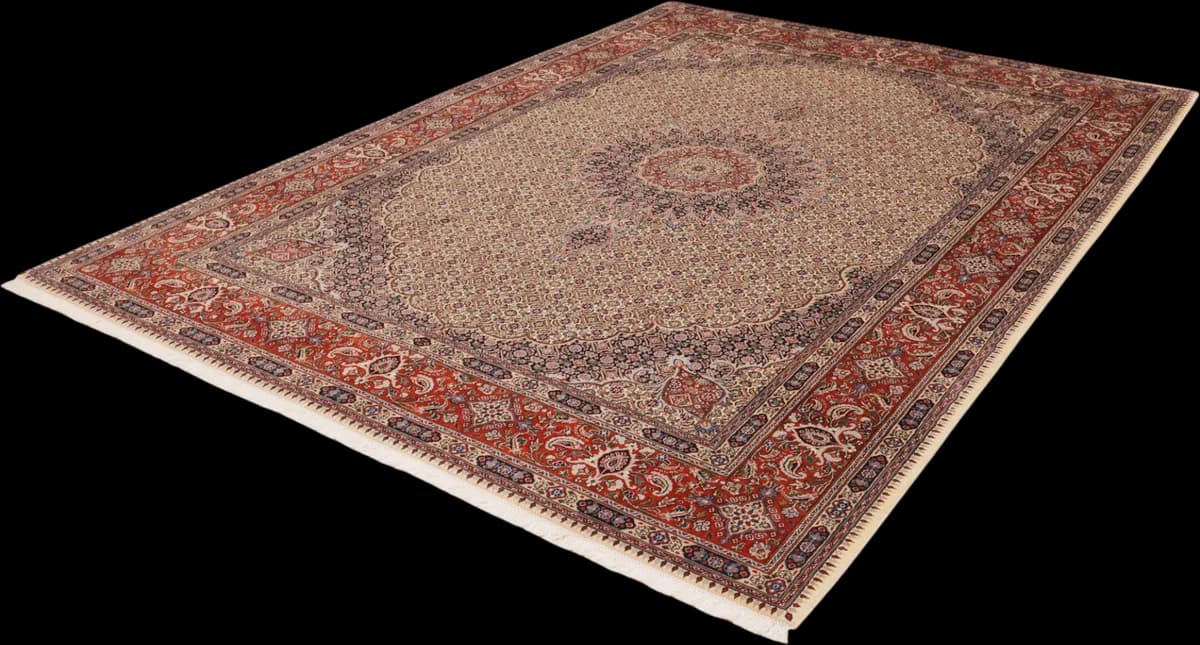
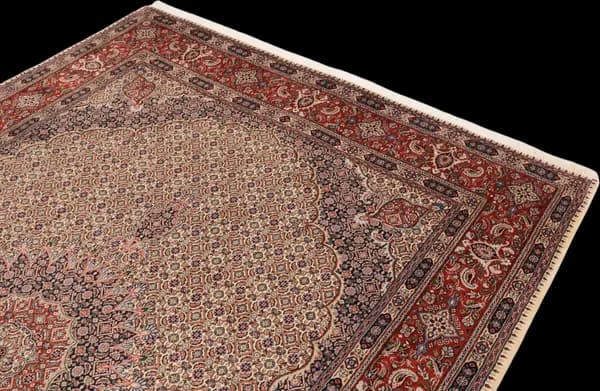
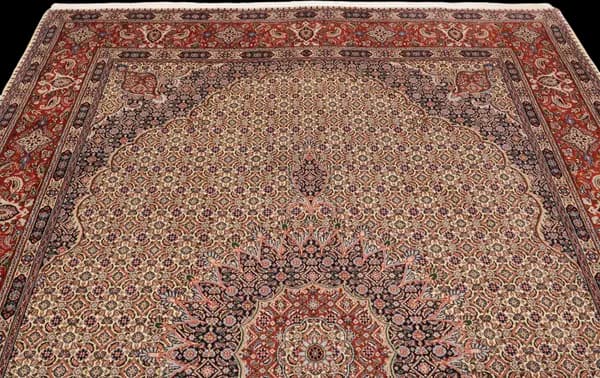
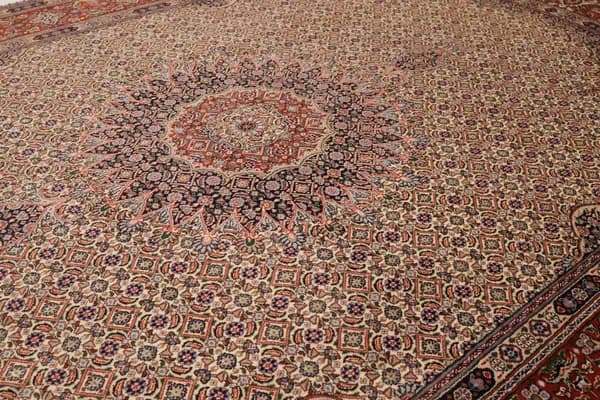
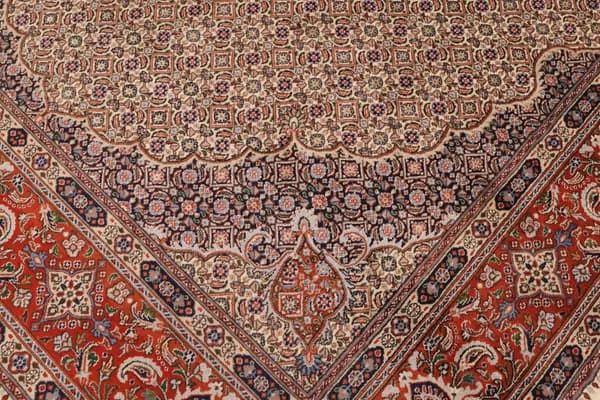
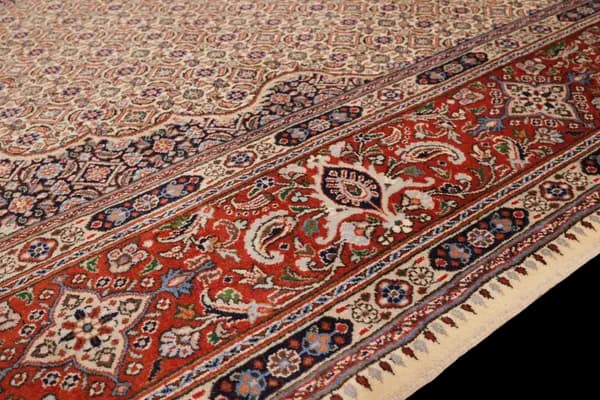
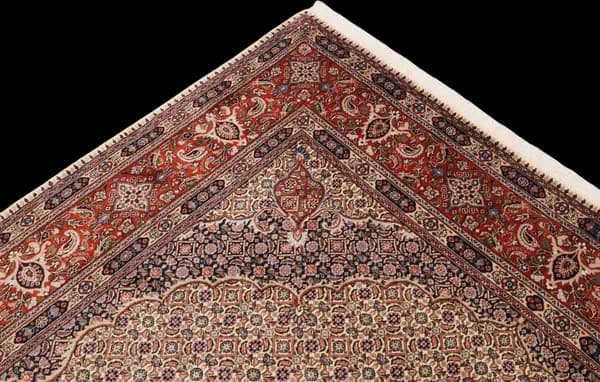
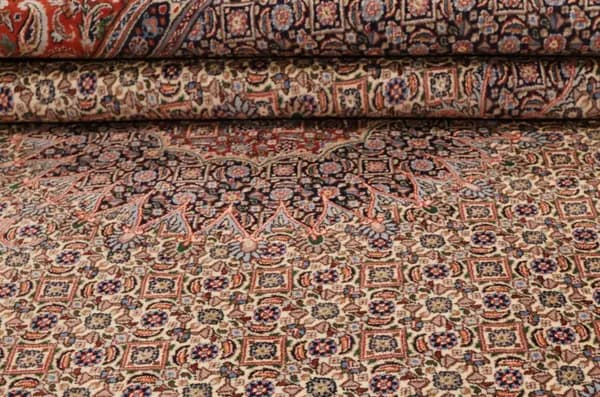
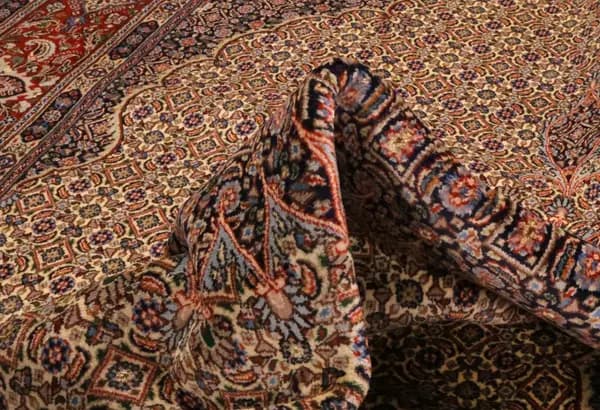
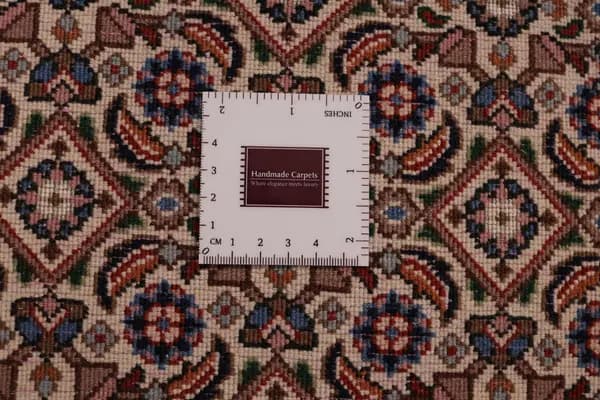
The field is a dense cream lattice of small navy fish and rosettes, the Mahi pattern repeating with no break until it meets a central sunburst medallion. That medallion is where the rug departs from convention: instead of the expected navy, its ring is a soft dusty pink around a red core, a colour rarely used at this point in a Tabriz-school Mahi design. Navy pendants anchor it top and bottom, and the whole field is framed by a broad brick-red border of palmette scrollwork in navy and cream, itself edged by narrow guard stripes making up close to a fifth of the rug's width.
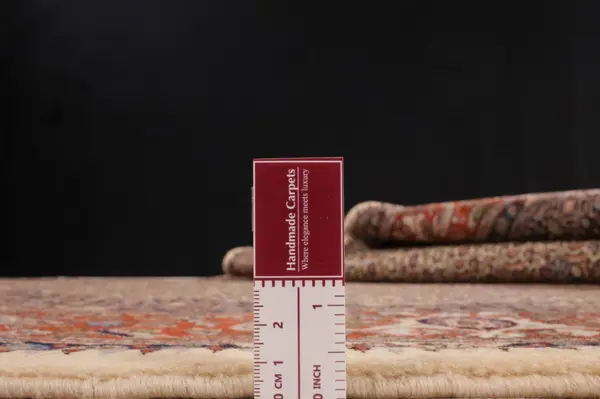
Wool carries silk through the pile here, and that mixture is what gives the surface its sheen and lets the drawing stay this crisp. Silk fibres are finer than wool, so blending them in allows tighter, more exact knotting, and at 321,000 to 380,000 knots per square metre this is a fine weave by any standard, months of work condensed into a rug this size. The pile is clipped short, at 12 mm, so the pattern reads sharply rather than sinking into depth, which is exactly what a Mahi lattice this intricate needs to remain legible.
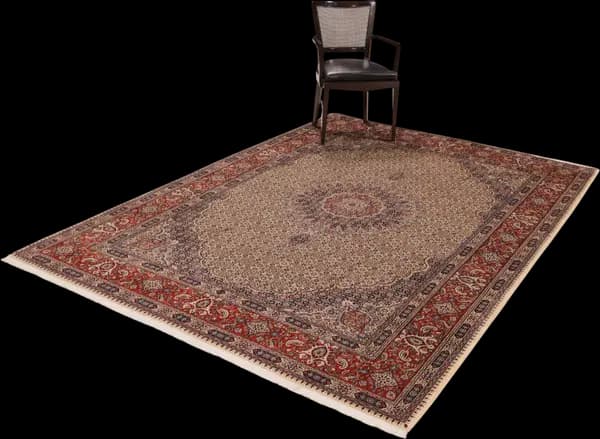
A rug of this size sits comfortably under a dining table or in front of a sofa group, and the cream field will lift a room that gets good daylight, letting that sheen do its work as the light moves across it through the day. Against pale floors the brick-red border holds its own without dominating, and the pink medallion reads as warmth rather than statement. Underfoot the weave is dense and firm, made for a room in daily use rather than one to be tiptoed around. It rewards a second look, and a third, in a way the more common all-navy versions of this design rarely do.
More on Dorokhsh rugs: origin, making and how to recognise a genuine piece
Superior craftsmanship
At 286 × 201 cm (5.75 m²) this is a large rug. It sits under a seating group with the front legs of sofa and chairs on it, or under a dining table for four. A table for six wants about 80 cm of clearance all round, and needs more.
Yes, knotted by hand — knot by knot on a loom, not machine-made. The density is 321,000 to 380,000 knots per square metre; across 5.75 m² that is roughly 1.8 to 2.2 million individual knots, every one of them tied by hand.
This pile contains silk and is more delicate than pure wool. Vacuum without a rotating brush and along the pile, do not beat it, and keep it out of permanent direct sun. Blot spills at once with a light cloth, never rub. For a proper clean a silk-blend rug belongs in expert hands — we handle that for pieces bought from us.
We are in the Hamburg Speicherstadt. Come and see this rug in daylight, or write to us — a person answers.
Certificate included verifying origin, materials, and craftsmanship.
Ref: 686969