Exclusive
Bidjar | Exclusivewith silk
299 × 207 cm
15.300 €






705 €
Incl. VAT
In Stock · Ready to Ship
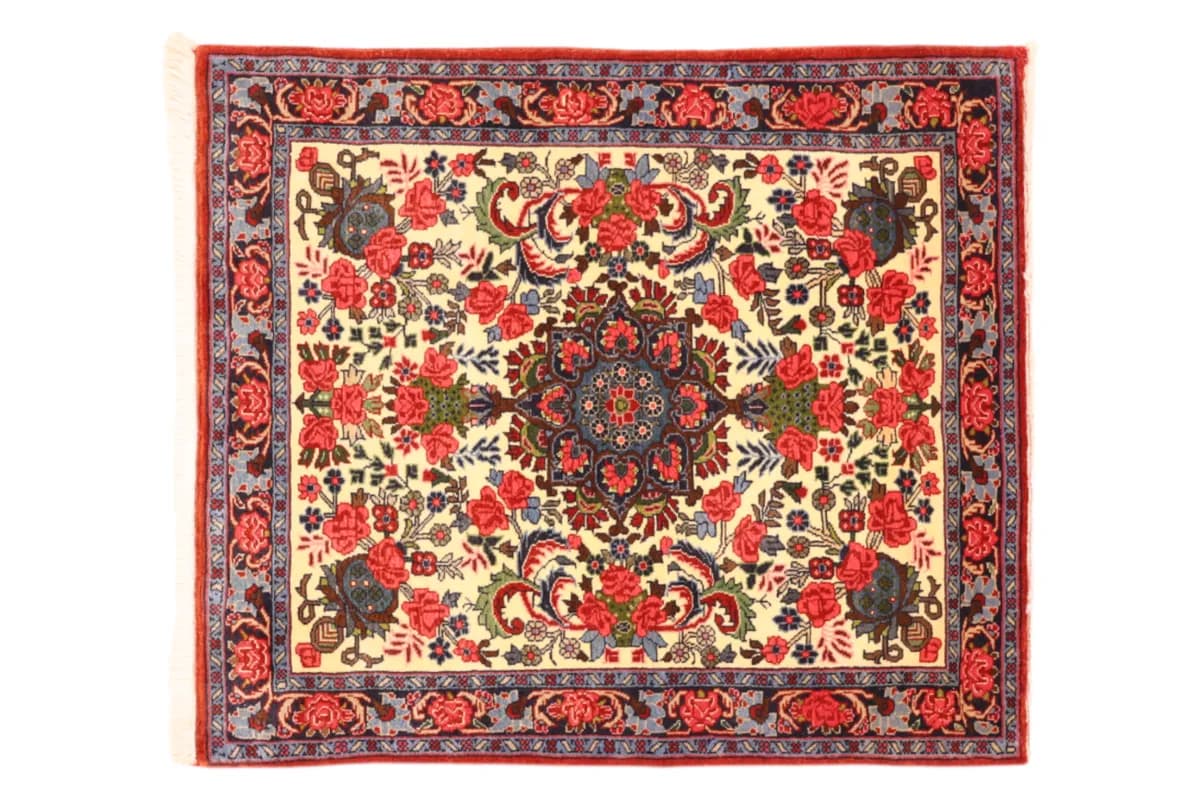
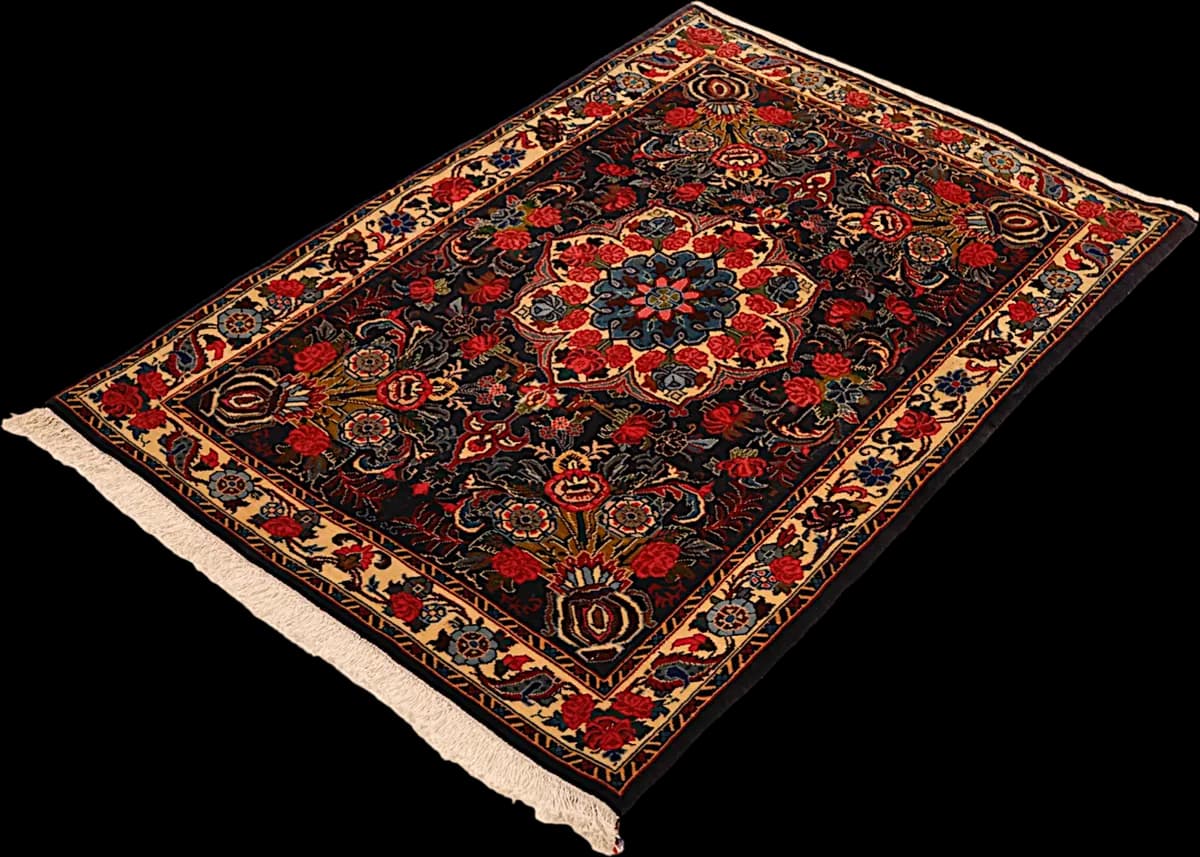
Here you are looking at a Bidjar, 116 x 81 cm (3'10" x 2'8"), from the Kurdish weaving regions of western Iran. The type has long been nicknamed the iron rug of Persia, prized for a structure so dense and firmly pressed that a Bidjar cannot even be folded, only rolled. This particular piece takes that reputation and puts it into something small enough for a single doorway or a narrow wall, losing none of the weight the name promises.
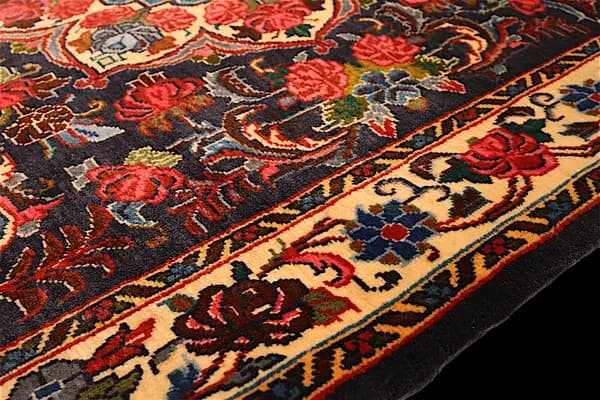
The field is a deep blue-black, and against it a cream medallion opens like a star, its floral shape repeated almost exactly in the corner spandrels, so the whole field reads as a mirrored composition rather than a single motif with a background. Crimson and pink roses crowd the dark ground between medallion and corners, joined by dark olive leaves and touches of steel blue and mustard gold. A wide cream border, itself filled with more roses and small rosettes, closes the design and gives the crimson its sharpest possible contrast, taking up close to a fifth of the rug's width and holding the eye at the edge as firmly as the medallion holds it at the centre.
That contrast, and the crispness of every petal edge, comes directly from how tightly this rug is knotted. At 161,000 to 200,000 knots per square metre, this sits among the densest knotting in the Persian tradition, and it is what lets a motif this detailed survive at such a small scale without blurring. The pile itself is handspun wool, worked over a cotton warp and sheared to a firm 15 millimetre height, which gives the surface its slight sheen and its smooth, even face. A rug this compact still asked for months of steady knotting to reach this density, and it shows in hands rather than in size.
At this size the rug belongs in a hallway, on a landing, or beside a bed, somewhere a larger medallion piece would overwhelm the space. In a hallway with little daylight the dark field and glowing roses do the work a lamp cannot, giving colour to a passage that would otherwise stay flat. Underfoot it feels dense and firm, built for the kind of daily crossing a hallway gets rather than a room people simply sit near. Wherever the light catches it, morning or lamplight, the roses lift off the dark ground and the cream medallion holds its shape, and that is the pleasure of a piece this small carrying so much weight.
More on Bidjar rugs: origin, making and how to recognise a genuine piece
Traditional weave
At 116 × 81 cm (0.94 m²) this is a small rug. It works beside a bed, in a reading corner, in front of a fireplace or as a mat by a door. It does not furnish a room; it makes a point in one.
Yes, knotted by hand — knot by knot on a loom, not machine-made. The density is 161,000 to 200,000 knots per square metre; across 0.94 m² that is roughly 150,000 to 190,000 individual knots, every one of them tied by hand.
Hand-spun wool still carries its own lanolin, which keeps liquid sitting on the surface for a moment: blot quickly, with clear water and a light cloth, working inwards and without rubbing. Otherwise regular vacuuming along the pile is enough. Turn the rug once or twice a year so light and footfall reach it evenly.
We are in the Hamburg Speicherstadt. Come and see this rug in daylight, or write to us — a person answers.
Certificate included verifying origin, materials, and craftsmanship.
Ref: 982646