ExclusiveSigned
Moud Dorokhshwith silk
290 × 202 cm
4.950 €






5.070 €
Incl. VAT
In Stock · Ready to Ship
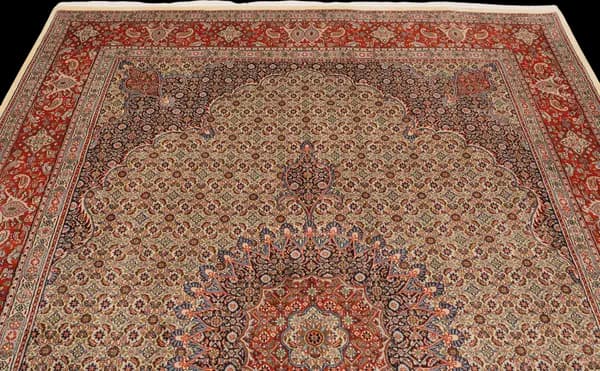
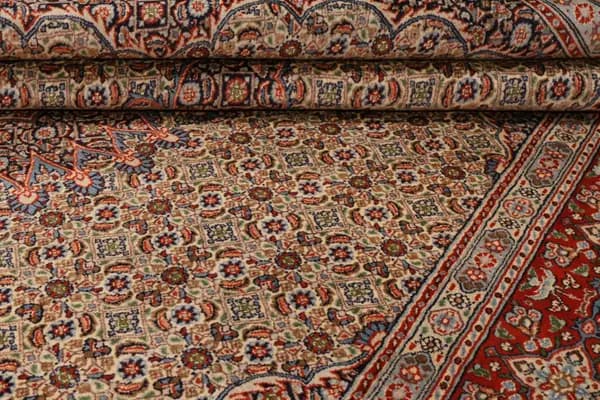
Dorokhsh rugs are woven in the villages around Birjand in South Khorasan, in eastern Iran, and are known in the trade together with their close neighbour Moud for a particularly elegant hand and a fine surface sheen. This piece measures 283 x 198 cm (9'3" x 6'6"), a size suited to a dining table or a generous seating group, and it shows the classic Mahi medallion design that the region is prized for, drawn here with unusual precision.
The field is a warm ivory, covered edge to edge in a small, tightly repeating Mahi lattice of fish and rosette forms, so fine and even that the pattern reads almost as texture before it reads as motif. Set over it is a round medallion in brick red, its outline not plain but serrated into points that alternate pale blue and salmon pink, giving it the look of a jagged sunburst rather than a simple disc. Navy spandrels anchor the four corners, and the whole field is held by a wide brick-red border of palmettes and vines, framed tightly by narrower cream and navy guard stripes that keep the pale centre from spilling outward.
This kind of clarity is a function of the knotting itself. At 321,000 to 380,000 knots per square metre, the weaver had enough resolution to turn each serrated point of the medallion and each small rosette of the lattice cleanly, without the rounding-off that coarser work forces on a design. The pile is wool with silk woven through the highlights; silk takes a finer twist than wool, so those threads sit slightly proud and catch the light along the motif outlines, which is the source of the sheen Dorokhsh weaving is known for. A cotton foundation keeps the whole construction stable under a pile just 12 mm deep, low enough to let the drawing stay sharp underfoot as well as to the eye.
In a dining room, this rug sits happily under a table without disappearing under the setting, since the ivory ground stays luminous even in the low light most dining rooms get in the evening, and the navy and brick red hold their own against dark wood furniture. In a living room, laid under a sofa group, it gives a pale floor real warmth without tipping the room towards red. Underfoot it is dense and firm rather than deep and soft, a rug built to be walked on daily rather than reserved for show. Move a lamp across it in the evening and the silk highlights along the medallion's points will catch and shift, a small pleasure that repeats every time the light does.
More on Dorokhsh rugs: origin, making and how to recognise a genuine piece
Superior craftsmanship
At 283 × 198 cm (5.60 m²) this is a large rug. It sits under a seating group with the front legs of sofa and chairs on it, or under a dining table for four. A table for six wants about 80 cm of clearance all round, and needs more.
Yes, knotted by hand — knot by knot on a loom, not machine-made. The density is 321,000 to 380,000 knots per square metre; across 5.60 m² that is roughly 1.8 to 2.1 million individual knots, every one of them tied by hand.
This pile contains silk and is more delicate than pure wool. Vacuum without a rotating brush and along the pile, do not beat it, and keep it out of permanent direct sun. Blot spills at once with a light cloth, never rub. For a proper clean a silk-blend rug belongs in expert hands — we handle that for pieces bought from us.
We are in the Hamburg Speicherstadt. Come and see this rug in daylight, or write to us — a person answers.
Certificate included verifying origin, materials, and craftsmanship.
Ref: 994303