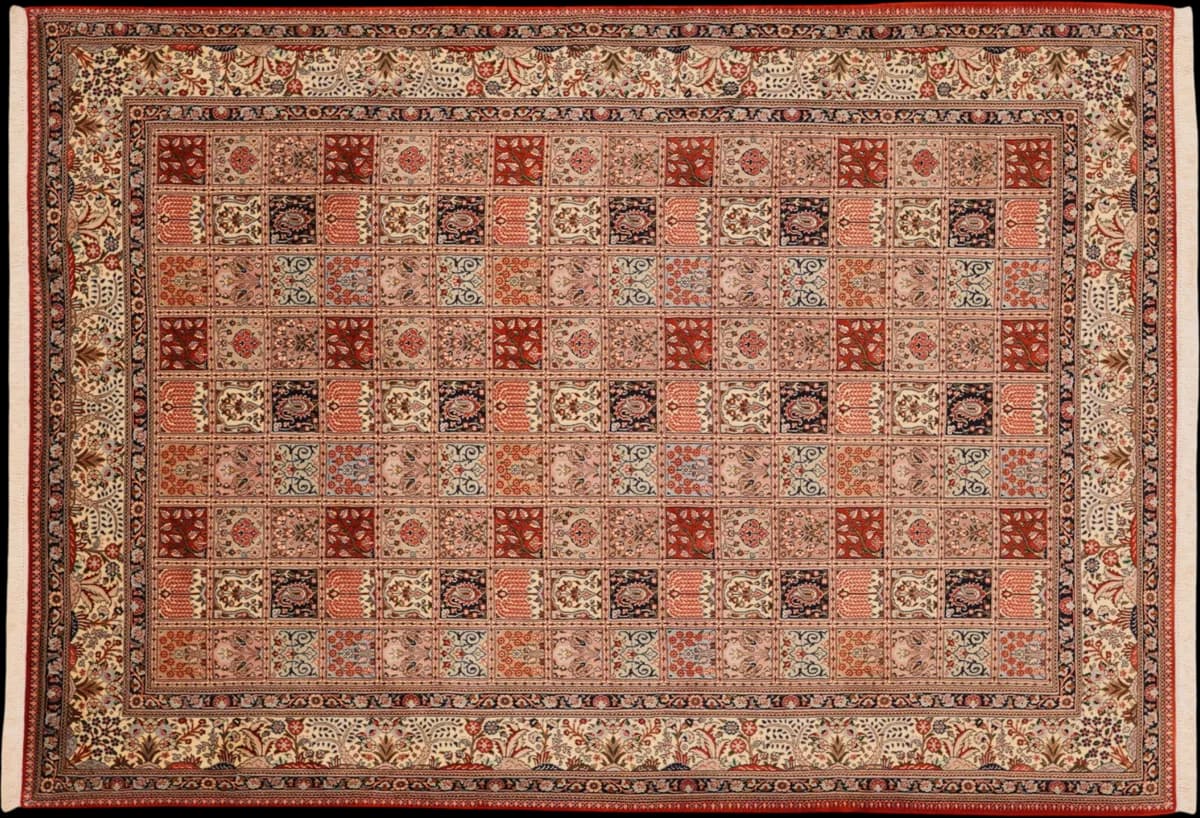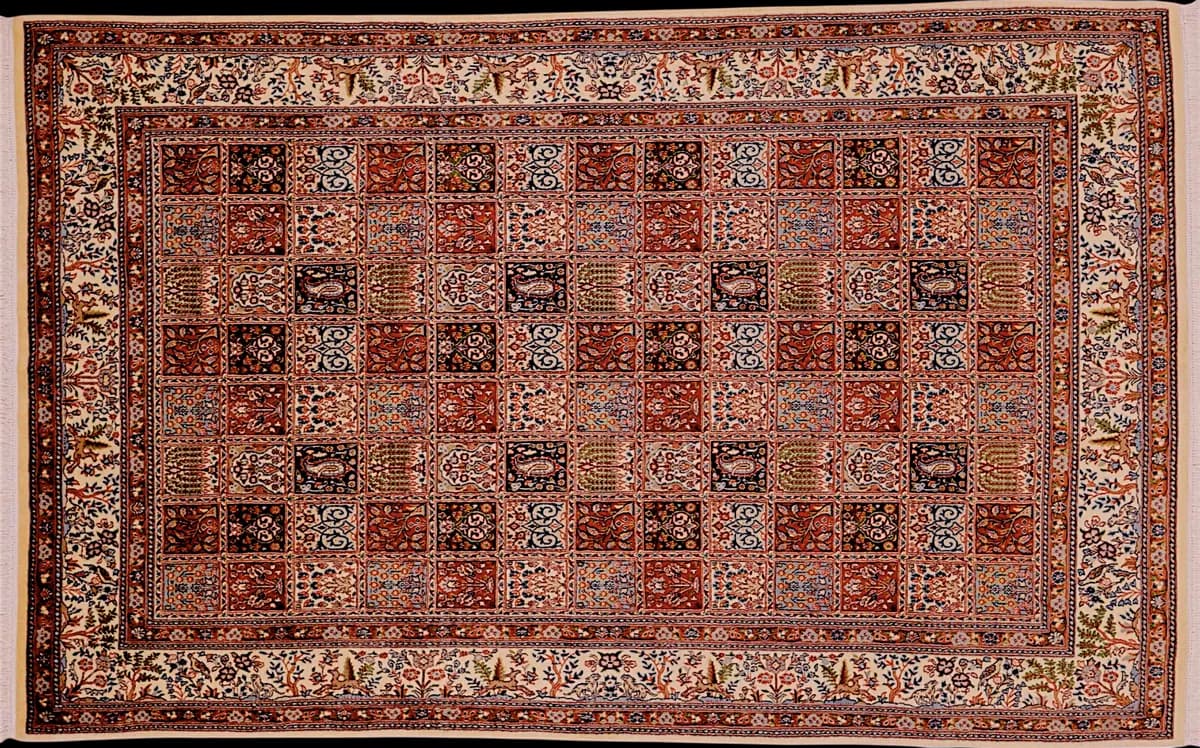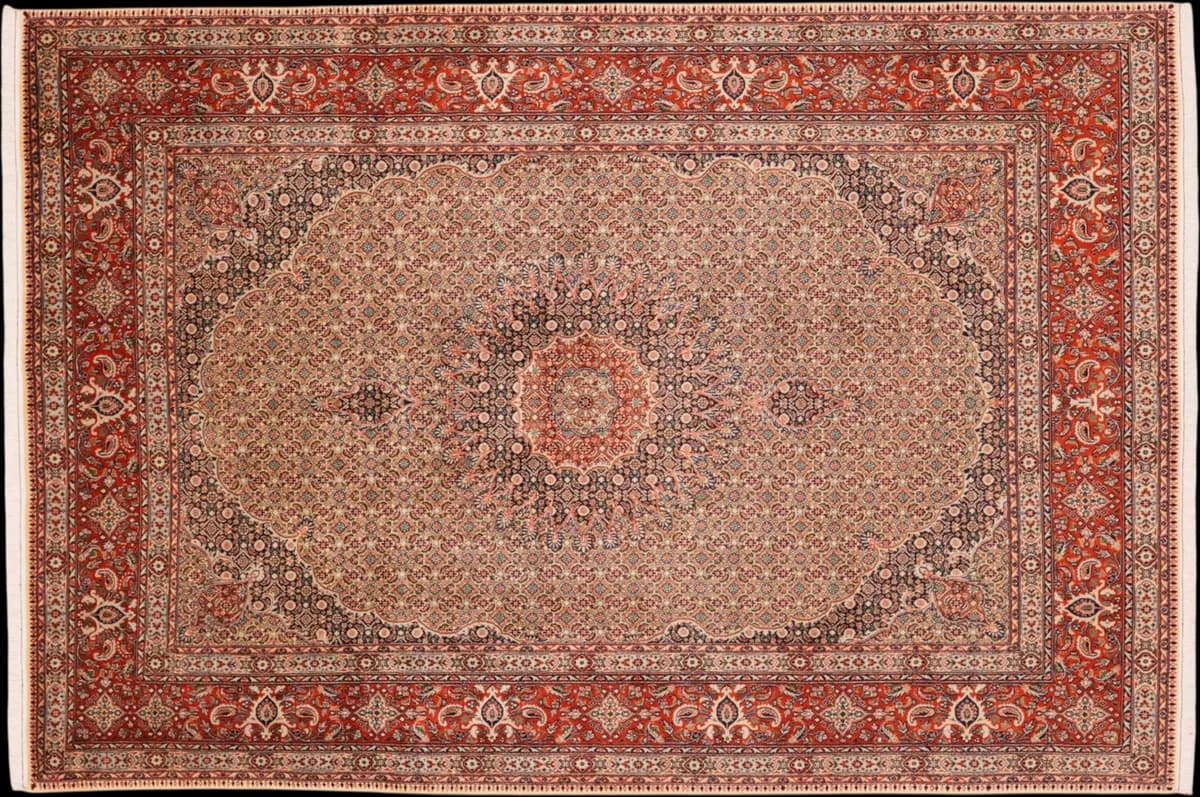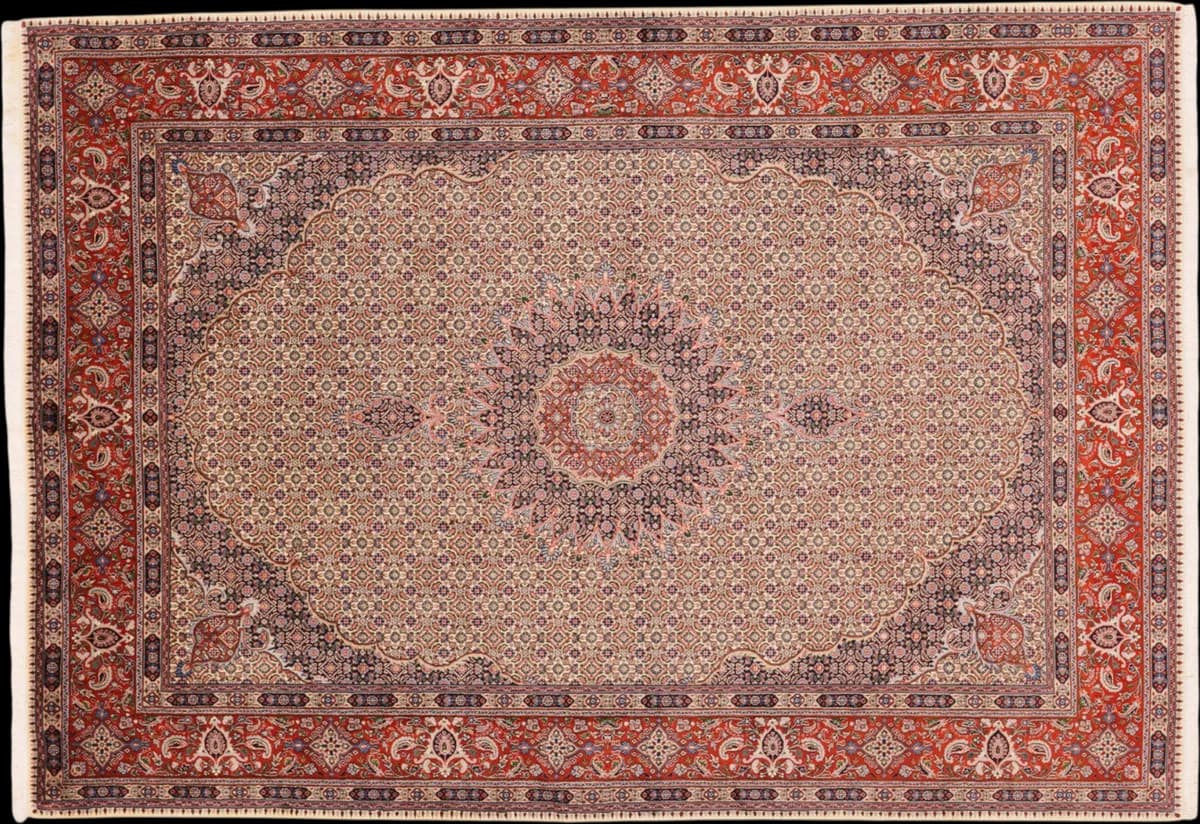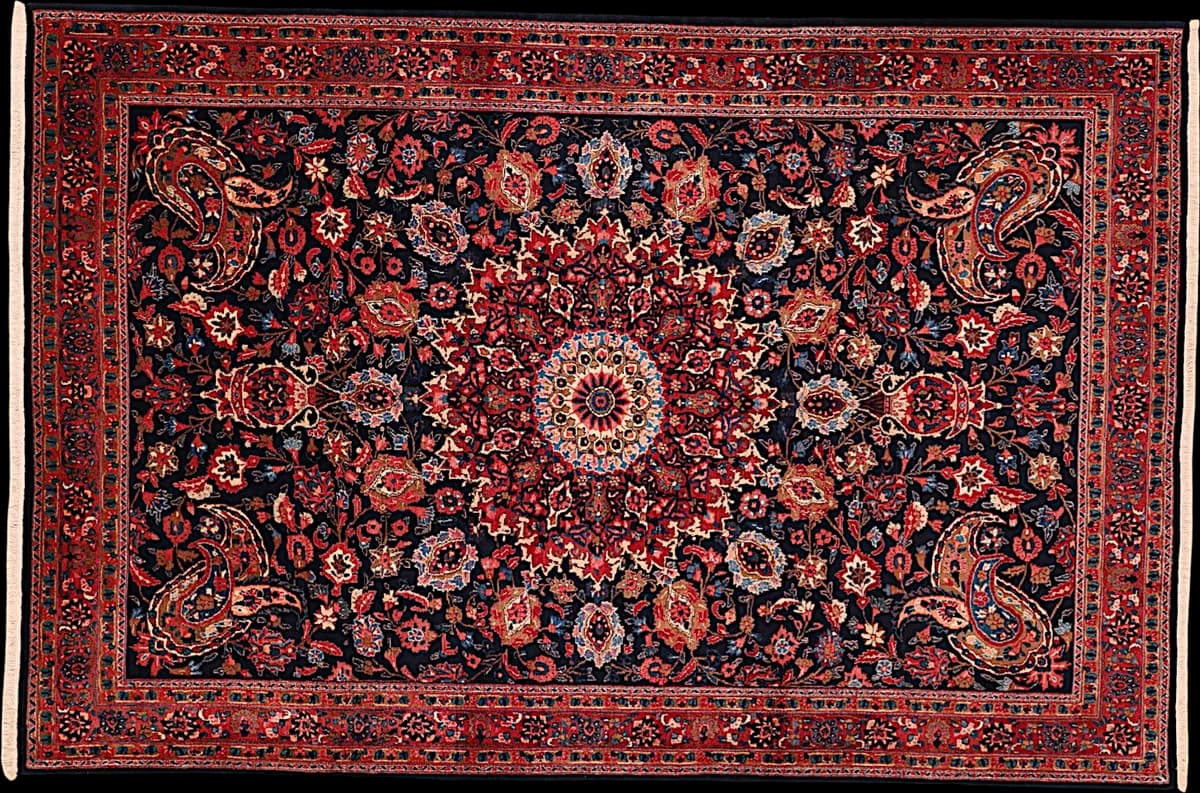
Moud Dorokhsh
310 × 206 cm
2.780 €






2.670 €
Incl. VAT
In Stock · Ready to Ship
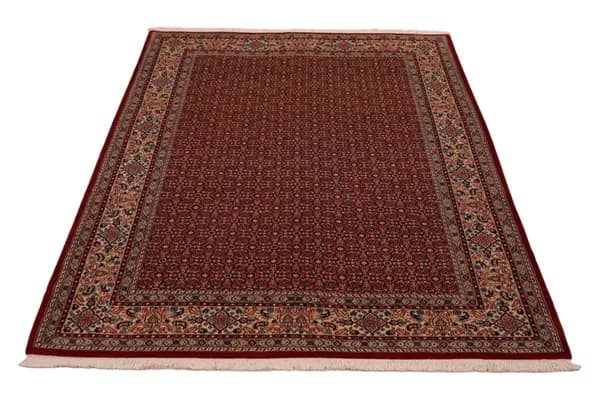
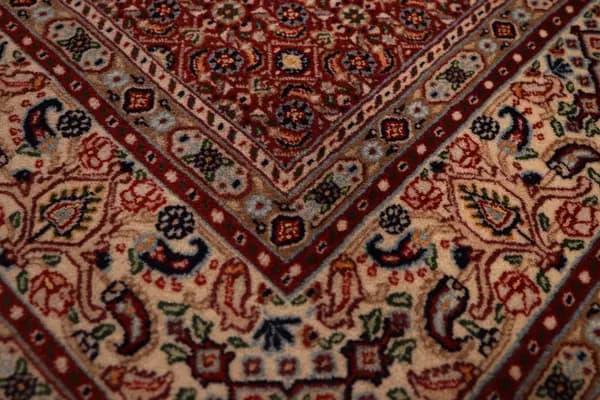
The rug in front of you is a Dorokhsh, 233 x 162 cm (7'8" x 5'4"), woven in the villages around Birjand in south Khorasan, eastern Iran. Dorokhsh and its near neighbour Moud share a reputation for fine knotting and elegant drawing, usually built around the Herati or Mahi repeat, and for a surface that catches light rather than sitting dull. This one is a clear example of why that reputation holds.
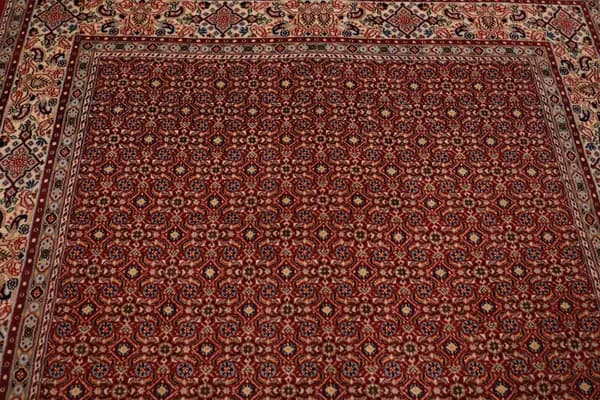
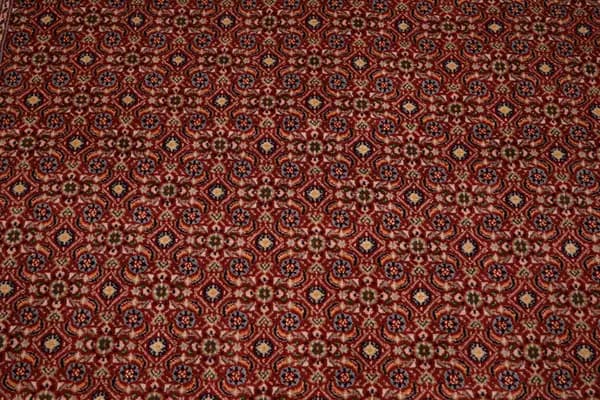
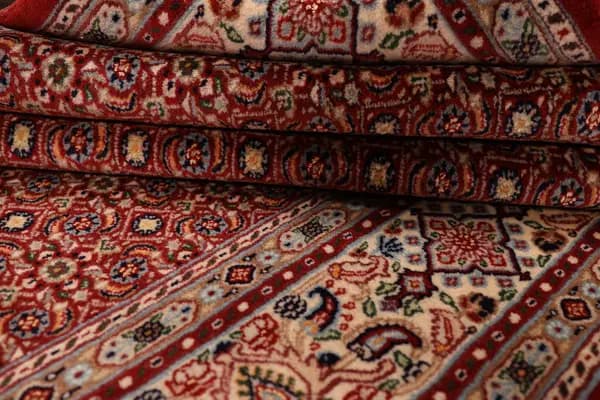
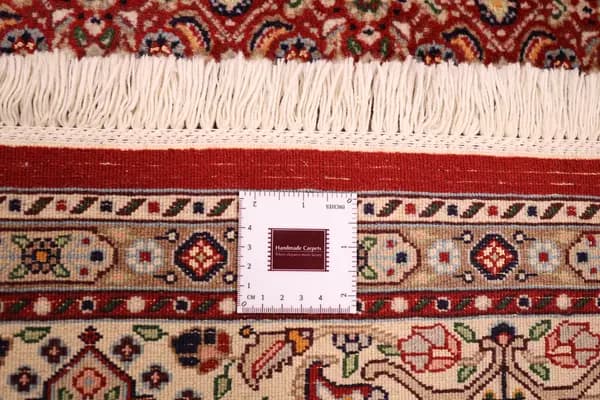
The field is a deep brick red, filled edge to edge with a fine diamond lattice of small rosettes and serrated leaf forms, the Mahi pattern repeating without a medallion or a centre to rest on. From a short distance the repeat is so even and so fine that the field reads almost like a woven textile rather than a knotted one. A wide ivory border interrupts it, carrying floral palmettes and vinework in navy, steel blue, terracotta, ochre and touches of sage, held in place by narrow navy and red guard stripes. Against the red, the ivory border does the work of a frame, and the whole piece stays composed rather than busy.
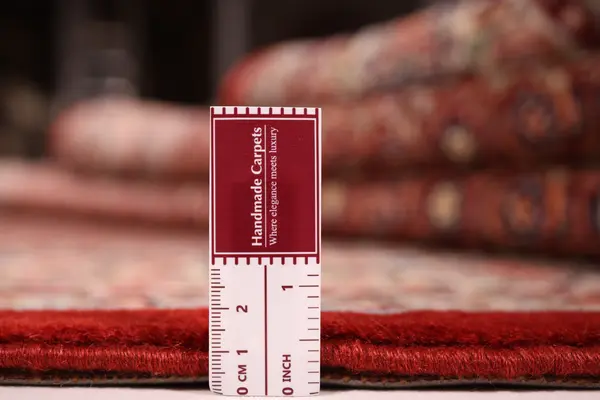
That fineness is not an accident of the eye. The pile is wool with an admixture of silk, knotted by hand onto a cotton warp at a density of 321,000 to 380,000 knots per square metre — silk spins thinner than wool, so it lets the weaver tie more knots into the same space, which is what gives the lattice its crispness rather than a blur. The pile itself is clipped low, to 12 millimetres, and cut level, which flattens the surface further and lets the small sheen in the wool and silk show rather than getting lost in depth of pile. The rug is signed, a small mark of a weaver standing behind the work.
At this size the rug suits a seating group in a living room, or a smaller dining table, rather than a hallway run. The brick red will hold its own against dark wood furniture and warm a pale floor considerably, while the ivory border keeps it from closing the room in. Underfoot it is dense and firm, a weave built for a room that gets used rather than one kept for best. As daylight moves across it through the day, the low sheen in the pile shifts with it, and the fine lattice keeps giving the eye something new to settle on.
More on Dorokhsh rugs: origin, making and how to recognise a genuine piece
Superior craftsmanship
At 233 × 162 cm (3.77 m²) this is a medium rug. It works in front of a sofa, in front of a bed or in a study. It is too small for a dining table — there you want about 80 cm of clearance so a chair does not tip over the edge when pushed back.
Yes, knotted by hand — knot by knot on a loom, not machine-made. The density is 321,000 to 380,000 knots per square metre; across 3.77 m² that is roughly 1.2 to 1.4 million individual knots, every one of them tied by hand.
This pile contains silk and is more delicate than pure wool. Vacuum without a rotating brush and along the pile, do not beat it, and keep it out of permanent direct sun. Blot spills at once with a light cloth, never rub. For a proper clean a silk-blend rug belongs in expert hands — we handle that for pieces bought from us.
We are in the Hamburg Speicherstadt. Come and see this rug in daylight, or write to us — a person answers.
Certificate included verifying origin, materials, and craftsmanship.
Ref: 454022