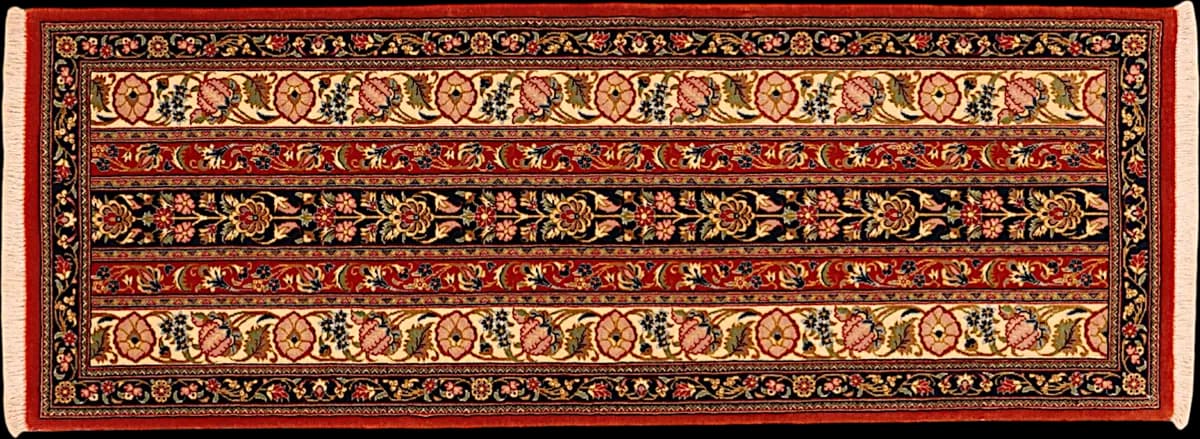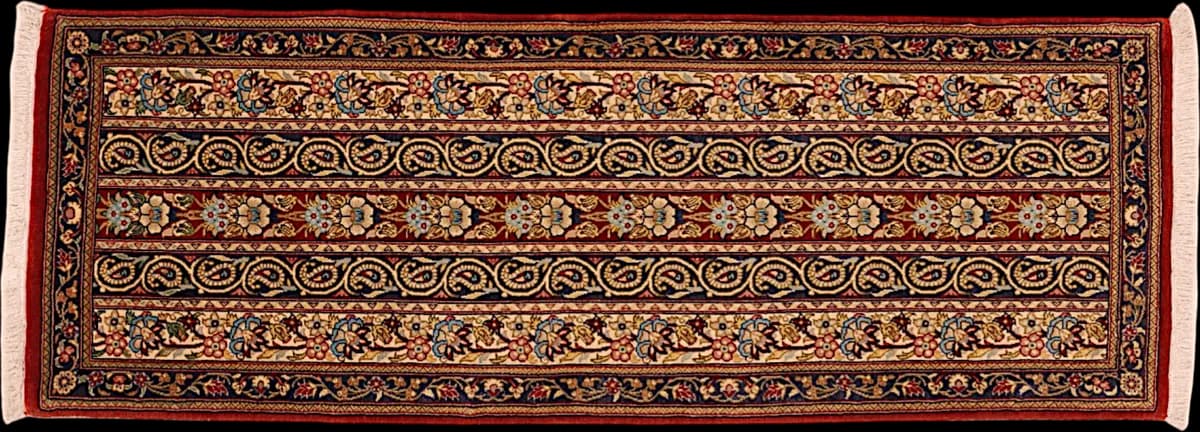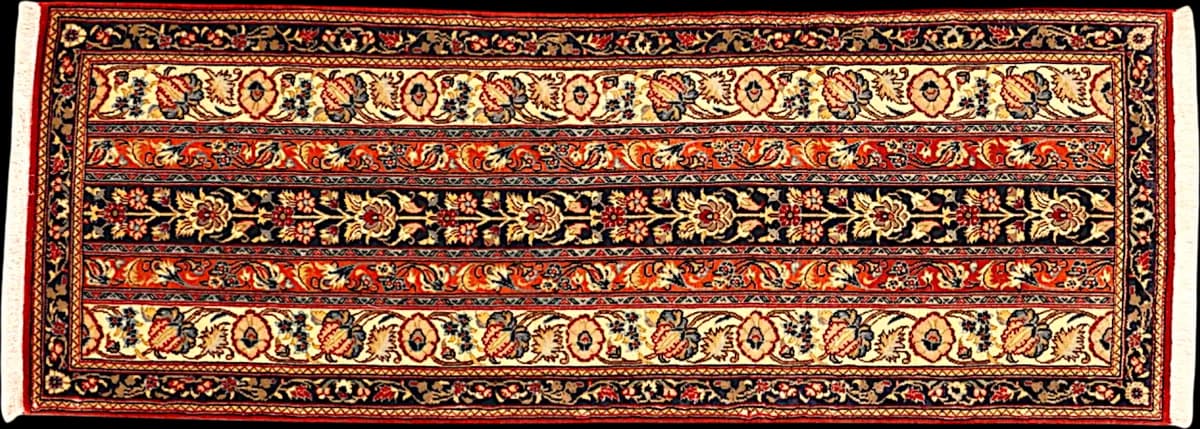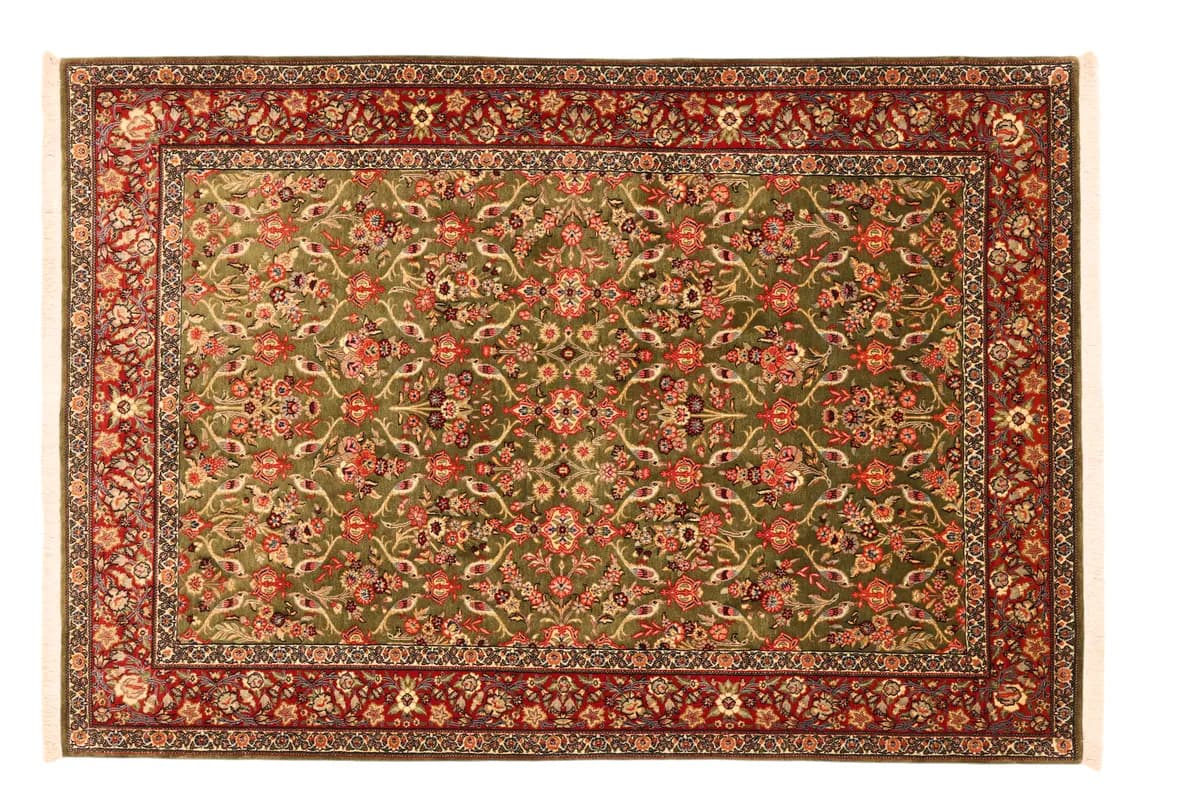
Silk or wool — what you actually have in front of you
Say Qom and people think silk. The city’s reputation rests on rugs of pure silk, where an extremely dense knotting allows detail at miniature scale and the surface changes lustre with the viewing angle. Those pieces are a price category of their own.
The same workshops also knot in wool on a cotton warp, and that line is the more common one in the trade. The draughtsmanship is identical — floral, small in scale, often pictorial — only in a material that may be walked on.
For a buyer this is the single most important distinction. A wool Qom costs a fraction, tolerates traffic and sun considerably better and needs no special handling. A silk Qom is a work of art to hang on a wall or lay in a quiet corner. The fringes tell you which you have: silk is thin, lustrous and cool; cotton is matt and soft.
Why the formats are so small
Qom rugs are strikingly small — many under two square metres. There are two reasons, and both come back to fineness.
The first is working time. At around half a million knots per square metre every additional square metre takes months. A large-format Qom is therefore a year-long project and correspondingly rare.
The second is effect. The drawing is so small in scale that it can no longer be read from five metres. A Qom unfolds from two metres away — and the small format is made for exactly that.
- Check the fringes — cotton matt and soft, silk thin, lustrous and cool.
- Around 490,000 knots — very fine for wool, far below a silk Qom.
- Short pile of around 10 mm for sharp contours.
- Floral, small-scale drawing, often with garden motifs.
- Small formats — for a corner, not for a room.
Which room a Qom suits
One to three square metres is the size for a place: in front of an armchair, beside a bed, in a study, in an entrance area with little traffic.
The wool Qom tolerates more than its silken namesake. Ten millimetres of pile on a cotton warp is a normal working construction — no reason to spare the rug.
In the middle of a large room a format under two square metres quickly looks lost. Anyone wanting to furnish floor area is better served by another type; a Qom is a detail, not a foundation.
Care
Vacuum along the pile, without a rotating brush. On a short-sheared pile there is no deep dirt for a brush to work loose.
Blot spills at once with clear water and a light cloth, never rub — on fine drawing a roughened patch stays visible.
A wool Qom needs no special treatment. Were it a silk piece the opposite would apply: do not beat, keep out of direct sun, deep-clean only through a specialist.
Qom or Isfahan?
Both are central Iranian manufacturing cities with fine floral drawing. The difference lies in construction and in scale.
| Criterion | Qom (wool) | Isfahan |
|---|---|---|
| Warp | cotton | silk |
| Pile | handspun wool | wool with silk content |
| Knot density | around 490,000 / m² | 640,000 – 1,000,000 / m² |
| Typical size | under 3 m² | 2.5 – 3.5 m² |
| Resilience | normal use possible | quiet position recommended |
Common questions
Is every Qom made of silk?
No. The city is famous for silk rugs, but the same workshops also knot in wool on a cotton warp. The wool line is more common in the trade, considerably cheaper and more robust. A glance at the fringes settles it: silk is thin, lustrous and cool, cotton matt and soft.
Qom or Ghom?
The same city. Ghom is the transliteration common in German, Qom the international one. Both describe the same origin.
Why are Qom rugs so small?
Because of the fineness. At around half a million knots per square metre each additional square metre costs months of work. Beyond that, the small-scale drawing works close up and loses its appeal at large format.
Is Qom an old weaving city?
No, a young one. Knotting began there only in the twentieth century, considerably later than in Tabriz, Kashan or Esfahan. Within a few decades it nonetheless reached the front rank — unusual in a tradition that otherwise counts in centuries.
Can I use a wool Qom in a hallway?
Yes. Ten millimetres of wool pile on a cotton warp is a normal working construction. Only with a silk piece would the hallway be the wrong place.