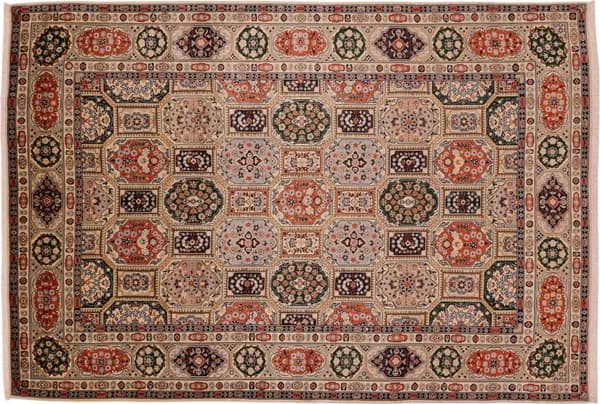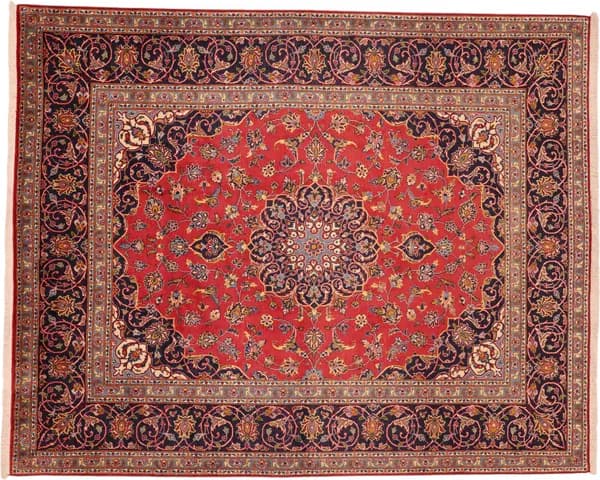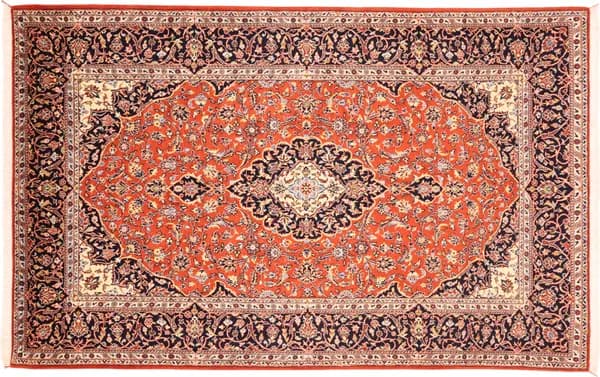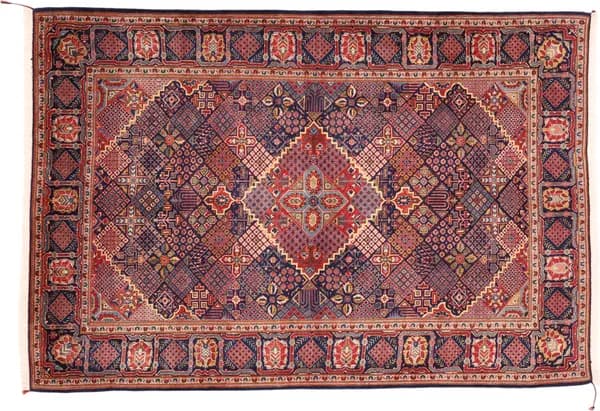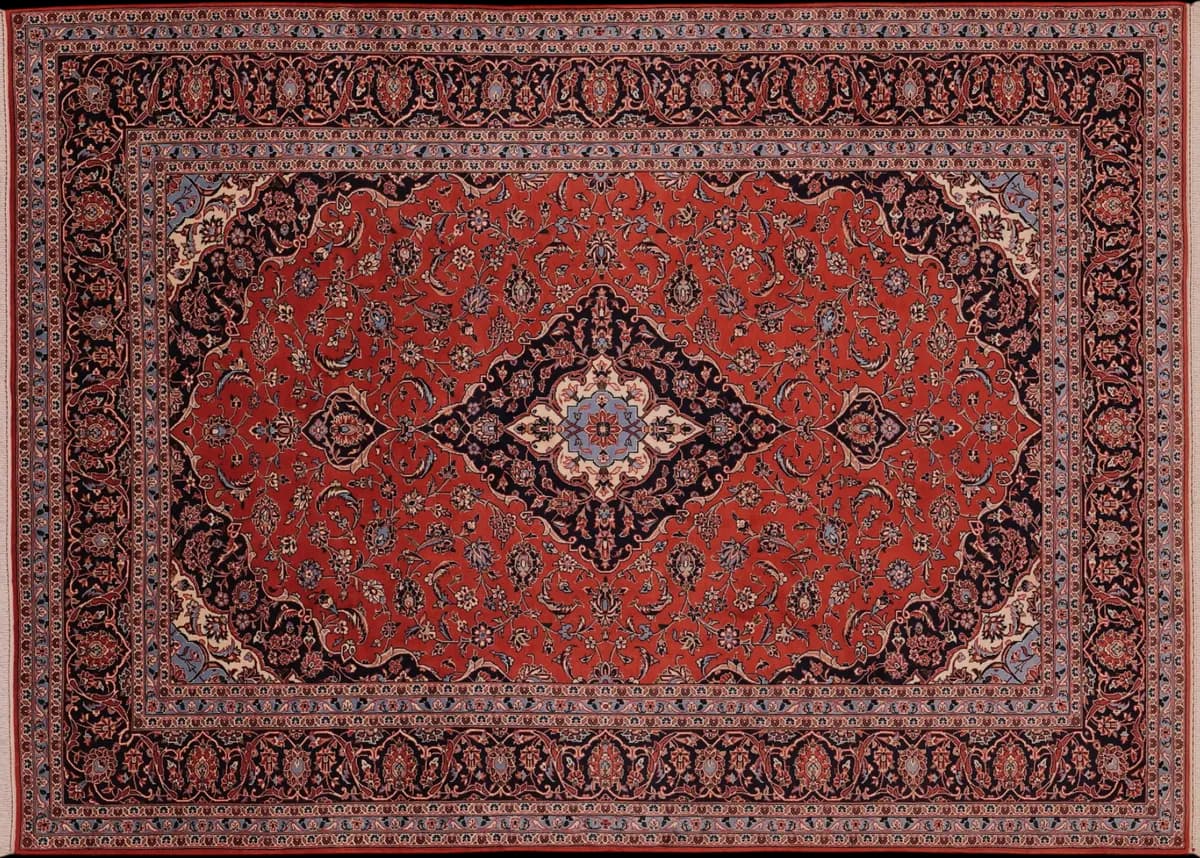
The classical composition
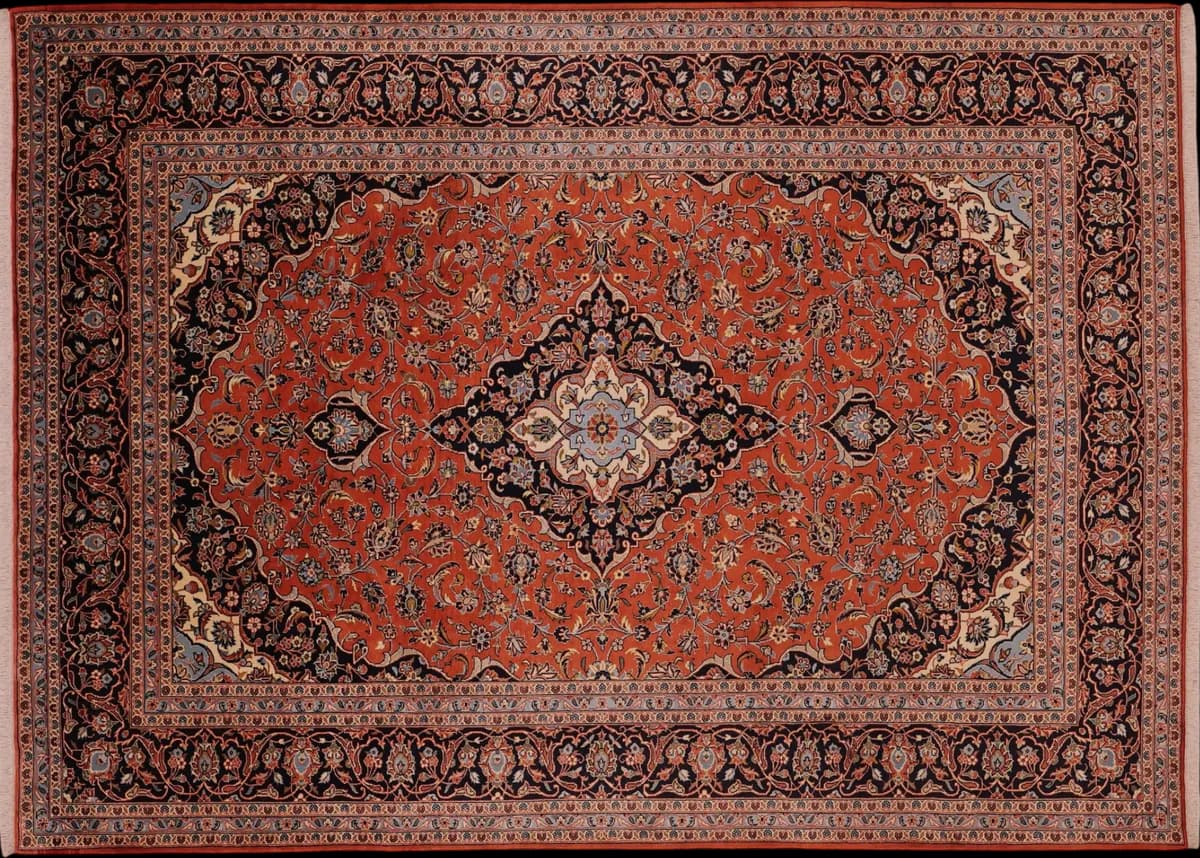
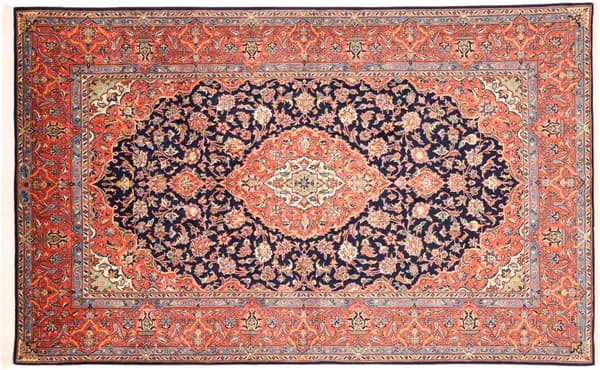
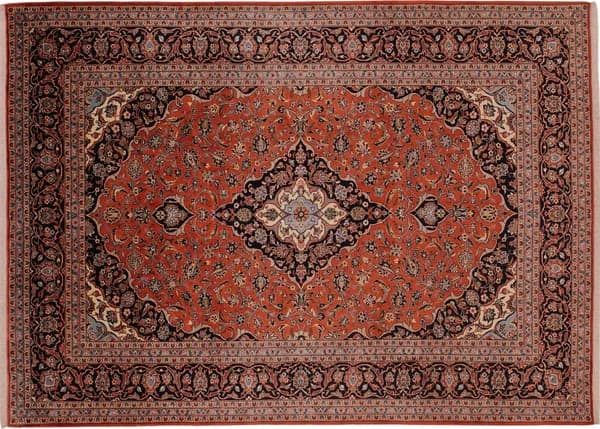
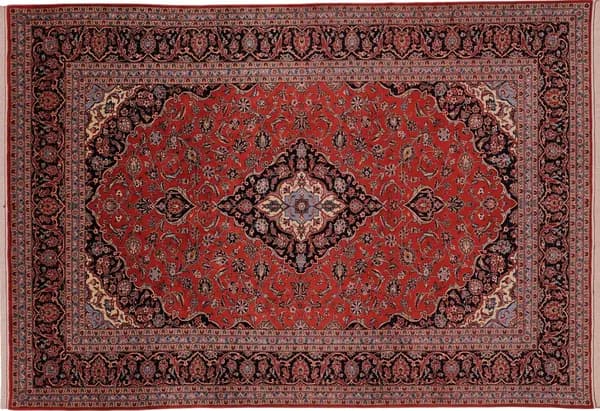
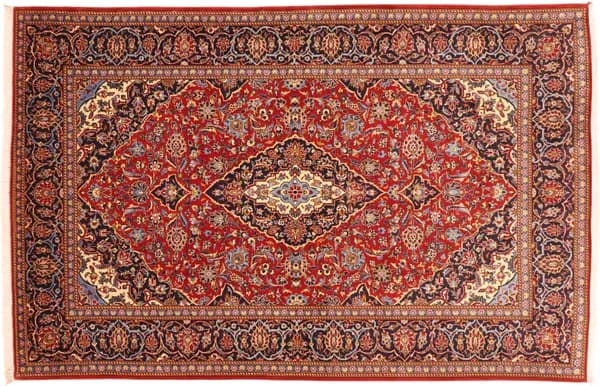
Almost every idea people have about what a Persian rug looks like comes from this layout: a medallion in the middle, four spandrels in the corners that repeat a quarter of its shape, and a wide border with narrow guard stripes on either side.
Kashan weaves it more consistently than anywhere else. The proportions are settled — the medallion takes a particular share of the field, the spandrels reach a particular distance inward — and a Kashan looks like a Kashan across centuries of production.
The composition has a consequence for the room. It has a centre, and the centre carries it. Covered by a sofa, a medallion rug loses more than an all-over field would; the arrangement stops working rather than simply being interrupted.
Colour and material
The Kashan palette is deep: madder red as the dominant ground, indigo for the drawing, ivory used sparingly as contrast rather than as a field. It is a warm, saturated scheme, quite unlike the pale restraint of Nain a hundred kilometres away.
At 321,000 to 380,000 knots per square metre the drawing is fine enough for curved floral work — palmettes, curling stems, cloud bands — without the extremes of the silk-warp cities.
Some Kashan pieces carry silk in the pile itself, placed in the lighter passages of the drawing where it catches light against the surrounding wool. Where present it is an accent rather than the body of the rug.
- Medallion, four spandrels, wide border with guard stripes.
- Deep madder red ground with indigo drawing.
- Curved floral vocabulary — palmettes, stems, cloud bands.
- Sometimes silk in the lighter passages of the pile.
- Cotton warp with smooth light fringes.
Which room a Kashan suits
The common size around 220 by 145 centimetres works in front of a sofa, in a study or a bedroom. Larger formats exist and take a full seating group.
Whatever the size, leave the middle visible. A medallion composition wants its centre seen — that is the difference between a Kashan and an all-over field, and it is the reason to buy one.
The dark, saturated palette suits rooms with wood, leather and low light. In a very pale, minimal interior it will dominate; that may be exactly what you want, but it is worth deciding on purpose.
Care
Vacuum along the pile, without a rotating brush — particularly where silk is present in the lighter passages.
Blot spills at once with clear water and a light cloth, working from the outside in. The deep ground hides marks better than a pale rug, which makes it easier to leave one to dry in; treat it anyway.
Keep it out of permanently direct sun. Madder red holds well but the contrast between ground and drawing is what the composition rests on, and that flattens as the ground fades.
Kashan or Sarough?
Both are dense central-Persian rugs with floral drawing. The difference is whether the composition has a centre.
| Criterion | Kashan | Sarough |
|---|---|---|
| Layout | medallion with spandrels | mostly all-over |
| Knot density | typically 321,000–380,000 / m² | typically 201,000–250,000 / m² |
| Palette | deep madder red, indigo | broader, often softer |
| With furniture on it | loses its centre | unaffected |
| Effect | formal, composed | even, surface-like |
Common questions
What are corner spandrels?
The quarter-shapes in the four corners of the field that repeat part of the central medallion. Together with the medallion and the border they form the classical Persian composition, and Kashan weaves it more consistently than any other origin.
Is there silk in a Kashan?
Sometimes, as an accent in the lighter passages of the pile rather than throughout. It catches light against the surrounding wool. A Kashan without silk is not a lesser piece — it is the more common form.
Can I put furniture on a Kashan?
You can, but a medallion composition depends on its centre being visible. If a sofa is going to cover half the rug, an all-over field such as a Sarough keeps working where a Kashan stops.
Why is Kashan darker than Nain?
Different traditions and different eras. Kashan is a classical centre working a deep madder-and-indigo palette; Nain began weaving in the twentieth century and built its reputation on light, restrained colour for lighter interiors.
How large do Kashan rugs come?
The common format is around 220 by 145 centimetres, which is a room-accent size. Larger pieces are woven and will carry a seating group, but the majority of what reaches the market sits in the smaller range.