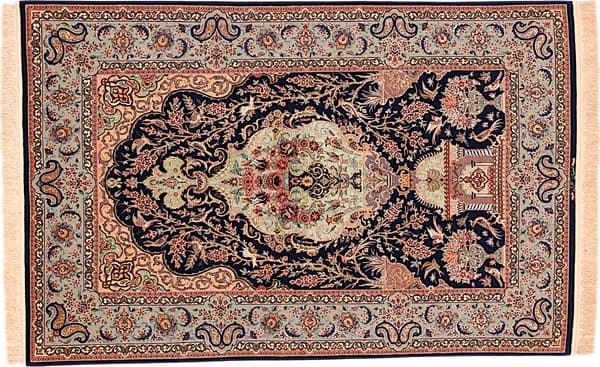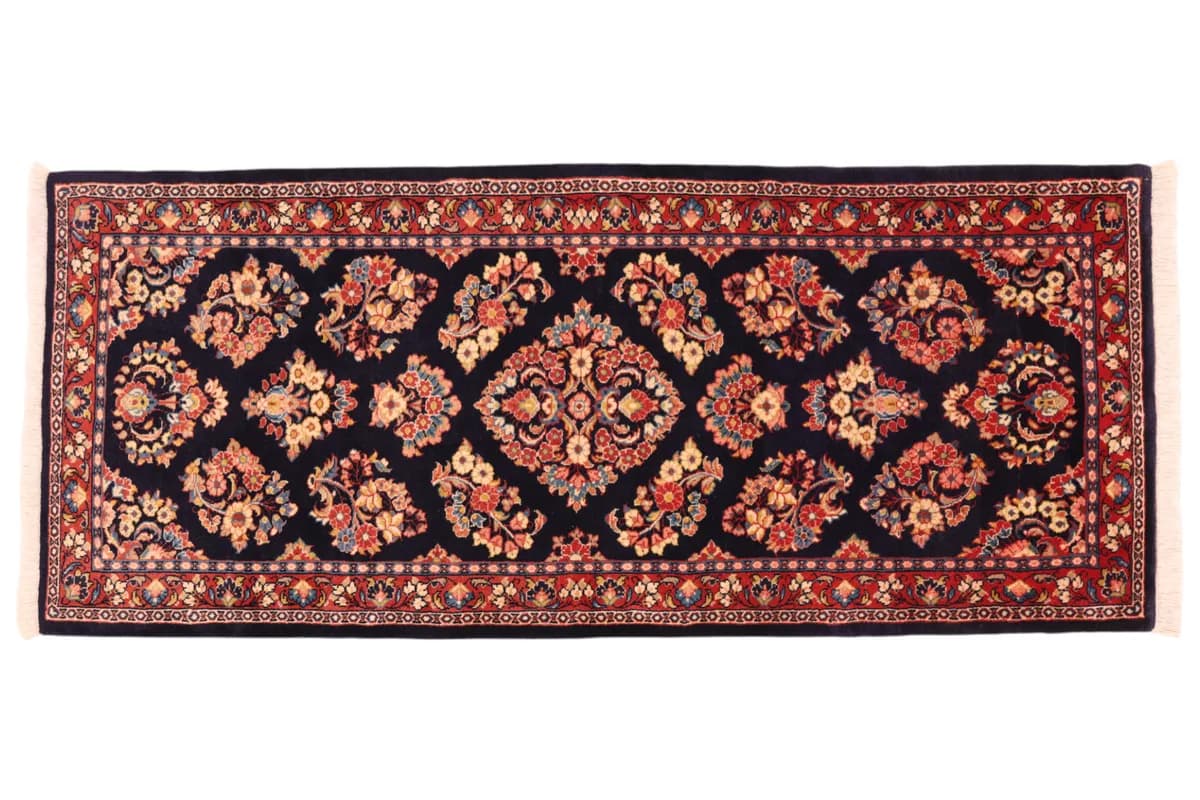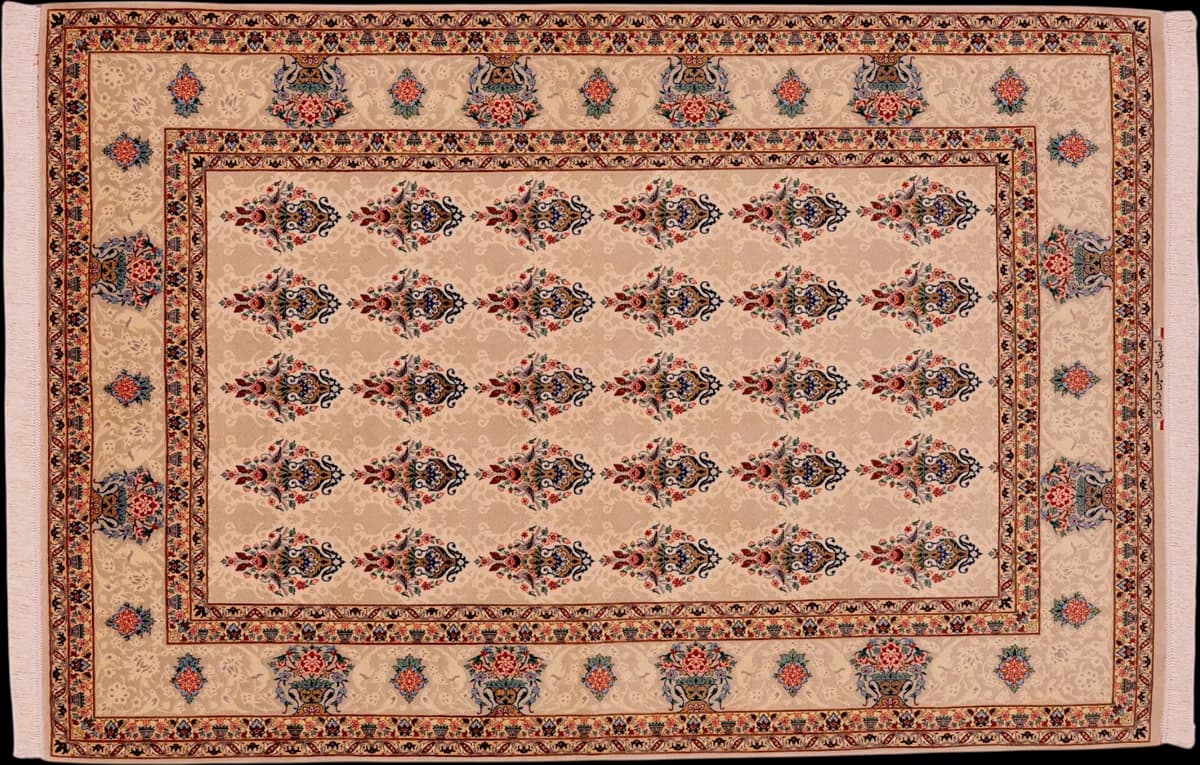
Why the silk warp makes the difference
The warp is the frame around which every knot is tied. Its thickness decides how many knots fit side by side — and silk can be spun considerably finer than cotton. A silk warp therefore accommodates rows of knots that simply could not be fitted onto cotton.
That is the technical reason for the fineness of an Isfahan. A million knots per square metre means a thousand rows in each direction, every knot tied by hand around two warp threads. A rug of three square metres carries some three million knots, and a weaver manages a few thousand on a good day. The arithmetic gives years, not months.
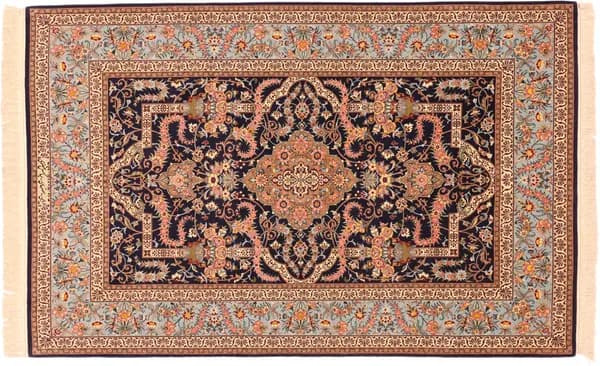
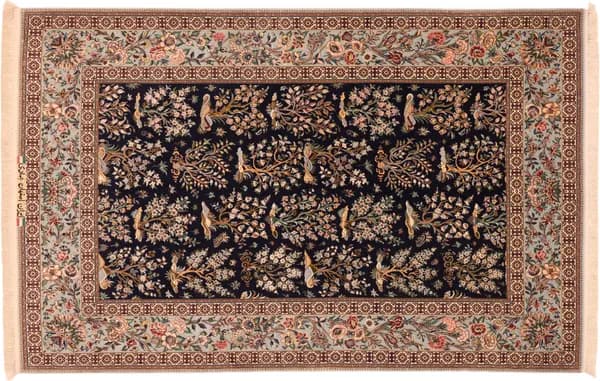
The silk in the pile is the second element. It is placed deliberately, usually in the lighter passages of the drawing, and it catches light differently from wool: the same area shifts between matt and lustrous depending on the angle. That is the effect by which an Isfahan is recognised from two metres away.
How to recognise a genuine Isfahan
The fringes first. Silk fringes are thinner, smoother and markedly more lustrous than cotton, and they feel cool. It is the fastest available check — and it cannot be faked, because the warp is the load-bearing structure of the rug and cannot be altered afterwards.
Then the back. At a density around a million knots the knot pattern is so fine it almost reads as a woven fabric; individual knots are hard to separate by eye. The design of the front appears on the back in full definition — a machine-made rug shows a backing fabric instead.
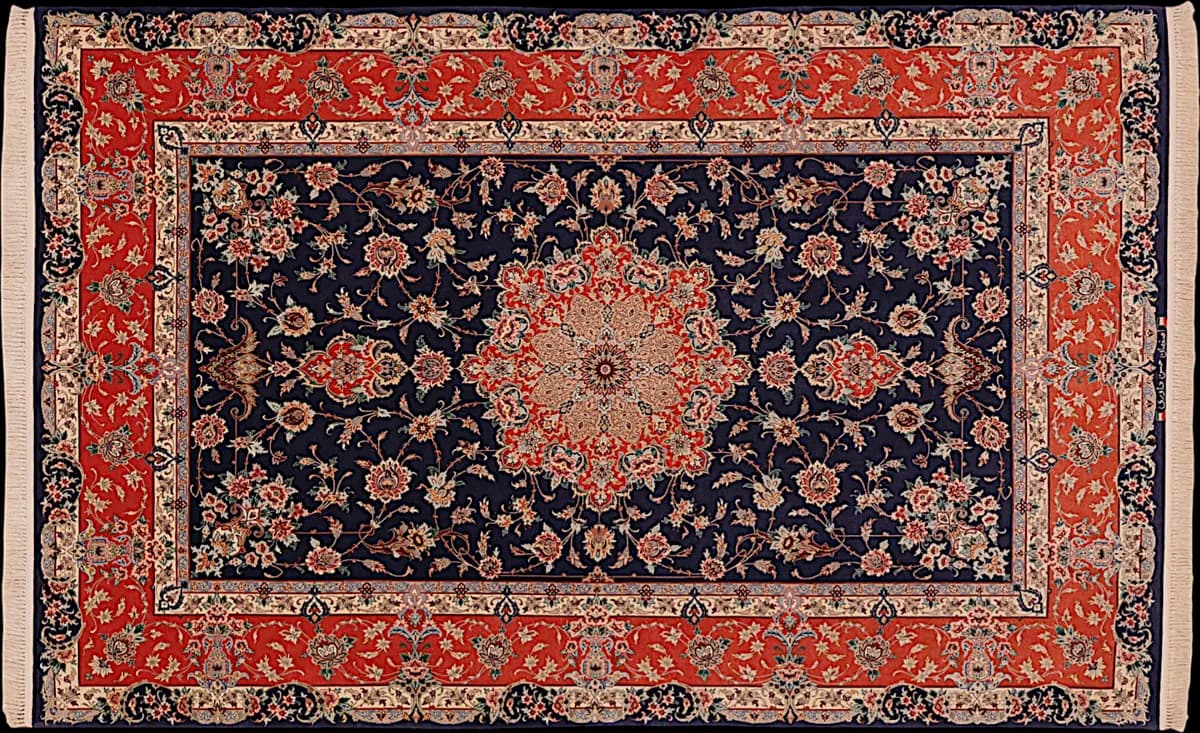
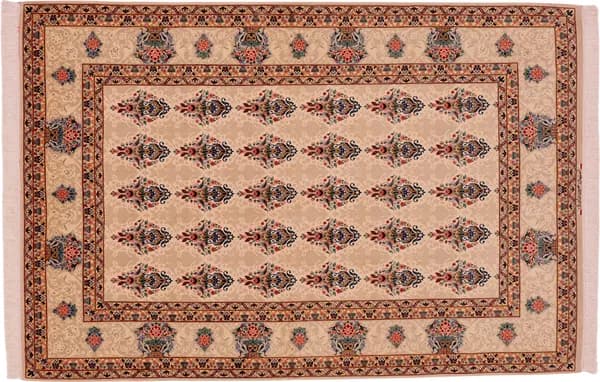
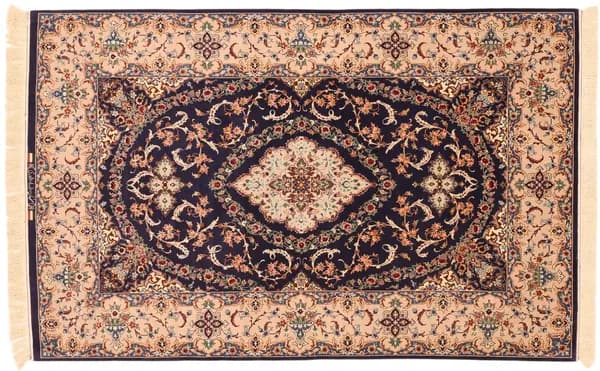
Finally the symmetry. An Isfahan is knotted to a drawn cartoon. The two halves of a border match exactly, the medallion sits centred, the four corner spandrels are identically built. A composition that has slipped off centre means a village piece, not an Isfahan manufactory.
- Silk fringes — thin, lustrous, cool to the touch — not matt cotton.
- Back with barely separable knots and the pattern fully drawn through.
- Exact symmetry in border, medallion and corner spandrels.
- Short pile of around 6 mm, smooth cool surface.
- Shifting lustre wherever silk lies in the pile.
Which room an Isfahan suits
Formats around three square metres and the fine construction settle the question: an Isfahan belongs where it is seen and little walked on — in front of a sofa, in a study, in a reception area, on a wall.
A pile containing silk does not take constant traffic the way a dense wool rug does. Nor is it built to: the fineness that defines it is exactly what suffers under heavy footfall. For a child’s room or a hallway, choose a more robust type.
Conversely it only works close up. The drawing is so small in scale that it cannot be read from five metres. As a single piece on open floor in a large room an Isfahan quickly looks lost; in a seating corner where it is seen from two metres, it is in the right place.
Care
Vacuum without a rotating brush and along the pile. On a silk-containing pile that is not advice but a requirement: a brush pulls the fine silk fibres out of the surface.
Do not beat it. What does a dense wool rug no harm loosens the knots of a fine construction. And keep it out of permanently direct sun — silk fades faster than wool.
Blot spills at once with a light cloth, never rub. For a deep clean a silk-containing rug belongs in expert hands; household rug cleaners are made for wool and can dull silk.
Isfahan or Nain?
Both are central Iranian manufacturing cities, both work with silk and to a drawn cartoon. The differences lie in the colour key and in the warp.
| Criterion | Isfahan | Nain |
|---|---|---|
| Warp | silk | mostly cotton |
| Knot density | 640,000 – 1,000,000 / m² | typically 441,000–500,000 / m² |
| Colour key | warm, often ivory and red | cool, cream and blue |
| Use of silk | in the pile of the light passages | as the contour thread of the drawing |
| Character | dense ornamental fullness | clear, quiet drawing |
Common questions
Is an Isfahan a pure silk rug?
As a rule, no. The warp is silk and the pile is wool with a deliberate silk content in the lighter passages. Pure silk rugs exist but are a separate and considerably more expensive category. A wool pile with silk accents is the classic Isfahan construction.
Why is an Isfahan so much more expensive than a village rug of the same size?
Because the working time is many times higher. At a million knots per square metre against a hundred and fifty thousand, the same area takes six to seven times as long — and the silk warp is the more expensive material on top of that.
How do I recognise the silk warp?
By the fringes. Silk is thinner, smoother, more lustrous and feels cool; cotton is matt and softer. Since the warp is the load-bearing structure and cannot be exchanged afterwards, this is a reliable mark.
Can I use an Isfahan in a living room?
Yes, provided it does not lie in the main traffic route. A silk-containing pile tolerates constant footfall less well than a dense wool rug. In front of a sofa or in a seating corner it is right; in a hallway it is not.
Why are Isfahan rugs usually small?
Because the fineness limits the area. One square metre at a million knots is months of work; at eight square metres it would be years for a single piece. Beyond that, the small-scale drawing works close up and loses its appeal at large format.