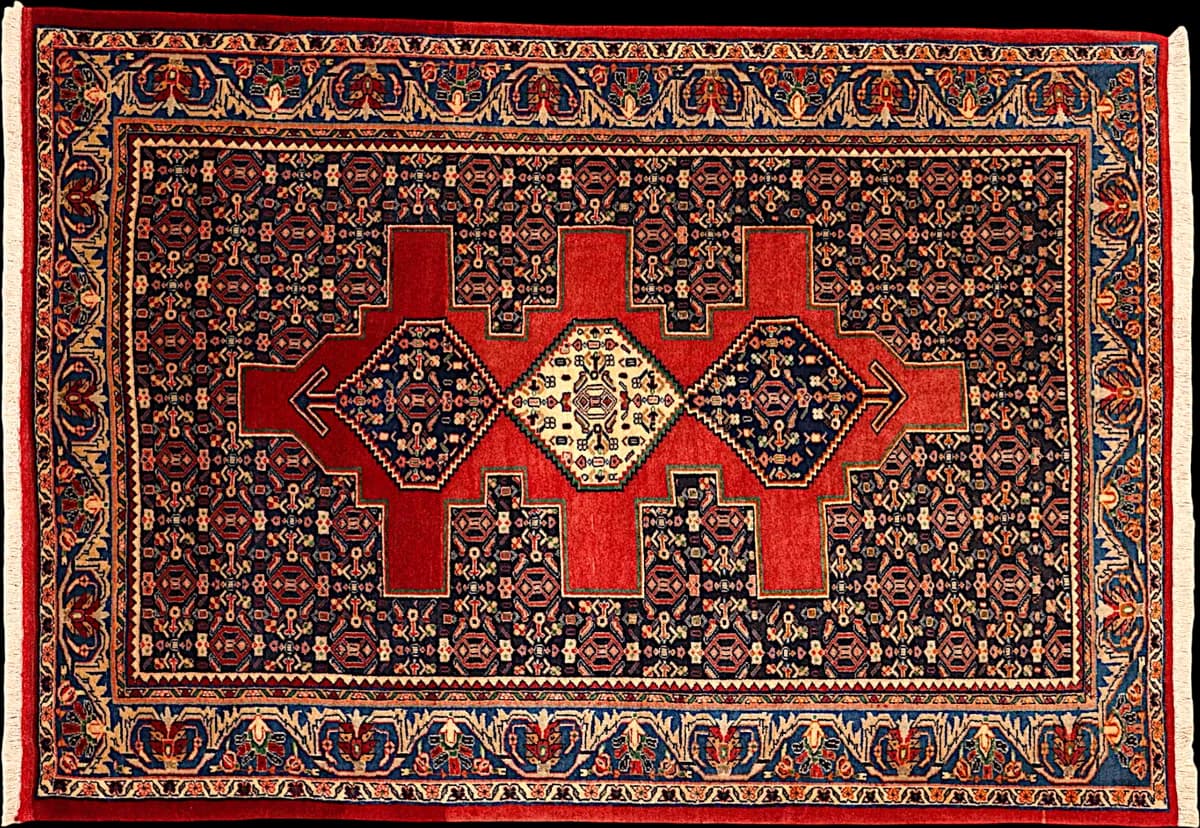
Senneh
151 × 128 cm
975 €
975 €
Incl. VAT
In Stock · Ready to Ship
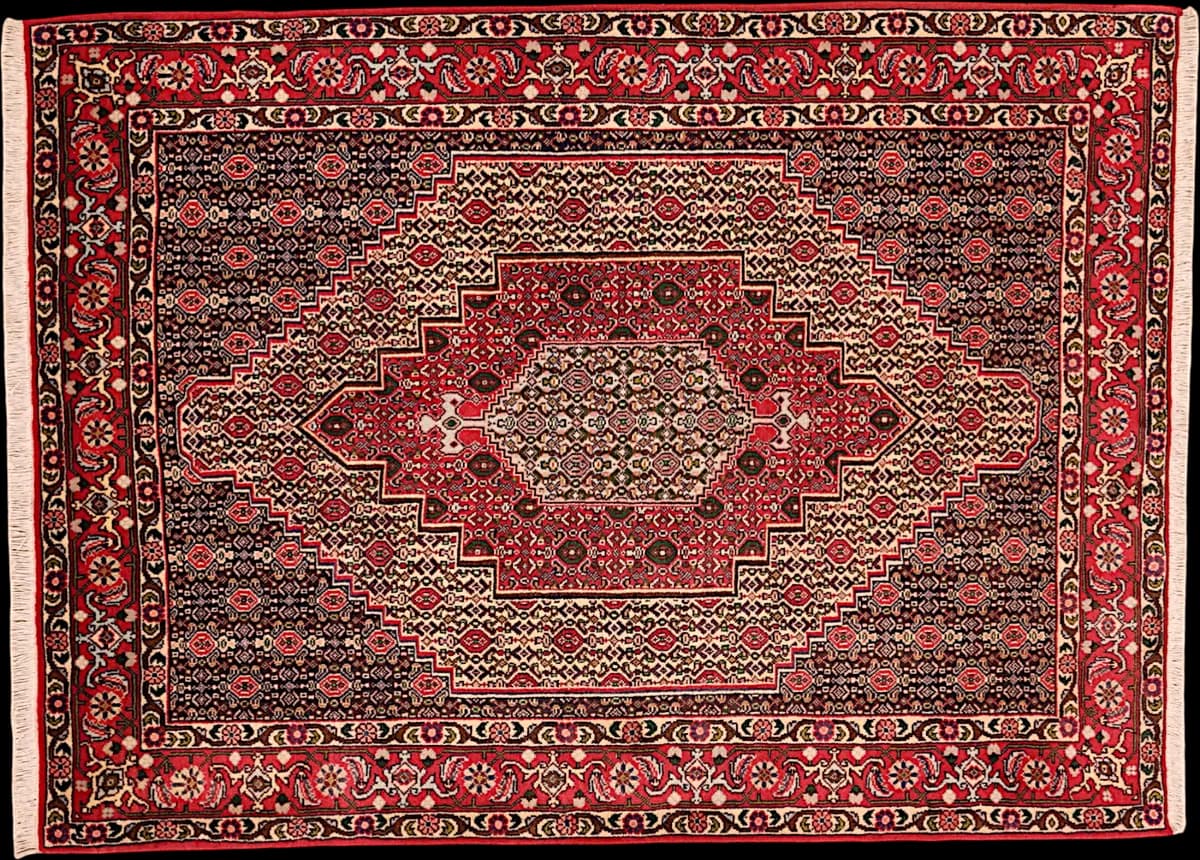
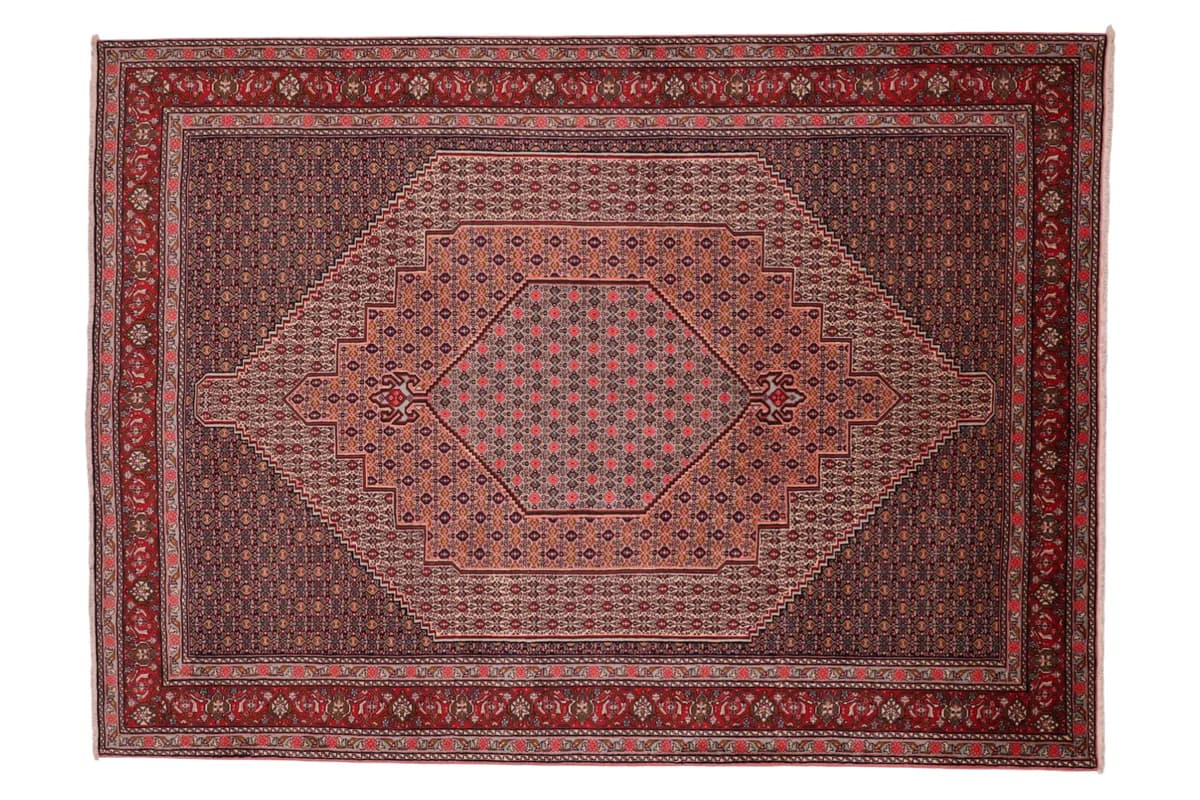
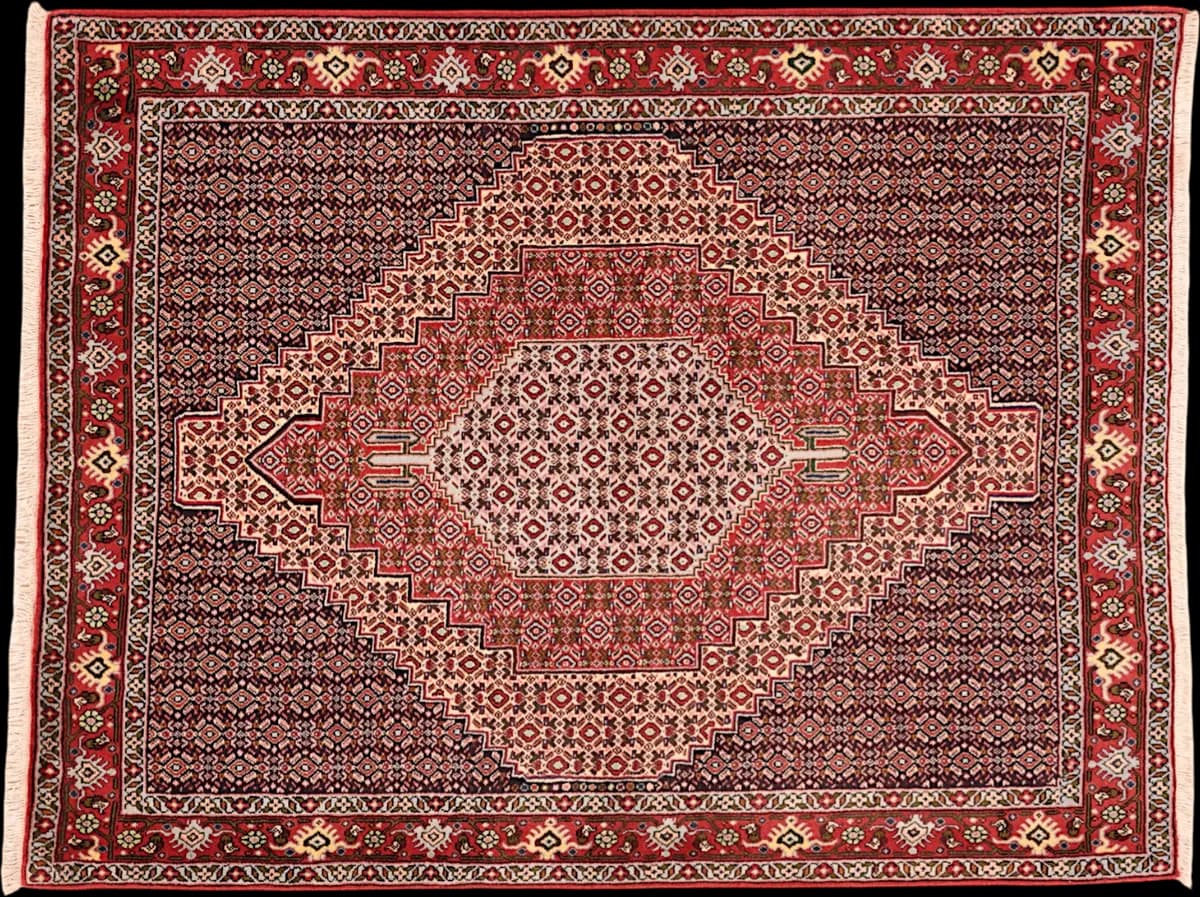
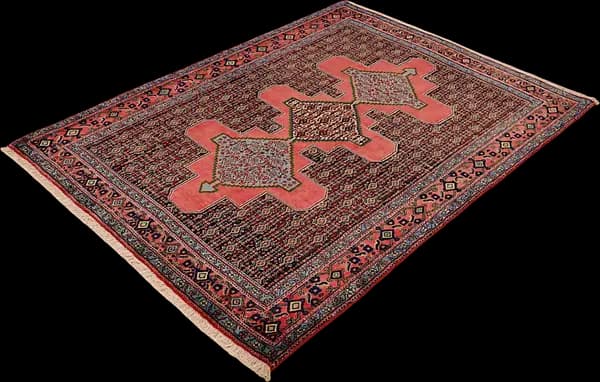
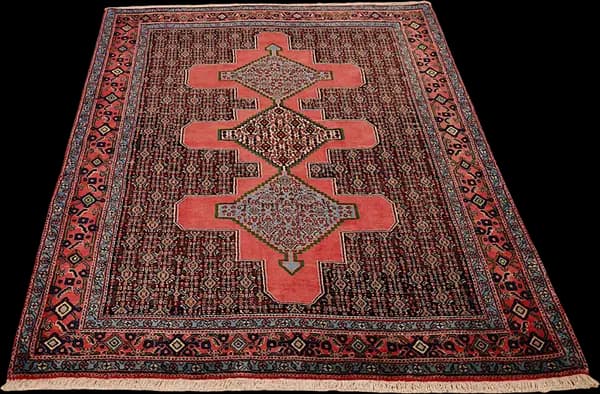
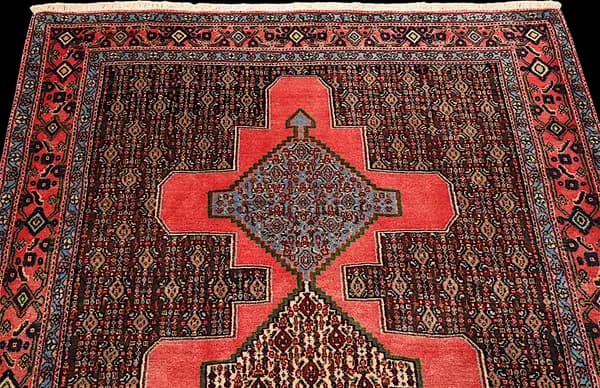
This is a Sanandaj, a city-woven rug from the Kurdish capital of Iran's Kurdistan province, 161 x 121 cm (5'3" x 4'0"). Also written Senneh, Sanandaj weaving has been recognised on the antique market since the early nineteenth century for a refinement unusual among Kurdish work: drawn cartoons, closely clipped pile, and a precision more often associated with Persian court workshops than with tribal looms.
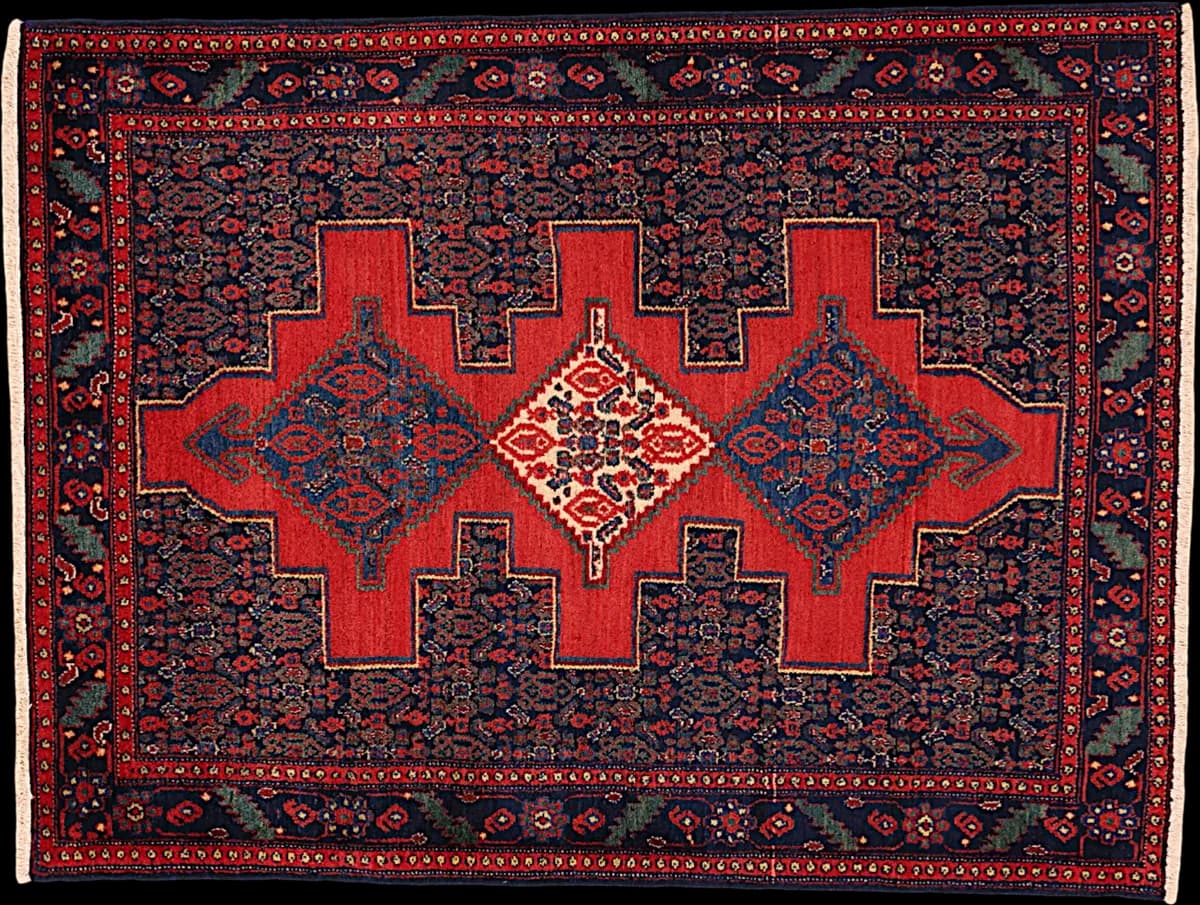
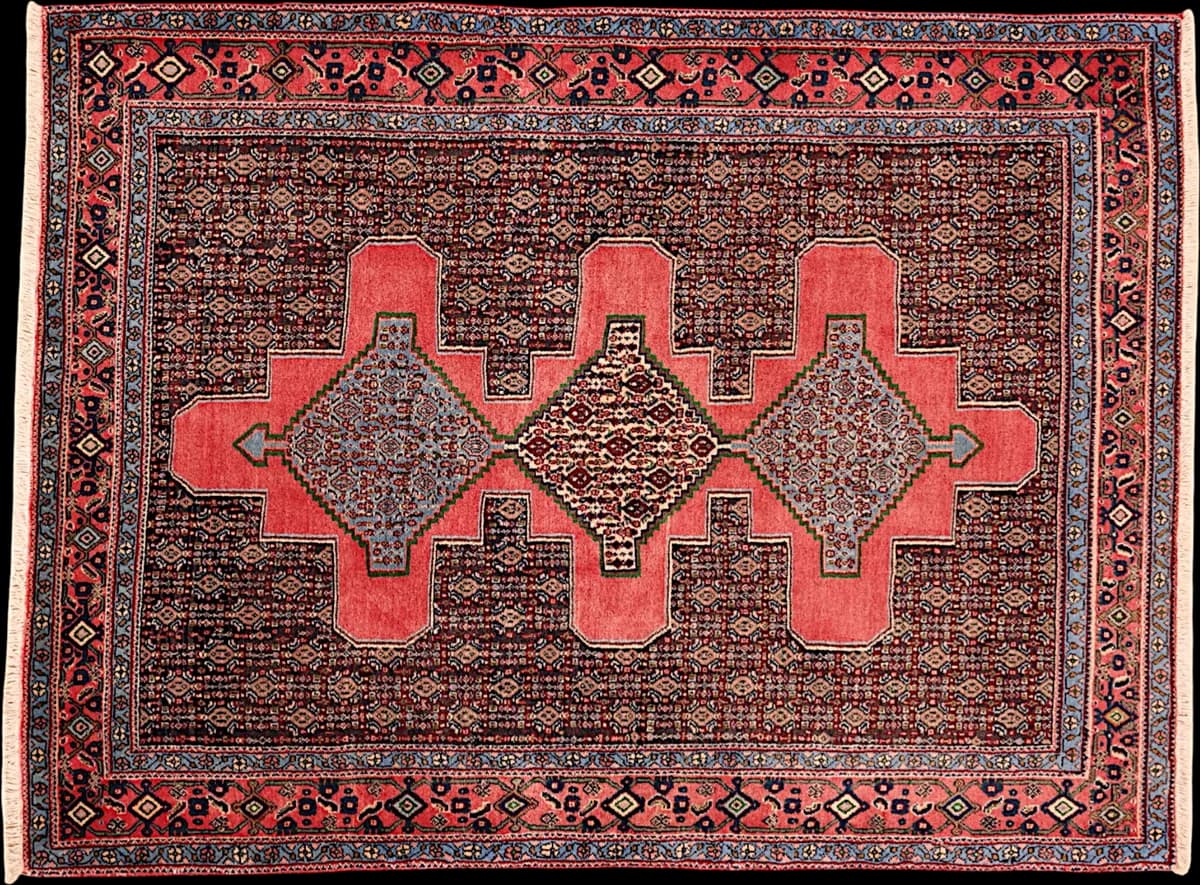
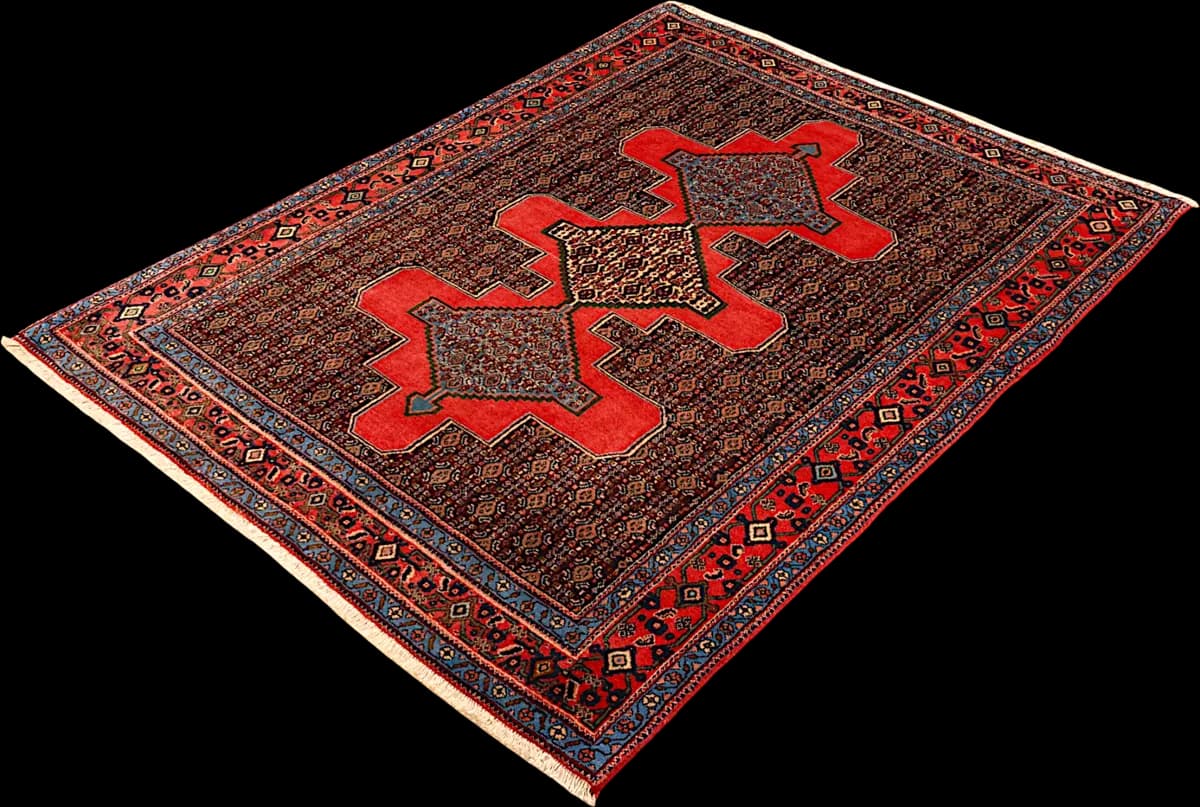
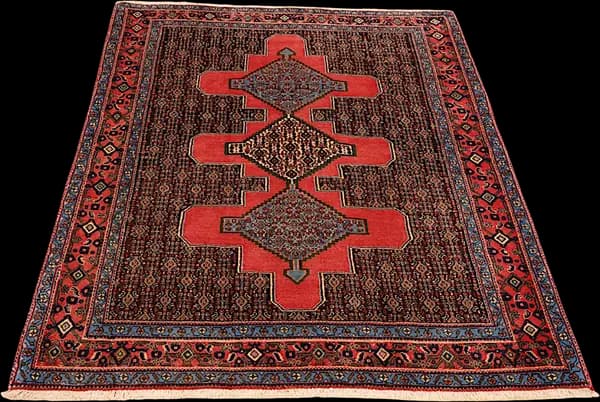
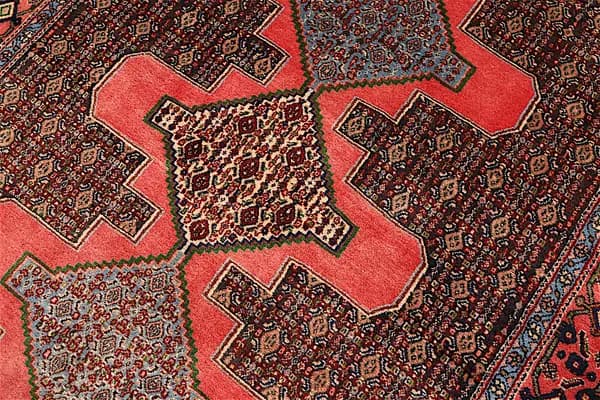
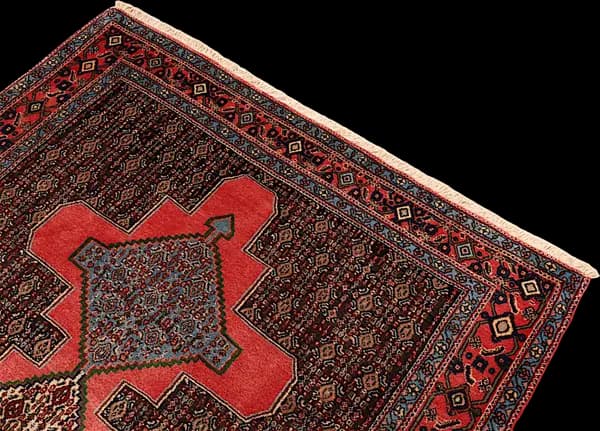
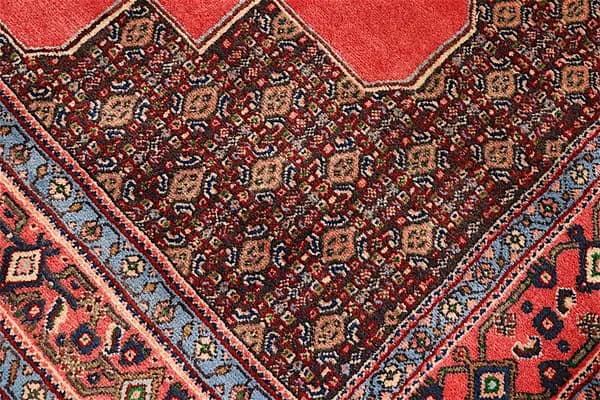
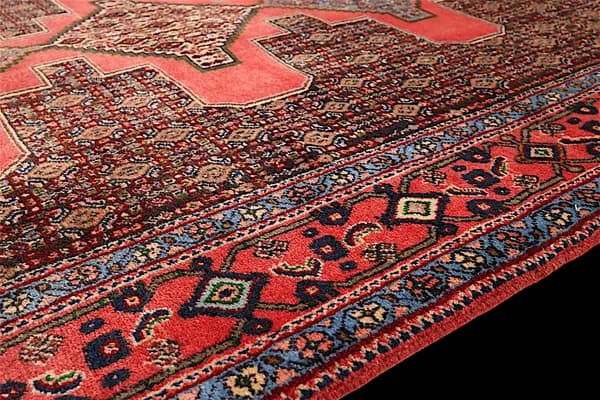
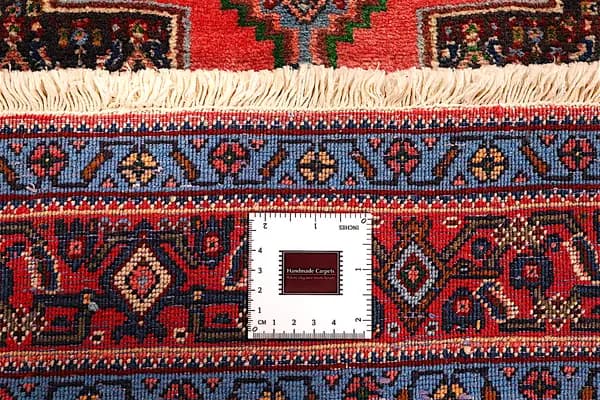
The field is a deep brown moving toward aubergine, dense with a small-scale Mahi lattice that reads almost black from across a room. Set in a horizontal row across it are three cruciform medallions in coral red, the classic Sanandaj centre repeated sideways into something closer to a sequence. Look again and they are not identical: the two outer medallions carry a blue-grey diamond fill, the middle one ivory instead. A wide, paler border of stepped diamonds in cream, navy and camel frames the field, closed by a narrow band of pale blue.
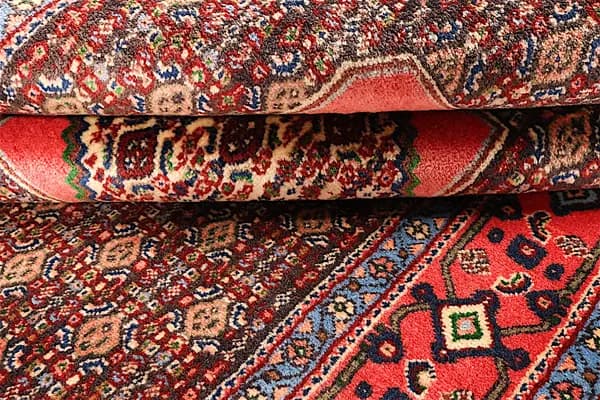
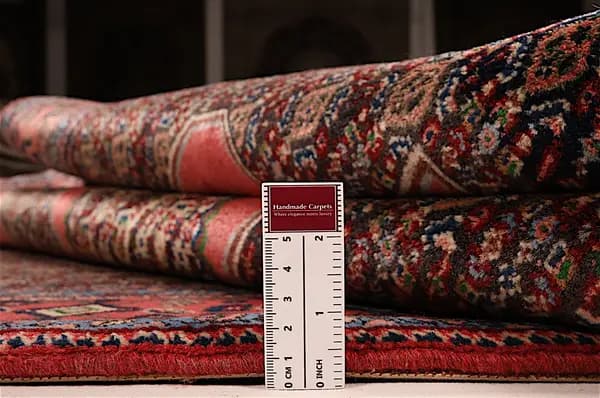
Sanandaj weavers work from a drawn cartoon rather than from memory, and that is what allows a variation like this to be deliberate rather than accidental — the sequence was planned on paper before it was ever knotted. The pile is hand-spun wool on a cotton warp, clipped low and even at 12mm, knotted at 251,000 to 320,000 knots per square metre. That density is what keeps the small lattice legible up close and gives the coral medallions their clean, sharp edge against the dark ground.
At this size, the rug suits a hallway, a study, or the floor beside a favourite chair rather than a room crossed underfoot in numbers. The dark field warms a pale floor and holds its own against dark wood, while the coral medallions catch the eye from a doorway before anything else in the room does. The pile is dense and firm, built for daily use rather than careful protection. Live with it for a while and it is the ivory medallion, quietly breaking the pattern of its neighbours, that you find yourself looking for first.
More on Senneh rugs: origin, making and how to recognise a genuine piece
Fine quality weave
At 161 × 121 cm (1.95 m²) this is a small rug. It works beside a bed, in a reading corner, in front of a fireplace or as a mat by a door. It does not furnish a room; it makes a point in one.
Yes, knotted by hand — knot by knot on a loom, not machine-made. The density is 251,000 to 320,000 knots per square metre; across 1.95 m² that is roughly 490,000 to 620,000 individual knots, every one of them tied by hand.
Hand-spun wool still carries its own lanolin, which keeps liquid sitting on the surface for a moment: blot quickly, with clear water and a light cloth, working inwards and without rubbing. Otherwise regular vacuuming along the pile is enough. Turn the rug once or twice a year so light and footfall reach it evenly.
We are in the Hamburg Speicherstadt. Come and see this rug in daylight, or write to us — a person answers.
Certificate included verifying origin, materials, and craftsmanship.
Ref: 196891