Senneh
197 × 136 cm
1.327 €





990 €
Incl. VAT
In Stock · Ready to Ship
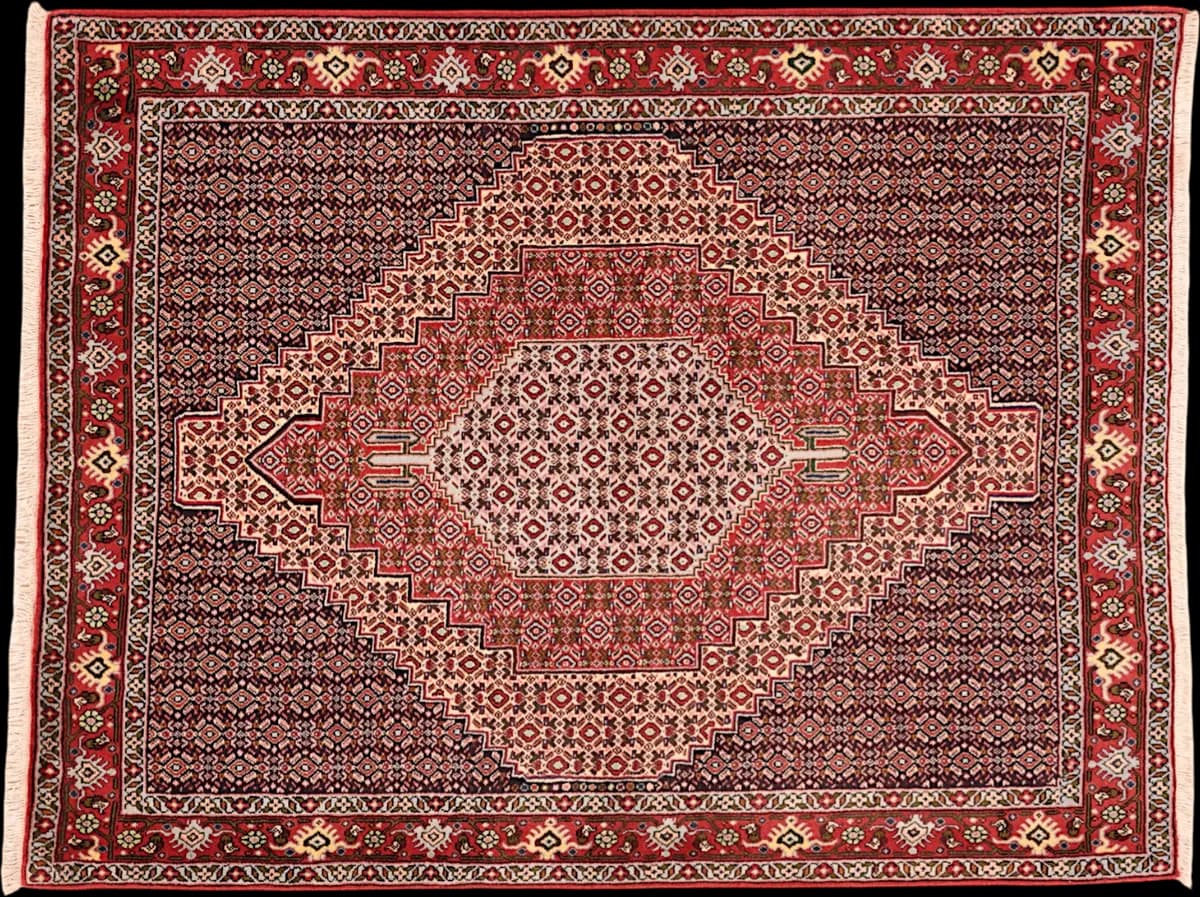
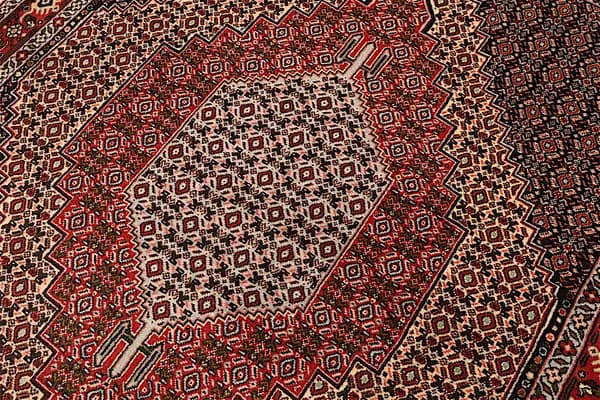
A Sanandaj, also written Senneh, 156 x 121 cm (5'1" x 4'0"), from the Kurdish city of that name in Iran's Kurdistan province, long regarded as the source of the finest Kurdish city weaving. These are workshop pieces, drawn to a plan rather than knotted from memory, prized for a close-clipped pile and a precision uncommon in Kurdish work generally. This piece takes that refinement and, unusually, makes it bold.
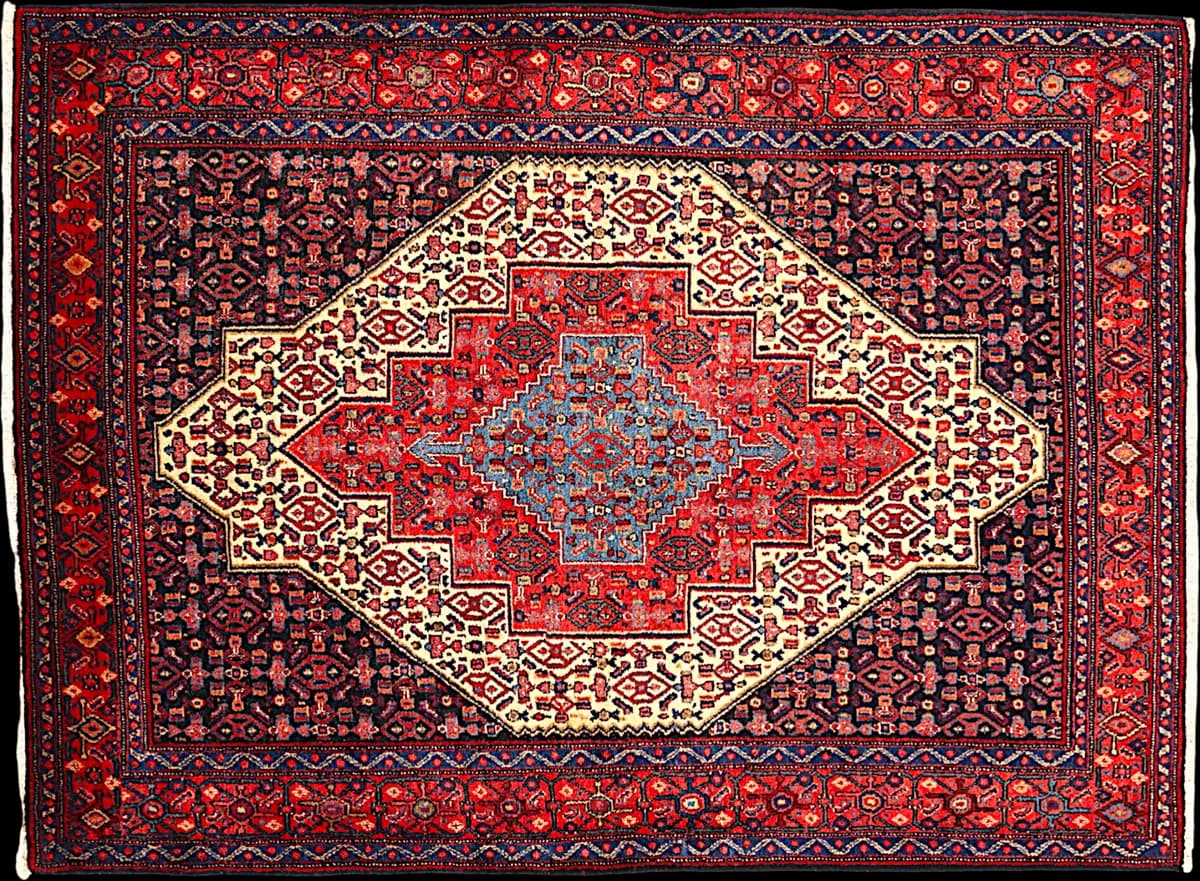
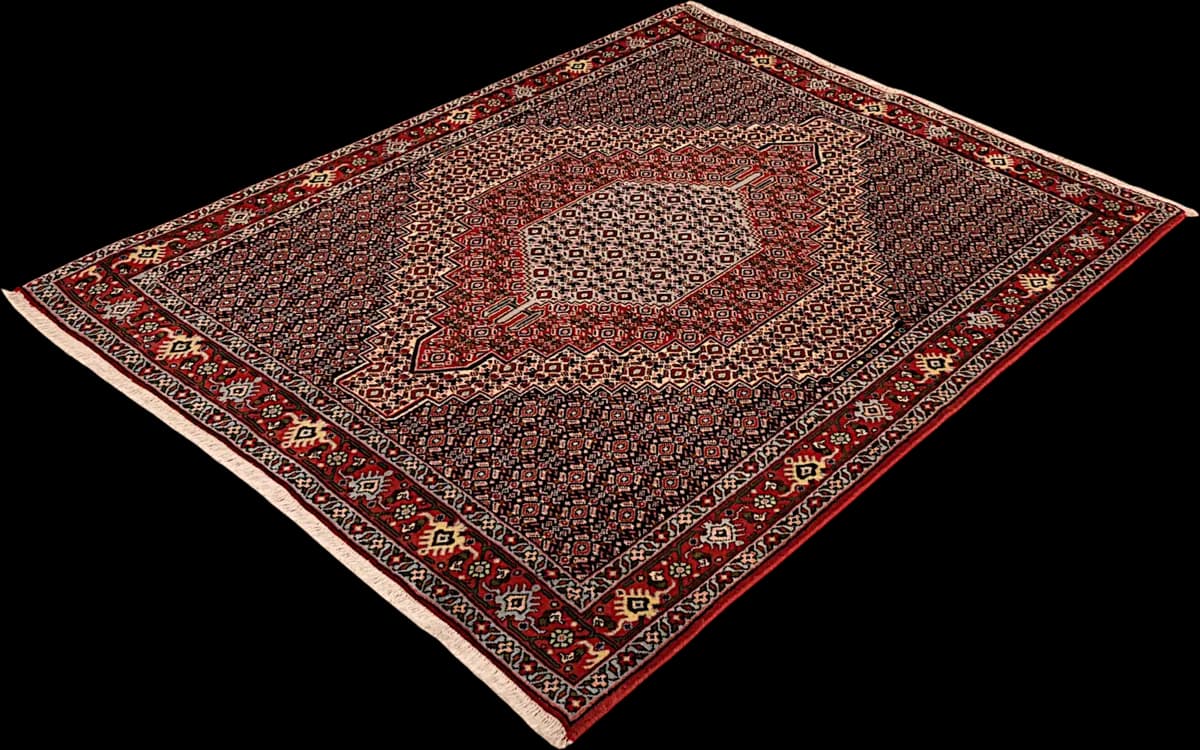
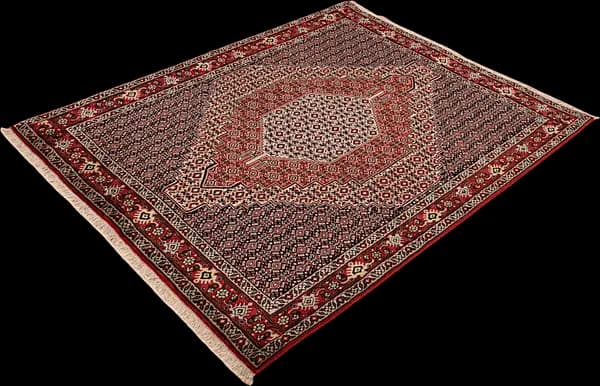
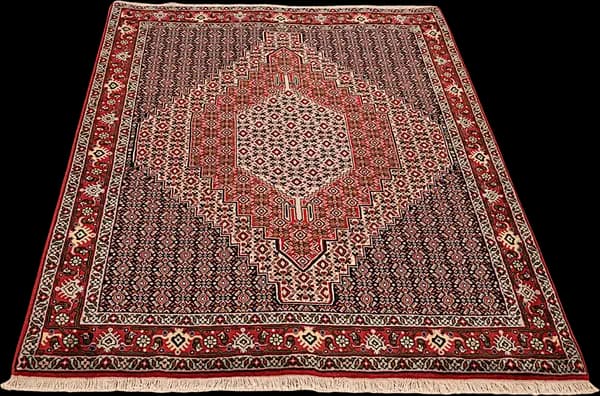
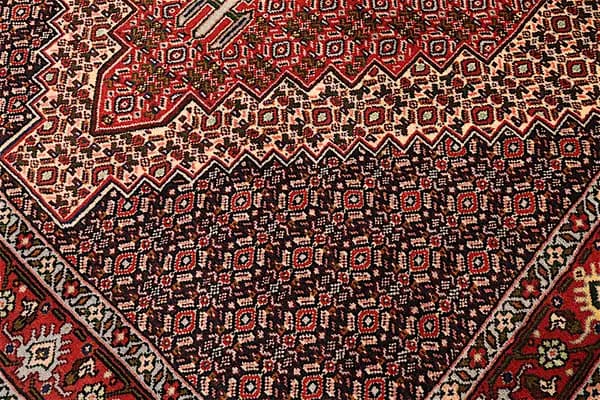
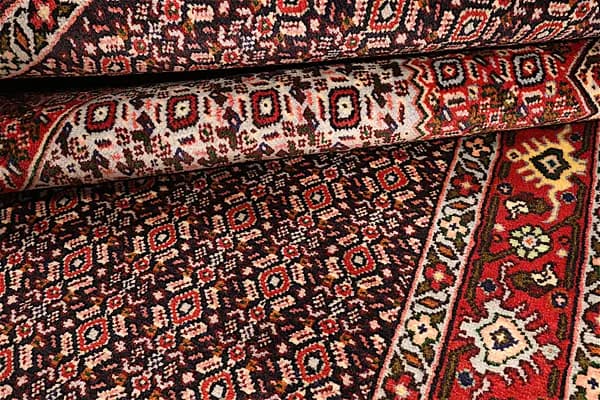
The eye lands first on a large ivory stepped-diamond medallion, its edges sharp against a dark navy field packed with a fine Mahi diamond lattice. A brick red band runs through the medallion's centre, and the outline repeats in layered concentric steps outward. At the points where the medallion meets the field sit small devices in blue and red stripes, set into the pattern like little pennants. The red main border carries small geometric and floral motifs at a width that holds its own against the field, framed by narrow pale blue-grey guard stripes with touches of mustard gold in the corner rosettes. Most Sanandaj medallions sit quietly within the density of the field; this one is drawn large enough, and pale enough, to dominate it.
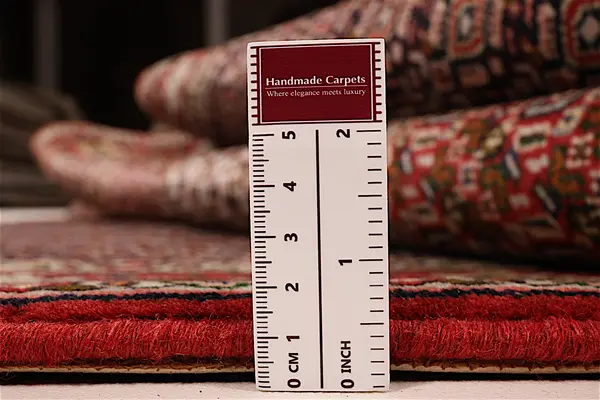
That contrast is a matter of drawing as much as colour, but the surface that carries it is built from a cotton warp and a hand-spun wool pile knotted by hand at 201,000 to 250,000 knots per square metre, then clipped to a low 12 mm. At this density the outline of a large medallion stays crisp rather than softening into the field around it, which is exactly what lets the ivory read as clearly as it does against the navy. Twenty to forty years of use have not blurred that edge.
A rug this size is not asking to anchor a living room; it is made for a study, a reading corner, or the floor beside a bed, somewhere it can be seen in full rather than half-covered by furniture. Against pale floorboards the navy grounds the room, and against darker wood the ivory medallion still lifts clear. Underfoot the pile is dense, low and firm, built for a chair pulled up to it rather than bare feet only. As light crosses the room through the day, the tight weave takes a slight sheen, and the ivory medallion is the part that catches it first.
More on Senneh rugs: origin, making and how to recognise a genuine piece
Fine quality weave
At 156 × 121 cm (1.89 m²) this is a small rug. It works beside a bed, in a reading corner, in front of a fireplace or as a mat by a door. It does not furnish a room; it makes a point in one.
Yes, knotted by hand — knot by knot on a loom, not machine-made. The density is 201,000 to 250,000 knots per square metre; across 1.89 m² that is roughly 380,000 to 470,000 individual knots, every one of them tied by hand.
Hand-spun wool still carries its own lanolin, which keeps liquid sitting on the surface for a moment: blot quickly, with clear water and a light cloth, working inwards and without rubbing. Otherwise regular vacuuming along the pile is enough. Turn the rug once or twice a year so light and footfall reach it evenly.
We are in the Hamburg Speicherstadt. Come and see this rug in daylight, or write to us — a person answers.
Certificate included verifying origin, materials, and craftsmanship.
Ref: 642776