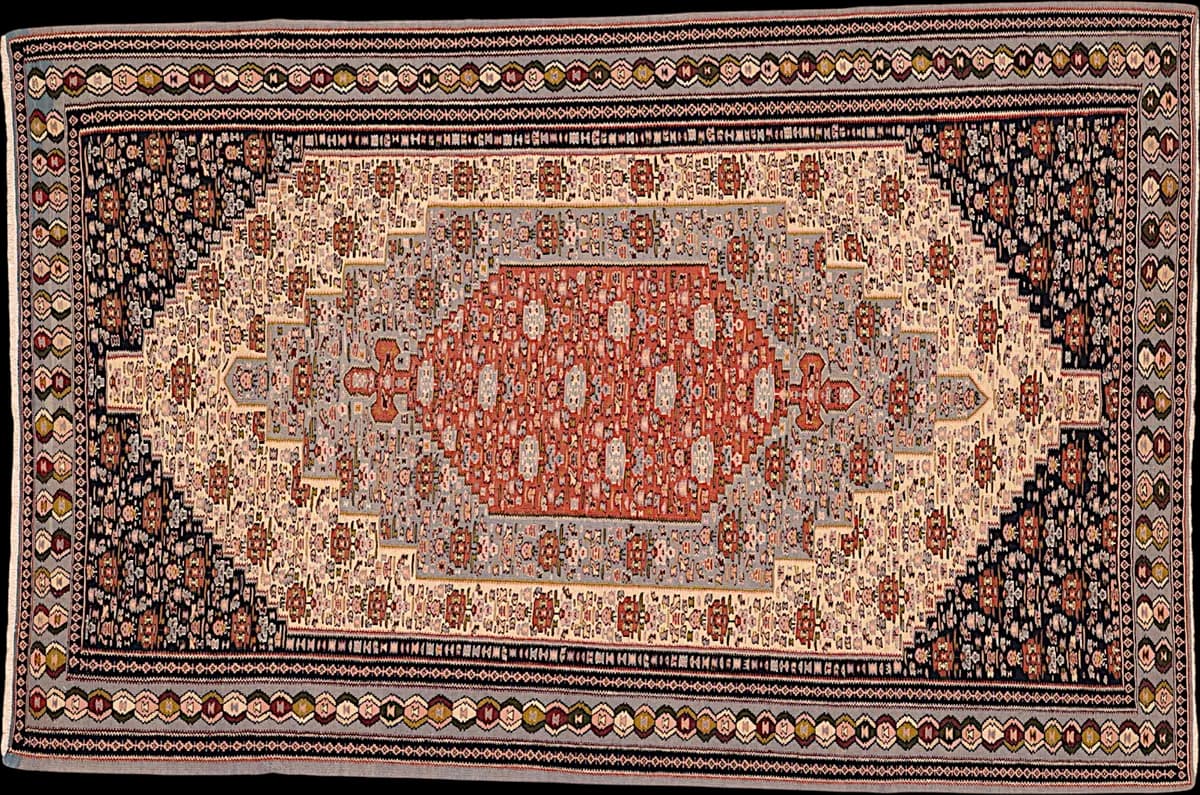
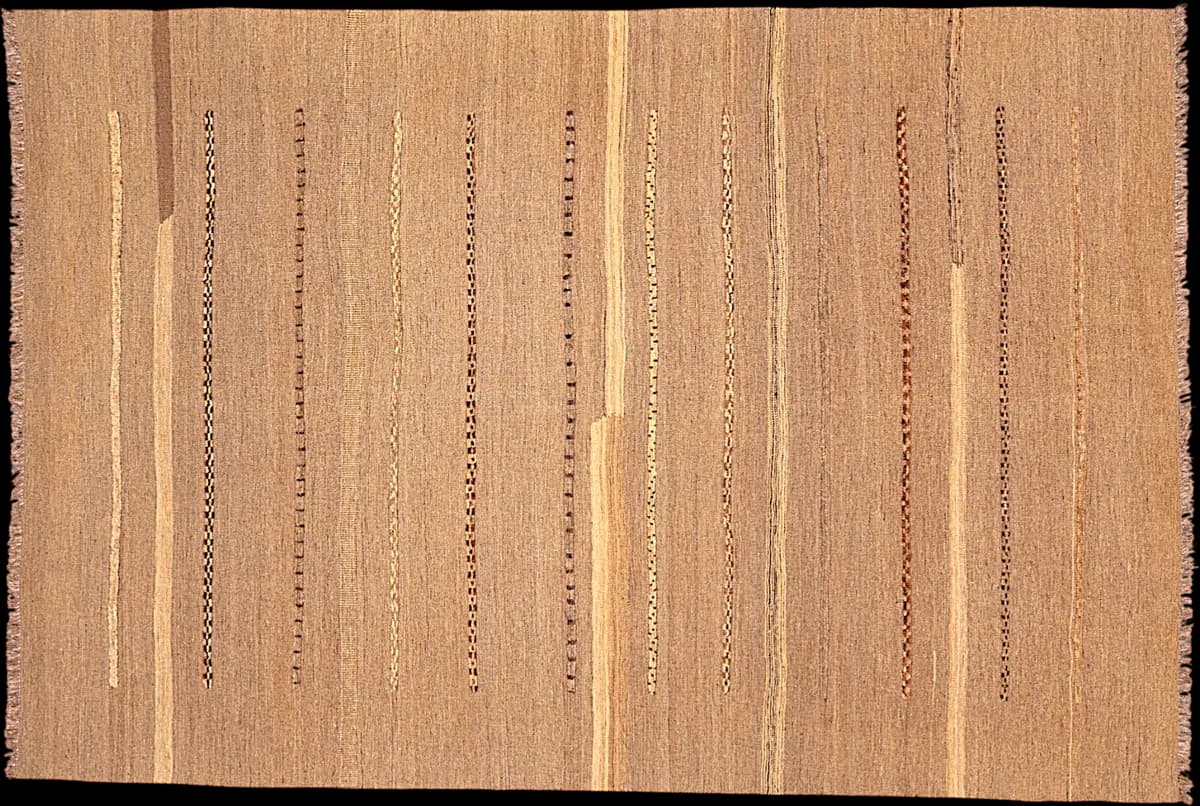
Kelim
291 × 208 cm
1.361 €




1.463 €
Incl. VAT
In Stock · Ready to Ship
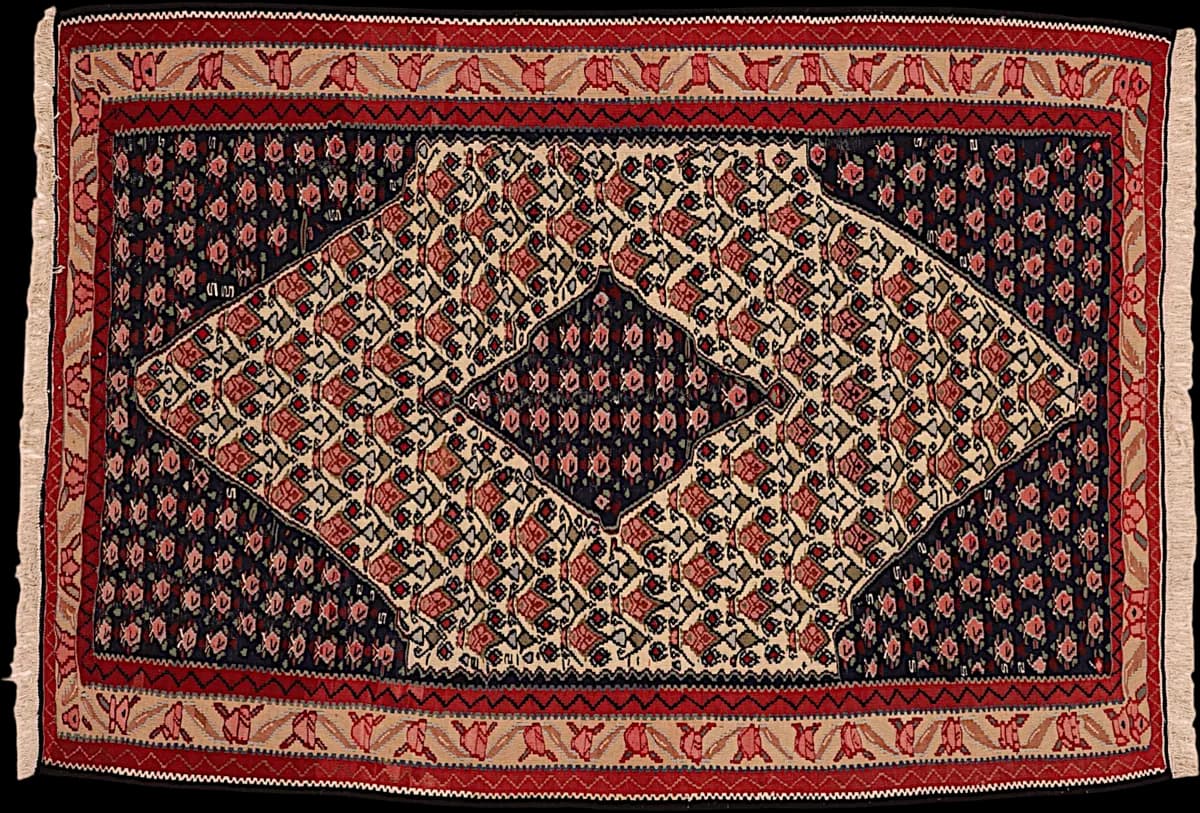
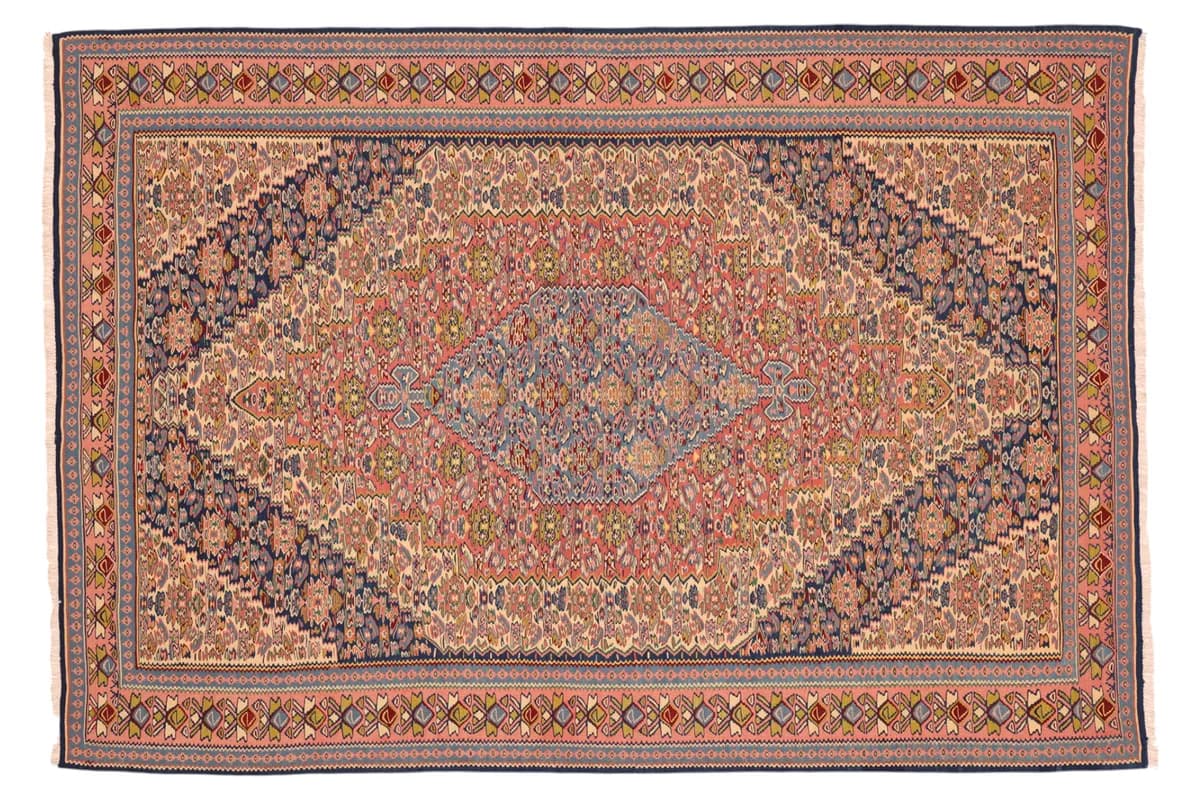
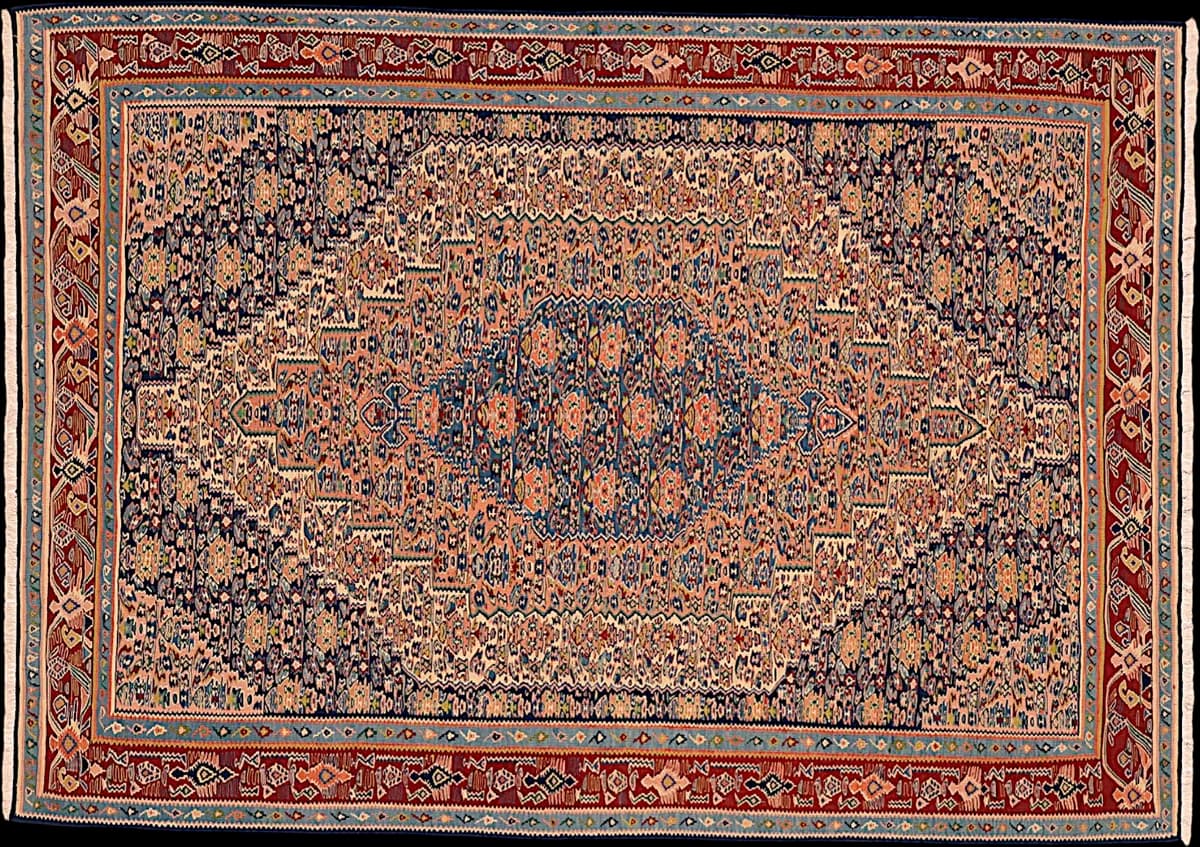
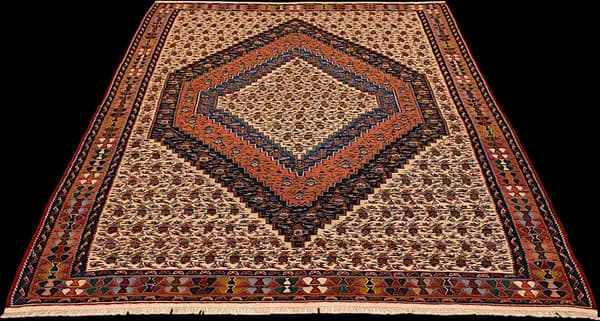
A kilim from the Kordestan region of western Iran, flatwoven rather than knotted, measuring 294 x 221 cm (9'8" x 7'3"). Kilims of this kind are made without a pile, the pattern built directly into the weave, and they are known for bold geometric design and for being usable on either face, since both sides come out equally finished. This one leans into that boldness rather more than most.
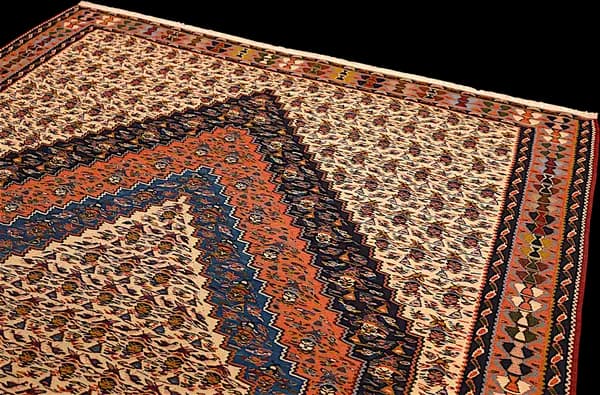
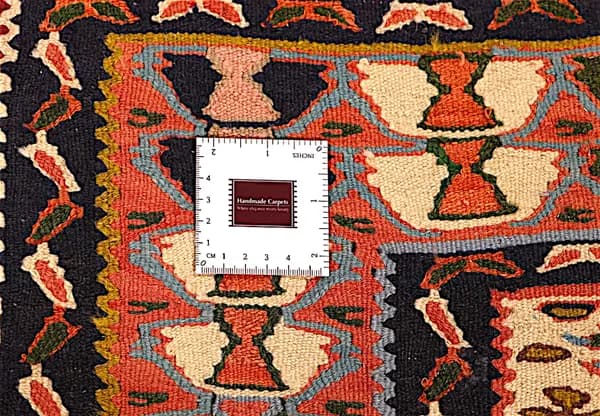
The field is a dense, warm ivory, closely covered with a small repeating Mahi pattern of rosettes and leaves that gives the background its own quiet texture before the eye reaches the medallion. Sitting on top of it is a large stepped diamond, built not as one soft-edged shape but as several nested diamonds in alternating navy and terracotta, banding inward toward the centre like a target. Small accents of mustard, teal and olive surface within the medallion and border bands, warming the contrast between the dark geometry and the pale field. The border stays narrow, roughly a tenth of the width, carrying a fine zigzag in the same navy, terracotta and cream.
This precision is a matter of technique as much as design. A kilim is weft-faced: the coloured wool is worked back and forth across the cotton warp in blocks, which is why its lines step in diagonals rather than curve. That is what gives this medallion its sharp, almost architectural geometry, and why nested diamonds read as clearly as they do against the finer, busier field around them. The wool itself is hand-spun, woven at a firm four millimetres, so the surface stays flat with only a light sheen rather than any depth of pile.
At 294 x 221 cm this is a rug for a living or dining room, comfortably under a table or in front of a sofa. The ivory field will lift a pale floor and hold its own against darker furniture, with the navy and terracotta doing the work of grounding the room. Underfoot it is flat and firm rather than soft, entirely suited to daily use, and since both faces are finished it can simply be turned over as the years go on. Light moving across the room will catch the slight sheen of the wool and shift along the stepped bands of the medallion, one of those things you keep noticing without quite meaning to.
More on Kilims: origin, making and how to recognise a genuine piece
At 294 × 221 cm (6.50 m²) this is a large rug. It sits under a seating group with the front legs of sofa and chairs on it, or under a dining table for four. A table for six wants about 80 cm of clearance all round, and needs more.
No — this piece is hand-woven, not knotted. A flatweave has no pile: the pattern comes from warp and weft alone. That makes it thin, light and usable on both sides, and it is a technique in its own right rather than a simpler version of a knotted rug.
Vacuum regularly, ideally along the weave and without a rotating brush. A flatweave can be turned over, which spreads the wear — flip it once or twice a year. Blot spills at once with clear water and a light cloth, working inwards, and never rub.
We are in the Hamburg Speicherstadt. Come and see this rug in daylight, or write to us — a person answers.
Certificate included verifying origin, materials, and craftsmanship.
Ref: 209337