Belutsch
88 × 73 cm
259 €







921 €
Incl. VAT
In Stock · Ready to Ship
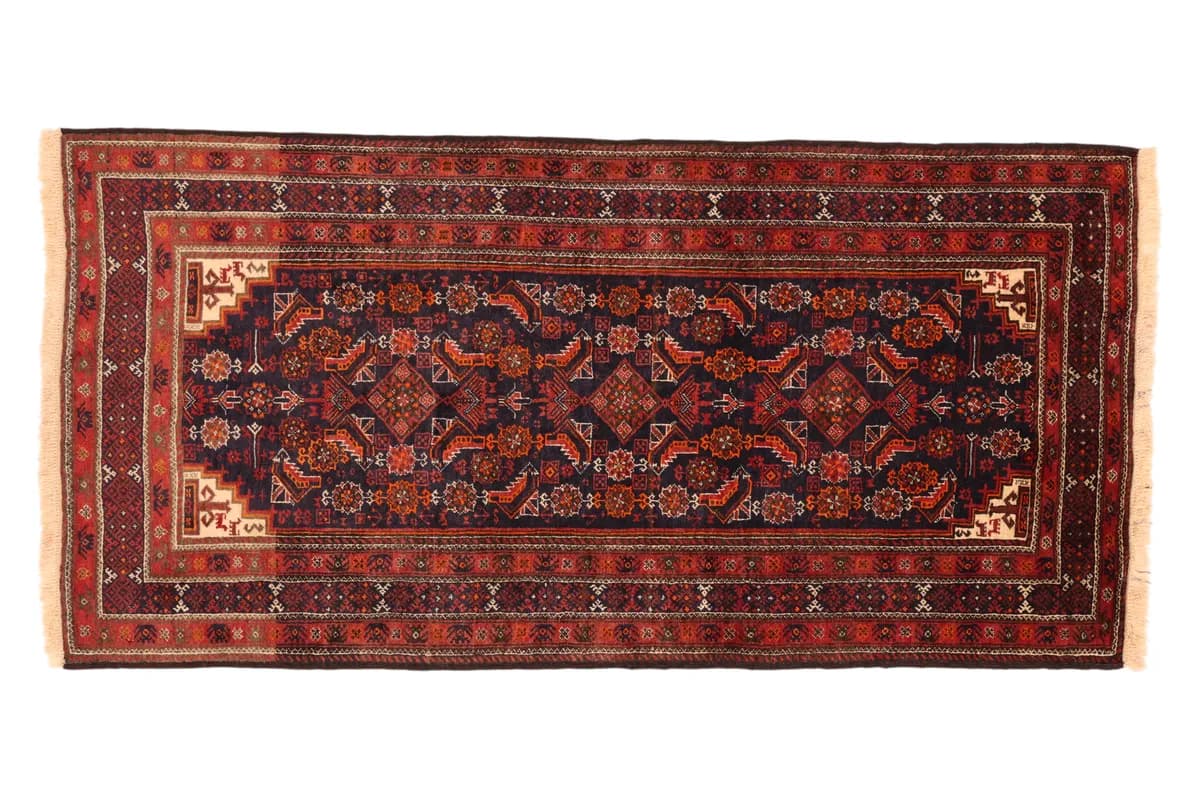
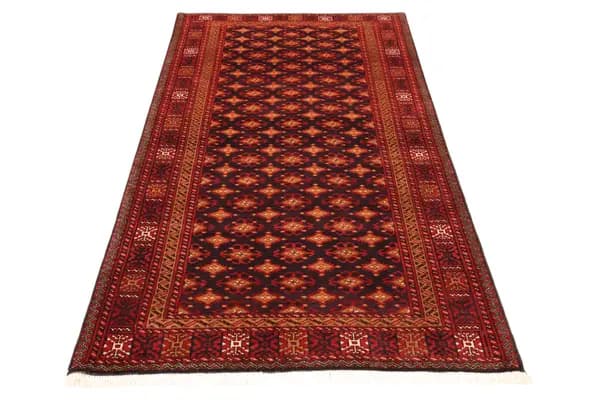
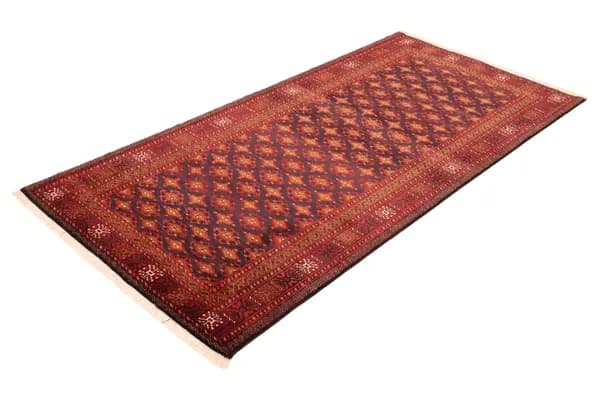
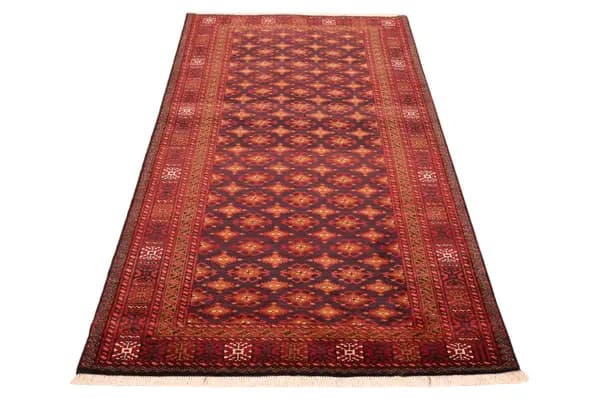
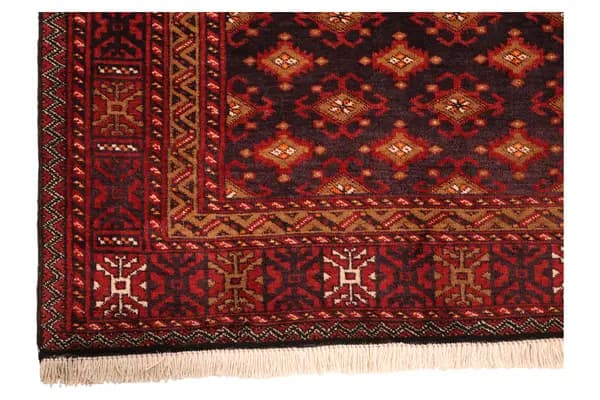
Belutsch weavings come from the tribal borderlands of southeastern Iran, made by women who knot from memory on a portable loom rather than from a drawn plan, and they are best known for a deep, earthy palette of reds and indigo carried in bold, angular geometry. This is a runner, 220 x 108 cm (7'3" x 3'7"), and rather than the prayer-niche layout often associated with the type, it carries a dense all-over lattice with no medallion at all — the discipline here is in the repeat, not in a single central motif.
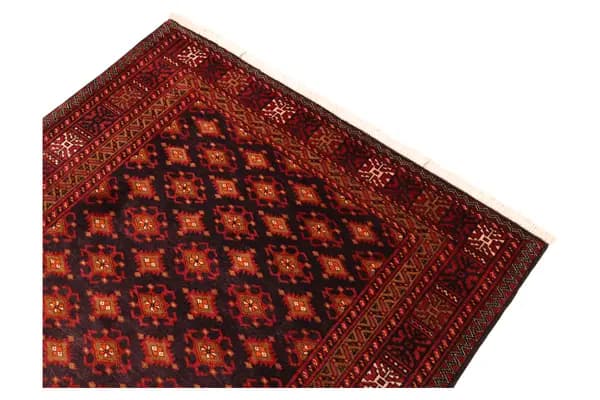
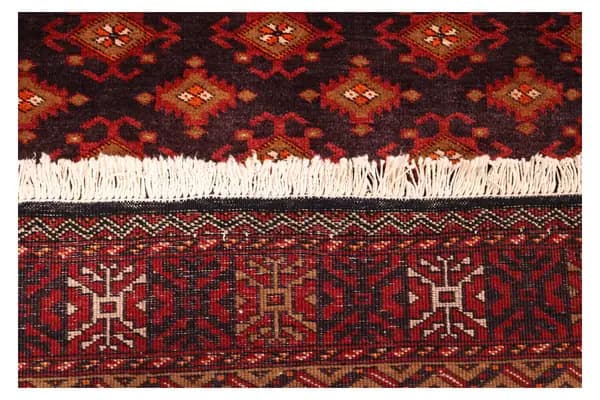
The ground is a deep aubergine-brown so dark it reads almost black, and across it runs a tight diamond lattice, each cell holding a small rosette in rust, terracotta and mustard, with touches of ivory. The rows repeat evenly from one end of the runner to the other, giving the field a quiet, steady rhythm rather than a single point to rest on. Around it sits a wide border built not from one dominant band but from many narrow stacked stripes in red, camel and ivory, with dark green and black threaded through — a layered frame that holds the dark field firmly in place. The pile is matte throughout, clipped tight and flat, with none of the sheen a workshop wool would show.
The wool here is hand-spun, which gives the surface its slightly irregular, textured flatness rather than a uniform sheen, and it sits on a cotton warp, knotted entirely by hand at a density of 128,000 to 160,000 knots per square metre — a genuinely fine count for a piece made on a nomadic loom rather than a workshop frame. That density is also what let the weaver hold such a small, repeating rosette steady across the whole field without it blurring. The many-stripe border took the same patience: counting and turning a dozen narrow bands is no less demanding than drawing one wide one, and arguably takes a steadier hand.
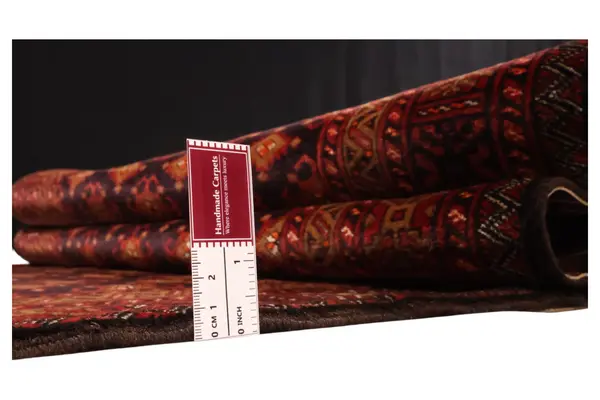
A runner of this size and this depth of colour is made for a hallway or landing, or along a corridor with little daylight of its own — the rust and camel against the near-black ground carry their own warmth without needing sun to do it. Underfoot the pile is dense and firm at 6 mm, wool that takes daily footsteps rather than asking to be spared them. Walk its length and the small rosettes catch the light differently with each step, so the pattern never quite settles into stillness.
More on Baluch rugs: origin, making and how to recognise a genuine piece
Traditional weave
At 220 × 108 cm (2.38 m²) this is a small rug. It works beside a bed, in a reading corner, in front of a fireplace or as a mat by a door. It does not furnish a room; it makes a point in one.
Yes, knotted by hand — knot by knot on a loom, not machine-made. The density is 128,000 to 160,000 knots per square metre; across 2.38 m² that is roughly 300,000 to 380,000 individual knots, every one of them tied by hand.
Hand-spun wool still carries its own lanolin, which keeps liquid sitting on the surface for a moment: blot quickly, with clear water and a light cloth, working inwards and without rubbing. Otherwise regular vacuuming along the pile is enough. Turn the rug once or twice a year so light and footfall reach it evenly.
We are in the Hamburg Speicherstadt. Come and see this rug in daylight, or write to us — a person answers.
Certificate included verifying origin, materials, and craftsmanship.
Ref: 258074