Belutsch
193 × 104 cm
573 €







745 €
Incl. VAT
In Stock · Ready to Ship
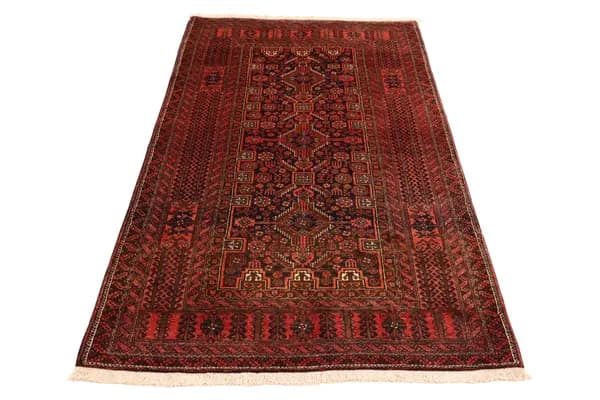
Baluch weavings come from the tribal borderlands of southeastern Iran, made by weavers working from memory rather than from any drawn plan. This one measures 198 x 109 cm (6'6" x 3'7"), a compact rectangle in the deep, earthy colouring the type is known for, and in the same bold geometric language handed down through generations of use.
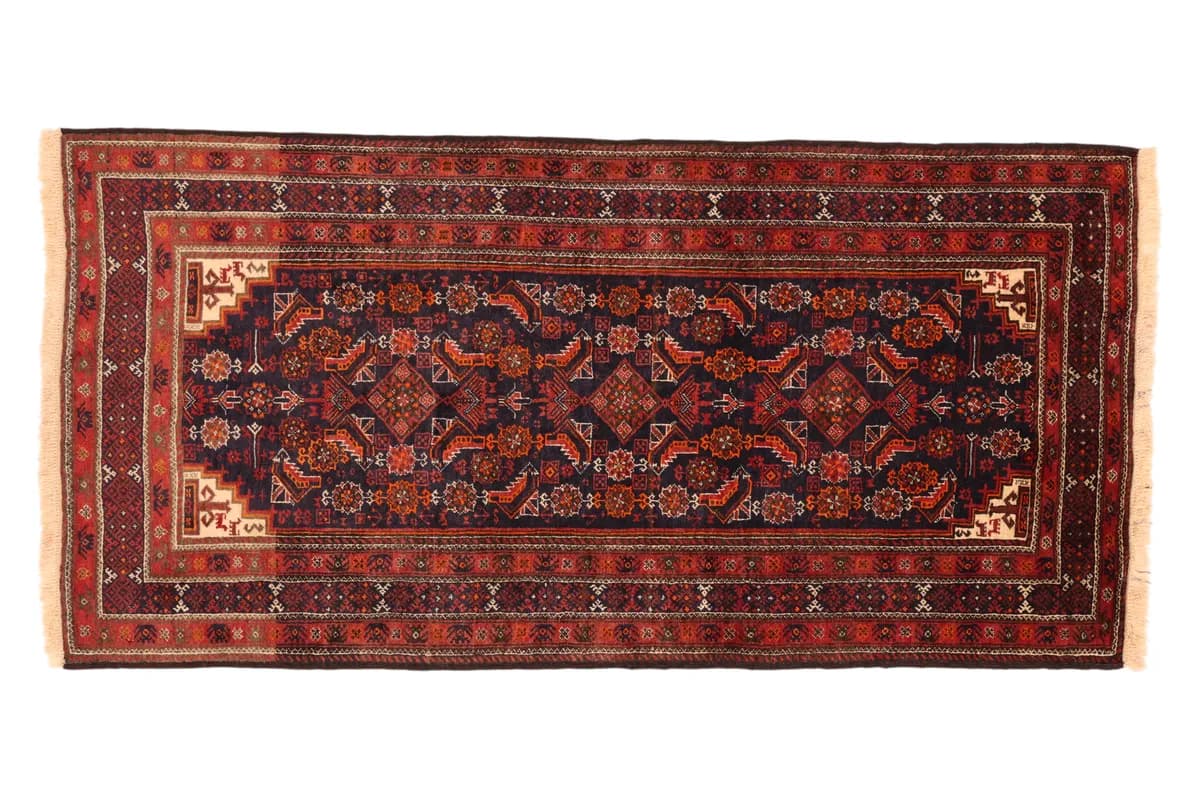
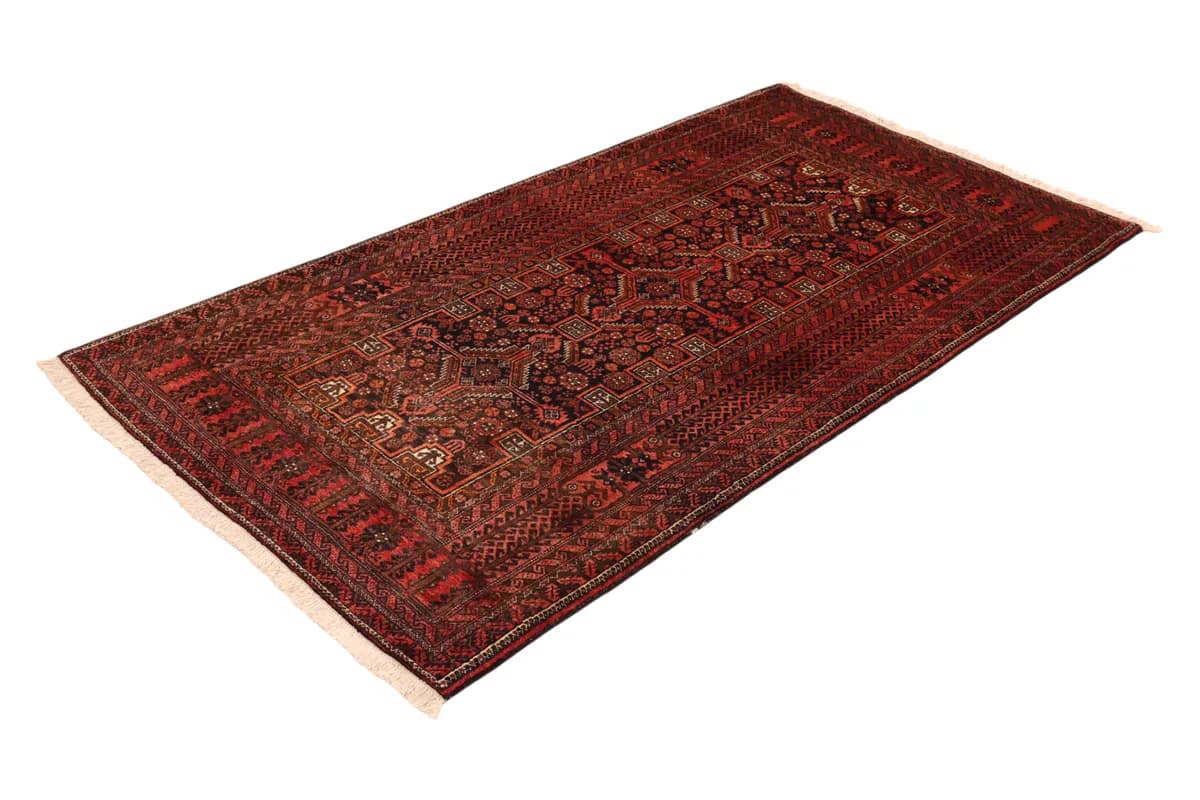
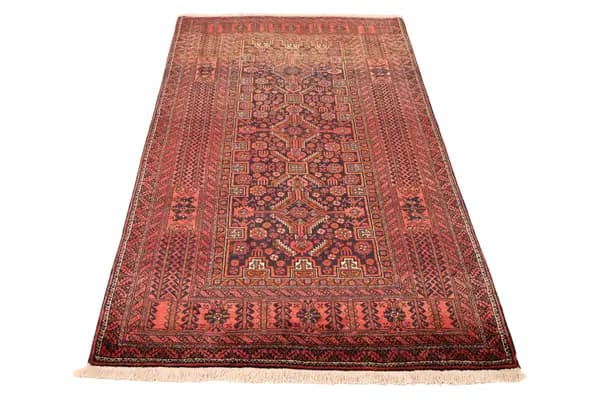
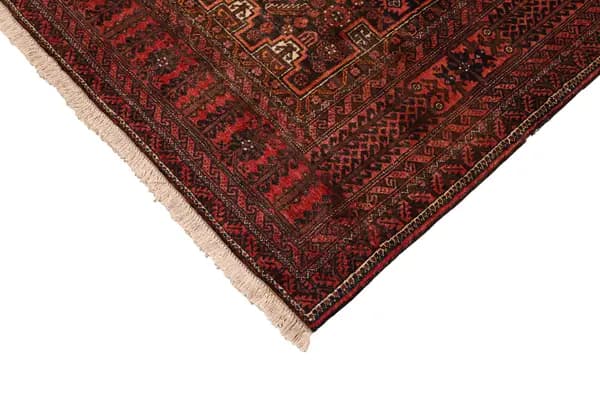
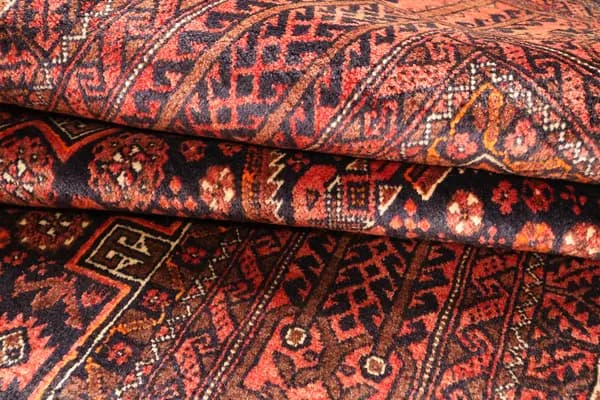
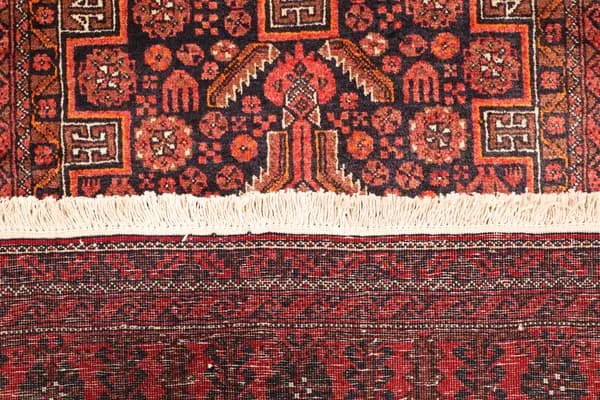
The field is a deep night-blue, almost black in places, and down its centre runs a column of stepped diamond medallions strung on a single vertical pole, like beads on a cord. Small rosettes scatter loosely across the ground around them. Framing all of this is a wide, busy border in brick-red and rust, built from several narrow bands of zigzags and hooked forms in cream, and it takes up nearly a quarter of the rug's width — enough to hold its own against the dark field it surrounds. Look closely at the navy ground and the tone shifts gently, a shade paler and greyer toward the left than the right, the kind of drift that comes from wool dyed and spun by hand in small batches.
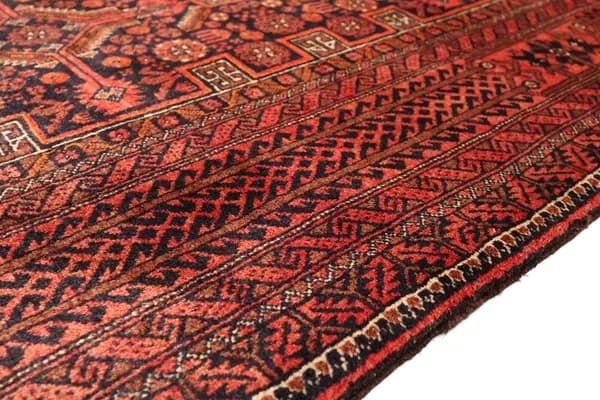
That same hand-spun wool sits on a cotton foundation, knotted at a density of 128,000 to 160,000 knots per square metre — modest by workshop standards, but entirely fitting for a rug made on a portable loom, from memory, by one weaver working without a cartoon to follow. It is this freedom, not a fixed plan, that gives the medallion column its slightly uneven, almost totemic rhythm and lets the border grow as wide and dense as it does. The pile is clipped low, at 6 mm, and the surface has a flat, matte hand and a visible ribbing along the weave lines, the texture of a rug some twenty to forty years into its life and only settling further into it.
At this size and shape, it belongs in a hallway or a landing, somewhere it will be seen end-on rather than sat upon. The dark field grounds a pale floor and gives a dim hallway some real weight of colour, while the red border keeps the eye moving along its length. Underfoot it is dense and firm, wool that has already worn in rather than one to be protected, so it can simply take the traffic of a passage. Morning light picks out the rust and cream in the border first; later in the day it is the deep indigo of the field that holds the room.
More on Baluch rugs: origin, making and how to recognise a genuine piece
Traditional weave
At 198 × 109 cm (2.16 m²) this is a small rug. It works beside a bed, in a reading corner, in front of a fireplace or as a mat by a door. It does not furnish a room; it makes a point in one.
Yes, knotted by hand — knot by knot on a loom, not machine-made. The density is 128,000 to 160,000 knots per square metre; across 2.16 m² that is roughly 280,000 to 350,000 individual knots, every one of them tied by hand.
Hand-spun wool still carries its own lanolin, which keeps liquid sitting on the surface for a moment: blot quickly, with clear water and a light cloth, working inwards and without rubbing. Otherwise regular vacuuming along the pile is enough. Turn the rug once or twice a year so light and footfall reach it evenly.
We are in the Hamburg Speicherstadt. Come and see this rug in daylight, or write to us — a person answers.
Certificate included verifying origin, materials, and craftsmanship.
Ref: 274658