ExclusiveSigned
Rafsanjan | Sherkat-e Farsh
60 × 65 cm
1.346 €






3.300 €
Incl. VAT
In Stock · Ready to Ship
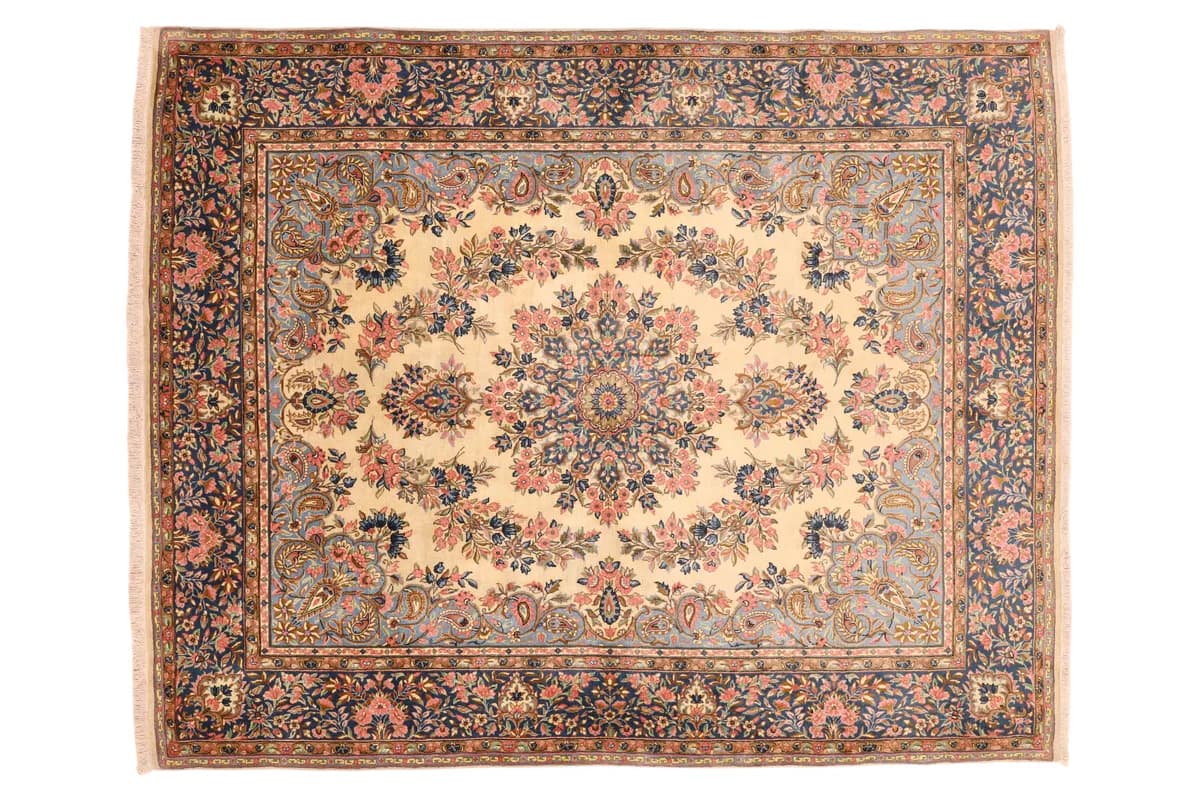
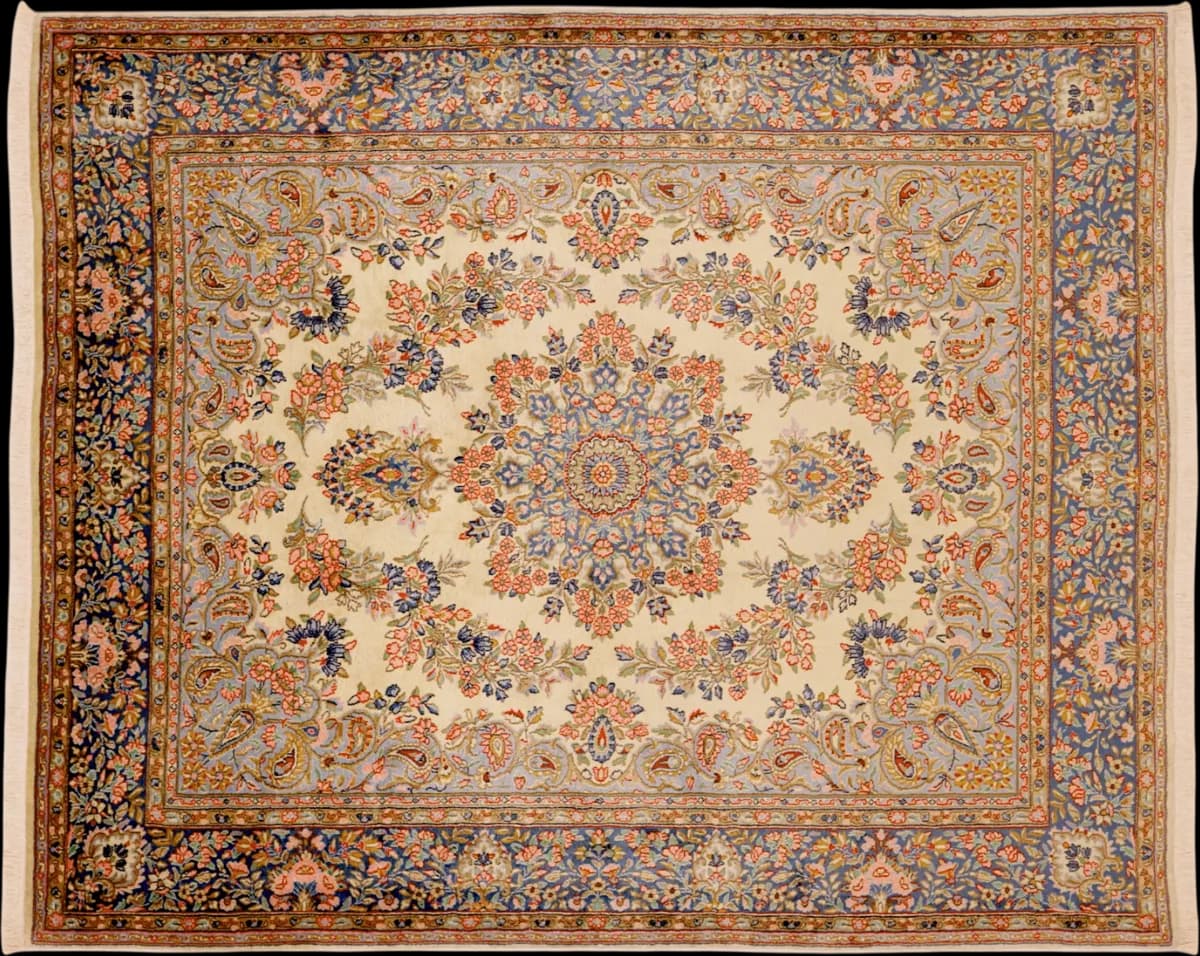
The type is a Ravar, from the small town of that name near Kerman in south-eastern Iran, and this piece measures 230 x 165 cm (7'7" x 5'5"). Ravar rugs are often sold under the trade name Lavar Kerman, and they have been prized in Europe and America since the Qajar era for a particular kind of quality: fine, controlled detail and a design built around a central medallion, drawn with a precision few other regions attempt. What sets this one apart from the usual Ravar layout is that it is not built around one medallion but three.
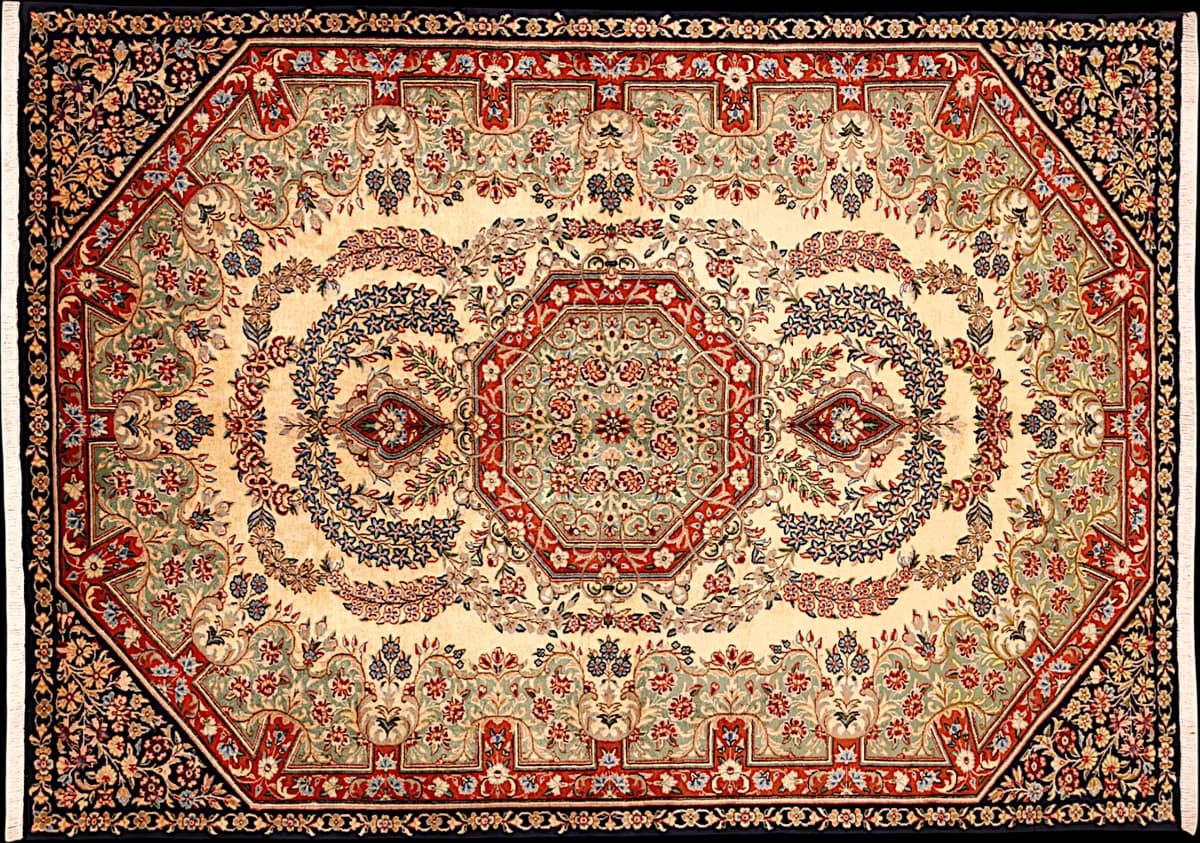
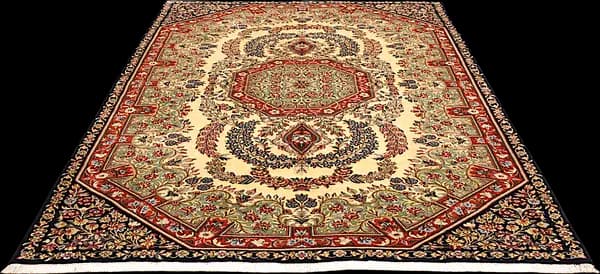
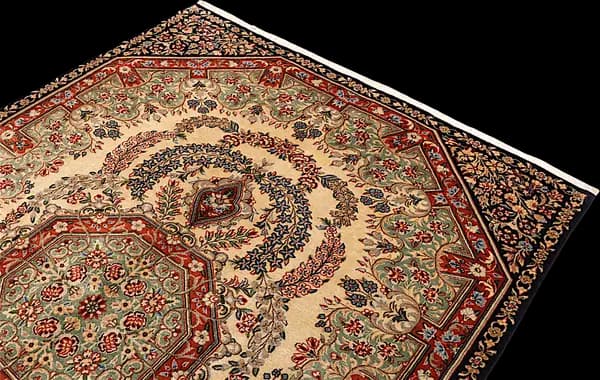
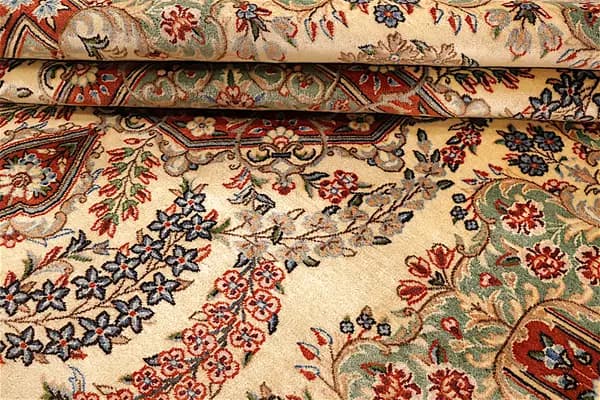
The ground is an ivory so even it reads almost as a canvas, and the first thing the eye does is follow the corners, which are cut away on the diagonal rather than left square, giving the field a shape closer to an elongated octagon than a rectangle. Within it sit three medallions in a row: a larger octagon at the centre with a smaller diamond pendant on either side, mirrored precisely, so the composition feels less like a single emblem and more like a tiled arrangement. Radiating floral vine wreaths fill the space around them in dusty blue and cream. The border answers the field's weight with its own: a broad sage-green floral band, then a brick-red band, then a narrow black guard with a fine floral trellis holding the whole edge together.
A drawing this exact, three medallions kept in true mirror symmetry with the field's edges cut on the diagonal, asks a lot of both the weaver and the wool. The pile here is hand-spun and knotted at a density of 321,000 to 380,000 knots per square metre, fine enough to carry the small turns of the floral scrollwork without them blurring into each other, and set at a modest 12 mm so the detail stays crisp rather than soft. That density, on a cotton warp, is what lets a mirrored composition like this hold its lines cleanly across a field of this size.
At 230 by 165 cm, this is a rug for a seating corner in a living room or the floor beside a bed, somewhere it is seen whole rather than half-covered. The ivory ground will lift a room with darker floors or furniture, while the black guard border gives it enough weight to hold its own against a dark sofa or bedframe. Underfoot it is dense and fine rather than deep, pleasant for a room that sees regular use but calm underneath a chair. In afternoon light the sheen in the florals catches against the matte ivory, and the three medallions read, quietly, as one settled, balanced whole.
More on Ravar rugs: origin, making and how to recognise a genuine piece
Hand-crafted heritage
At 230 × 165 cm (3.79 m²) this is a medium rug. It works in front of a sofa, in front of a bed or in a study. It is too small for a dining table — there you want about 80 cm of clearance so a chair does not tip over the edge when pushed back.
Yes, knotted by hand — knot by knot on a loom, not machine-made. The density is 321,000 to 380,000 knots per square metre; across 3.79 m² that is roughly 1.2 to 1.4 million individual knots, every one of them tied by hand.
Hand-spun wool still carries its own lanolin, which keeps liquid sitting on the surface for a moment: blot quickly, with clear water and a light cloth, working inwards and without rubbing. Otherwise regular vacuuming along the pile is enough. Turn the rug once or twice a year so light and footfall reach it evenly.
We are in the Hamburg Speicherstadt. Come and see this rug in daylight, or write to us — a person answers.
Certificate included verifying origin, materials, and craftsmanship.
Ref: 468934