ExclusiveSigned
Tabriz | Exclusivewith silk
197 × 154 cm
7.050 €






11.100 €
Incl. VAT
In Stock · Ready to Ship
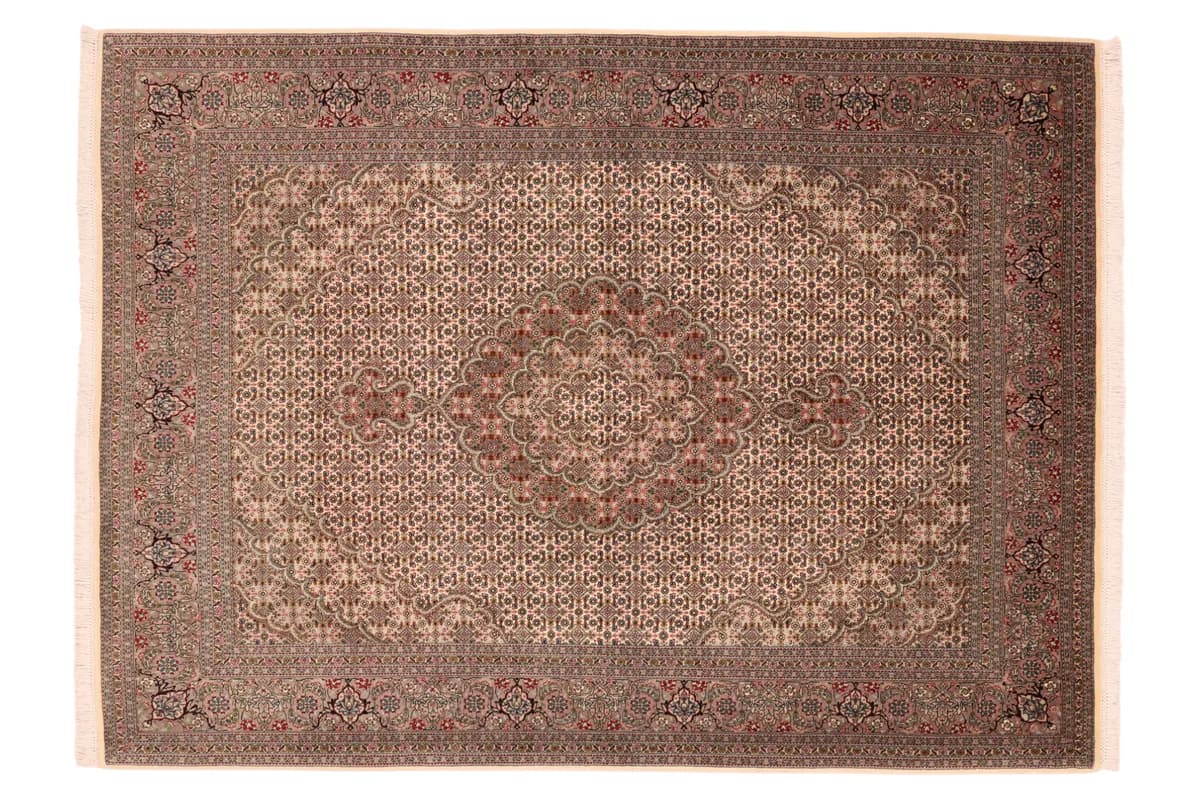
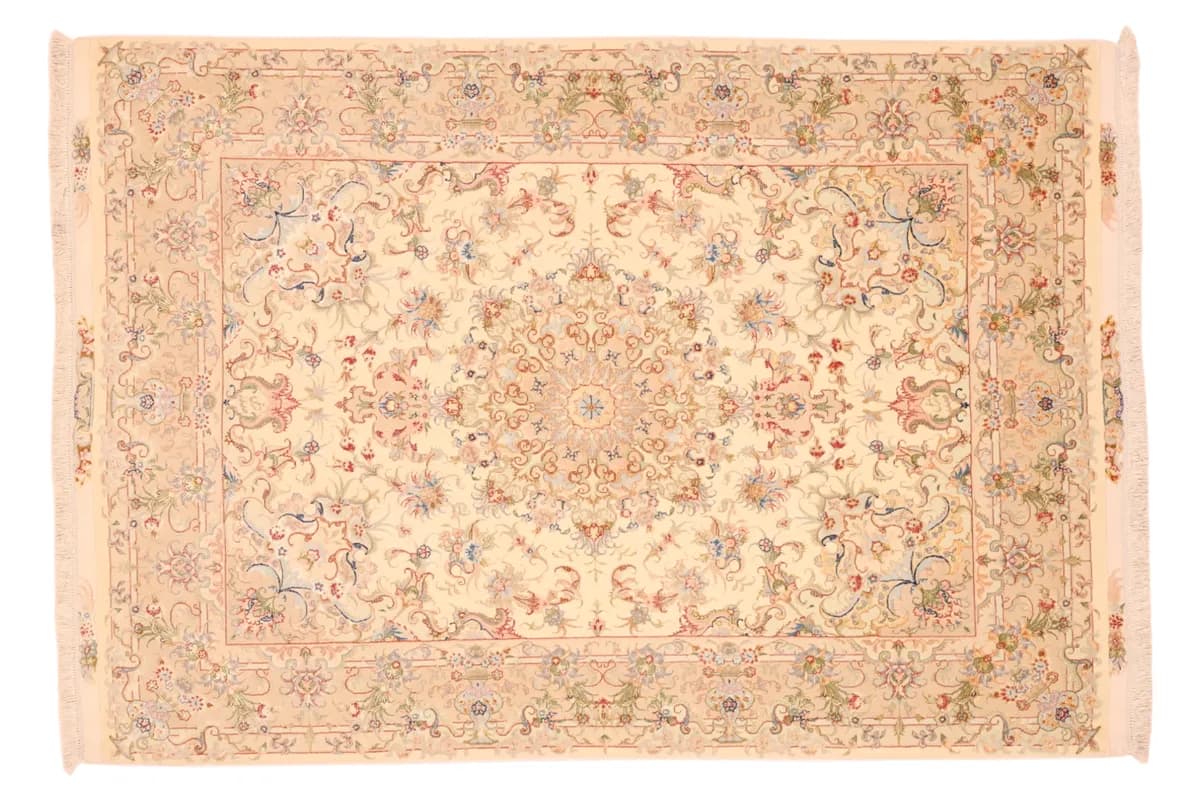
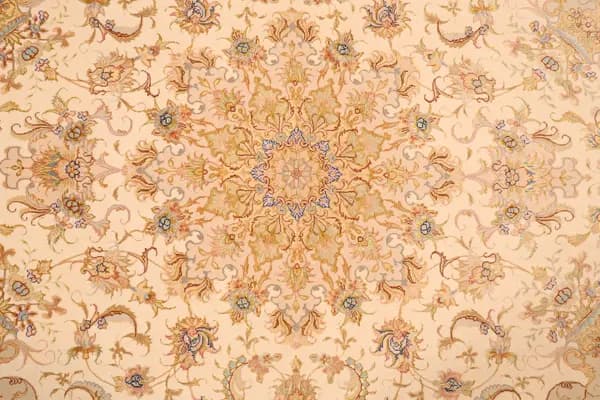
A Tabriz medallion carpet, 215 x 146 cm (7'1" x 4'10"), from the northern Persian city that has set the standard for workshop weaving for five centuries. Tabriz is where cartoon-drawn design and disciplined knotting meet, and its medallion pieces are usually built on deep, saturated colour. This one is not. The palette here is unusually pale for the type, closer to pastel than to the jewel tones the design normally carries.
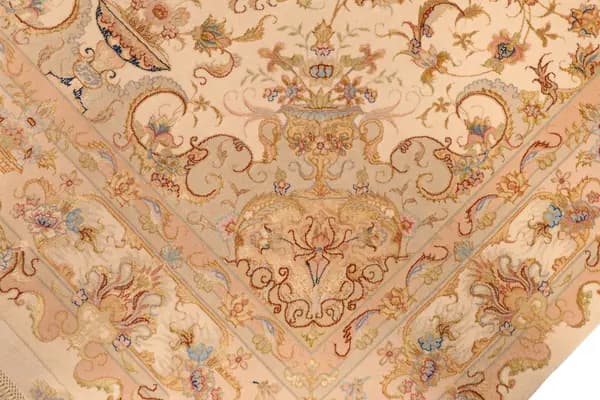
An ivory field opens out with almost no clutter on it, so the eye goes straight to the round central medallion and settles there before finding its echo in each corner, where a quarter-medallion repeats the same drawing in miniature. Fine scrolling vinework, sage green against the cream, links the centre to the corners and keeps the field from feeling empty. A border in soft apricot-peach frames the whole composition, its own scrollwork picking up the same sage tones, with muted gold, powder blue and touches of dusty rose worked through the motifs. The surface carries a light sheen along the medallion outlines, which is what lets a palette this restrained still read as clearly drawn.
The carpet is hand-knotted on a silk warp, with a pile of wool and silk, at a density of 501,000 to 640,000 knots per square metre. A silk warp takes a far finer knot than cotton, and Tabriz weavers use the symmetric knot, which pulls tight and holds a sharp edge. Both are needed for a design this pale to work: pastel colour has no depth to hide behind, so the drawing has to be exact, and here the outlines of the medallion and its corner-pieces stay crisp rather than softening into the field. At the upper end of that density, a piece this size represents months of knotting by hand.
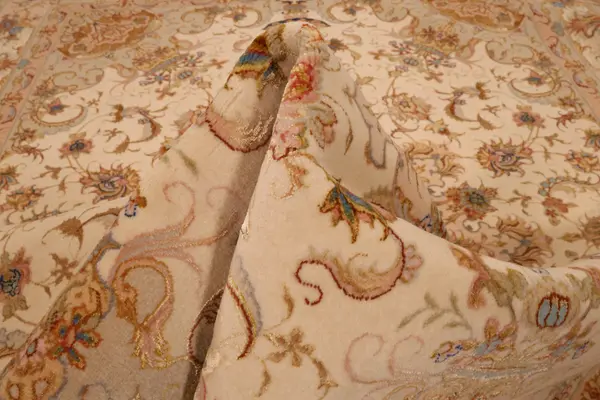
At 215 x 146 cm this suits a bedroom or a smaller seating corner rather than a large dining table, and its pale field is exactly what earns it that place. Against dark floorboards or furniture it holds its own without darkening the room further; on a pale floor it simply continues the light rather than interrupting it. The wool and silk pile, at 7 mm, sits soft and dense underfoot, comfortable for a room that is walked through gently rather than hard-used. As daylight moves across it through the day, the silk in the medallion catches first, and it is that quiet shift of sheen, more than any single colour, that stays interesting long after the rug has settled into the room.
More on Tabriz rugs: origin, making and how to recognise a genuine piece
Exceptionally fine weave
At 215 × 146 cm (3.14 m²) this is a medium rug. It works in front of a sofa, in front of a bed or in a study. It is too small for a dining table — there you want about 80 cm of clearance so a chair does not tip over the edge when pushed back.
Yes, knotted by hand — knot by knot on a loom, not machine-made. The density is 501,000 to 640,000 knots per square metre; across 3.14 m² that is roughly 1.6 to 2.0 million individual knots, every one of them tied by hand.
This pile contains silk and is more delicate than pure wool. Vacuum without a rotating brush and along the pile, do not beat it, and keep it out of permanent direct sun. Blot spills at once with a light cloth, never rub. For a proper clean a silk-blend rug belongs in expert hands — we handle that for pieces bought from us.
We are in the Hamburg Speicherstadt. Come and see this rug in daylight, or write to us — a person answers.
Certificate included verifying origin, materials, and craftsmanship.
Ref: 519377