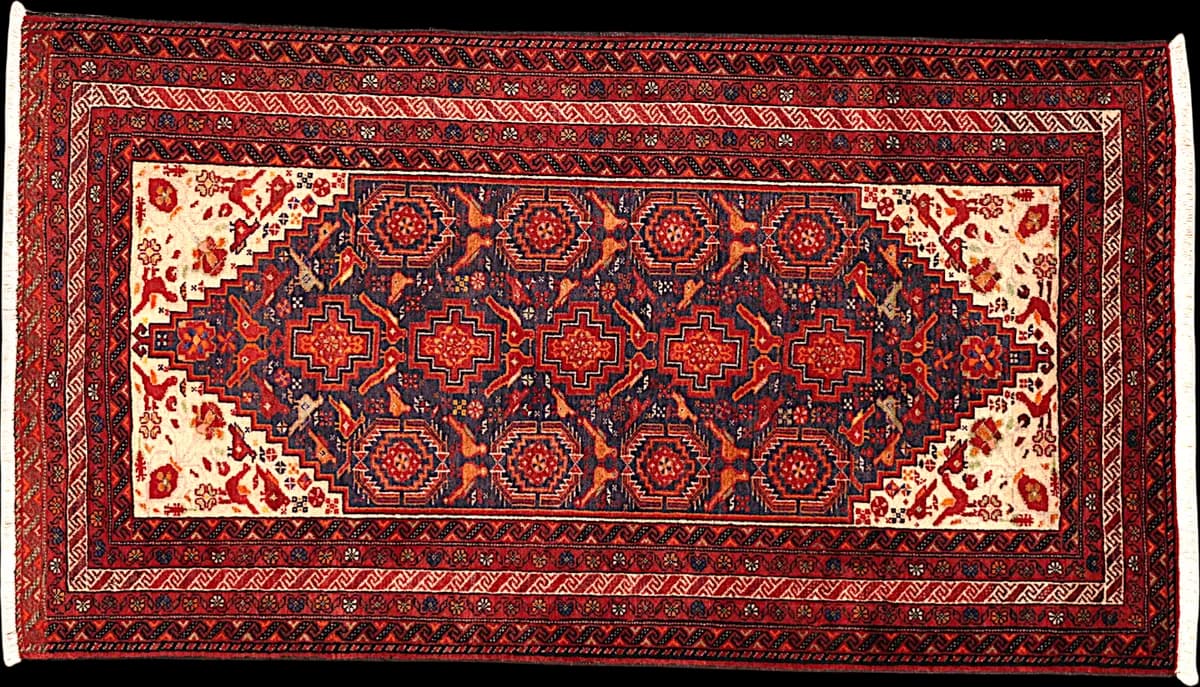
Belutsch
196 × 103 cm
603 €





462 €
Incl. VAT
In Stock · Ready to Ship
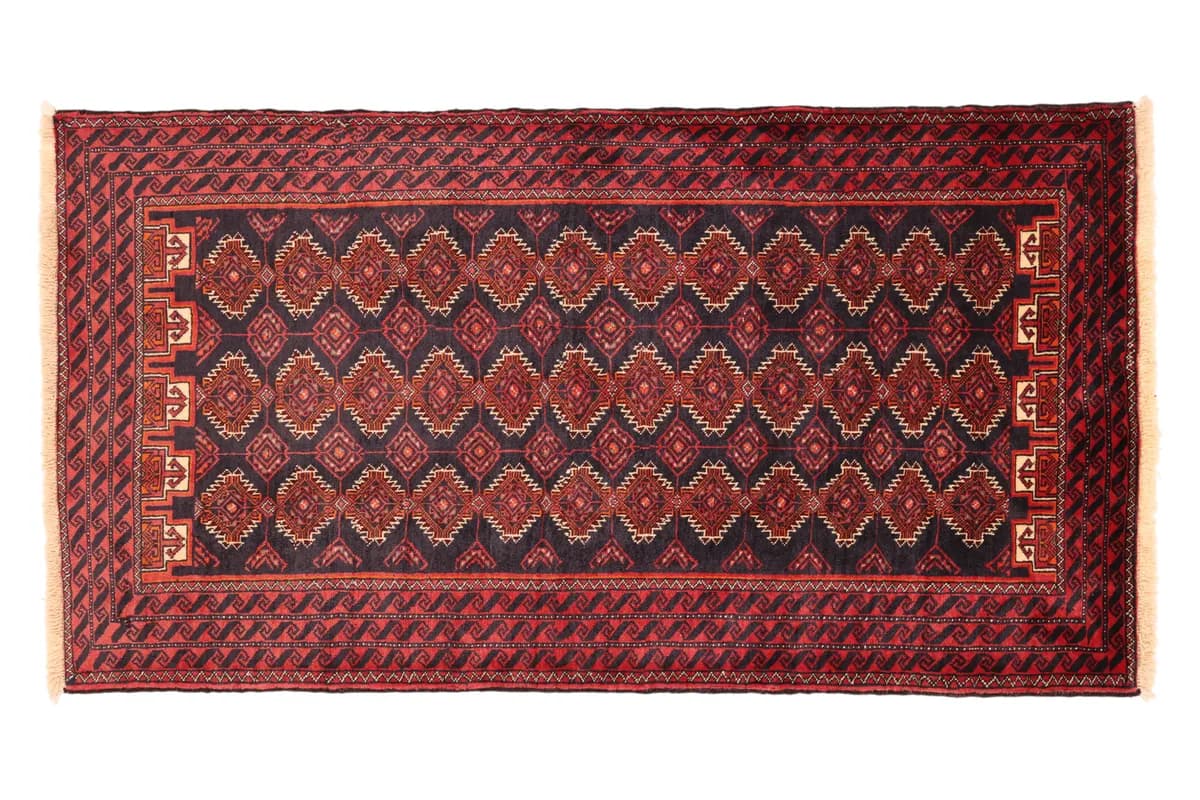
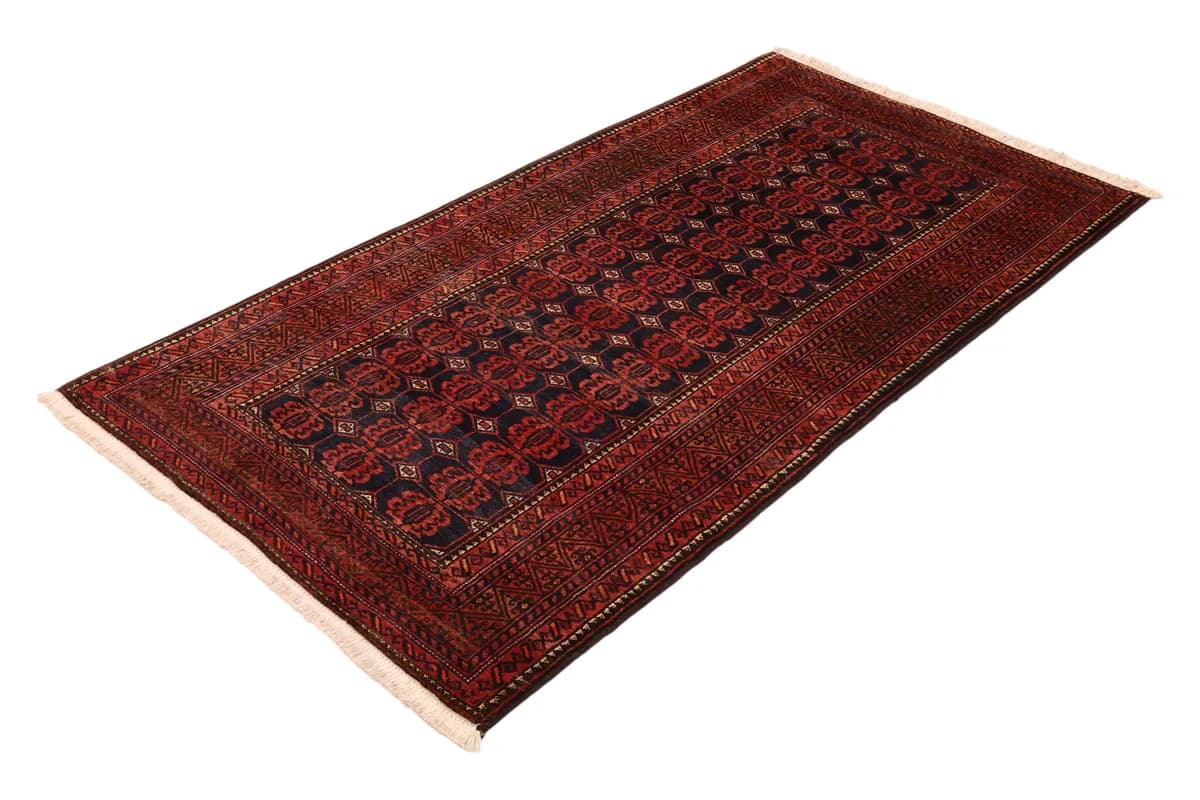
Deep in the southeastern borderlands of Iran, Baluch weavers have long worked from memory rather than from a drawn plan, carrying bold geometric patterns and earthy colour from one generation to the next. This piece measures 178 x 91 cm (5'10" x 3'0"), a narrow format well suited to a slender space. Rather than the mihrab layout often associated with the group, it carries a gul repeat more usually linked to Turkmen weaving, taken up and reworked here with a nomadic hand.
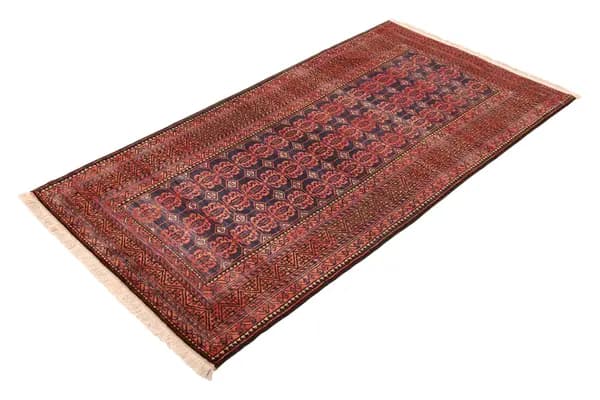
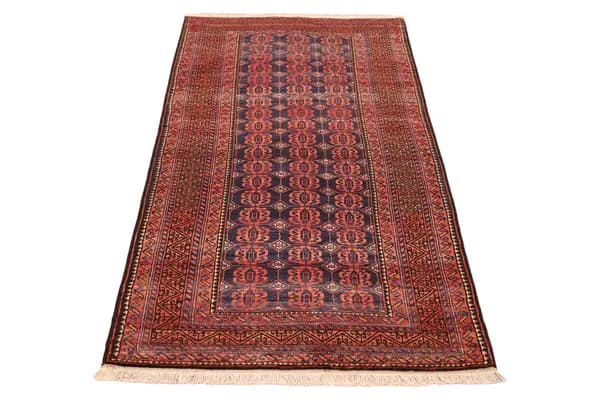
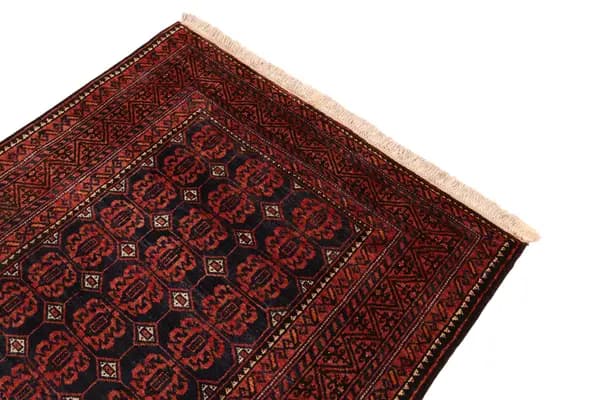
The navy ground is almost entirely given over to rows of brick-red octagonal guls, each one outlined in dark brown-black and set with a small ivory diamond at its heart. These columns march down the field with real consistency, nearly thirty rows of them, before giving way to a wide rust-red border. There, diamonds and triangles repeat in darker tones, held in check by several narrow guard stripes and a fine ivory zigzag at the very edge. Against the density of red on navy, it is the ivory that does the work, breaking each gul open and keeping the whole field from turning heavy.
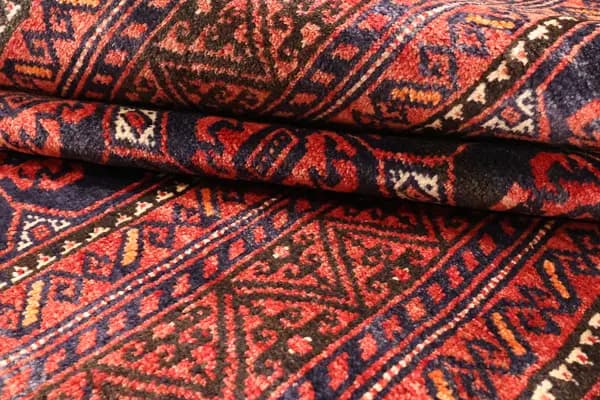
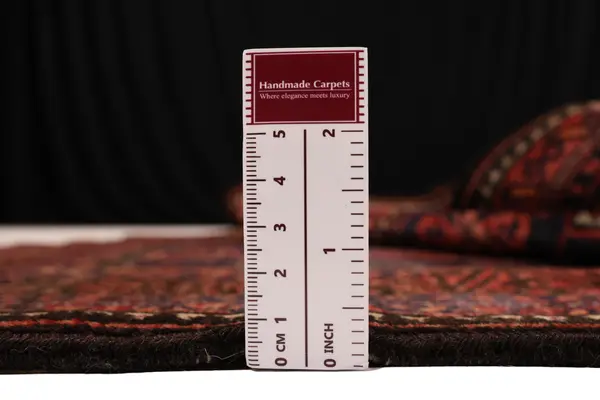
That evenness is notable given how this rug was made. It was knotted by hand on a portable loom, the wool spun by hand before it ever reached the warp, with no cartoon to follow and only memory to keep nearly thirty rows aligned. At a density of 128,000 to 160,000 knots per square metre, the weaver had enough resolution to place each ivory diamond cleanly inside its gul, which is what gives the pattern its sharpness rather than a blur. The pile sits low, at 6 mm, and the wool's matte, slightly irregular surface is part of its character rather than a flaw in it.
A rug this size and this grounded in colour earns its keep in a hallway, along a landing, or at the foot of a bed, where a wide, pale piece would be wrong but a narrow, dense one is exactly right. Where daylight is scarce, the rust-red border and the terracotta zigzag within it hold their own and give the space some warmth to work with. Underfoot it is dense and flat, built for a passage rather than a room to linger in, and it takes that use without complaint. Catch it under a lamp in the evening and the ivory diamonds are what hold your eye, small points of light steadied against all that red and navy.
More on Baluch rugs: origin, making and how to recognise a genuine piece
Traditional weave
At 178 × 91 cm (1.62 m²) this is a small rug. It works beside a bed, in a reading corner, in front of a fireplace or as a mat by a door. It does not furnish a room; it makes a point in one.
Yes, knotted by hand — knot by knot on a loom, not machine-made. The density is 128,000 to 160,000 knots per square metre; across 1.62 m² that is roughly 210,000 to 260,000 individual knots, every one of them tied by hand.
Hand-spun wool still carries its own lanolin, which keeps liquid sitting on the surface for a moment: blot quickly, with clear water and a light cloth, working inwards and without rubbing. Otherwise regular vacuuming along the pile is enough. Turn the rug once or twice a year so light and footfall reach it evenly.
We are in the Hamburg Speicherstadt. Come and see this rug in daylight, or write to us — a person answers.
Certificate included verifying origin, materials, and craftsmanship.
Ref: 638960