Azerbaijan
287 × 193 cm
2.078 €






3.914 €
Incl. VAT
In Stock · Ready to Ship
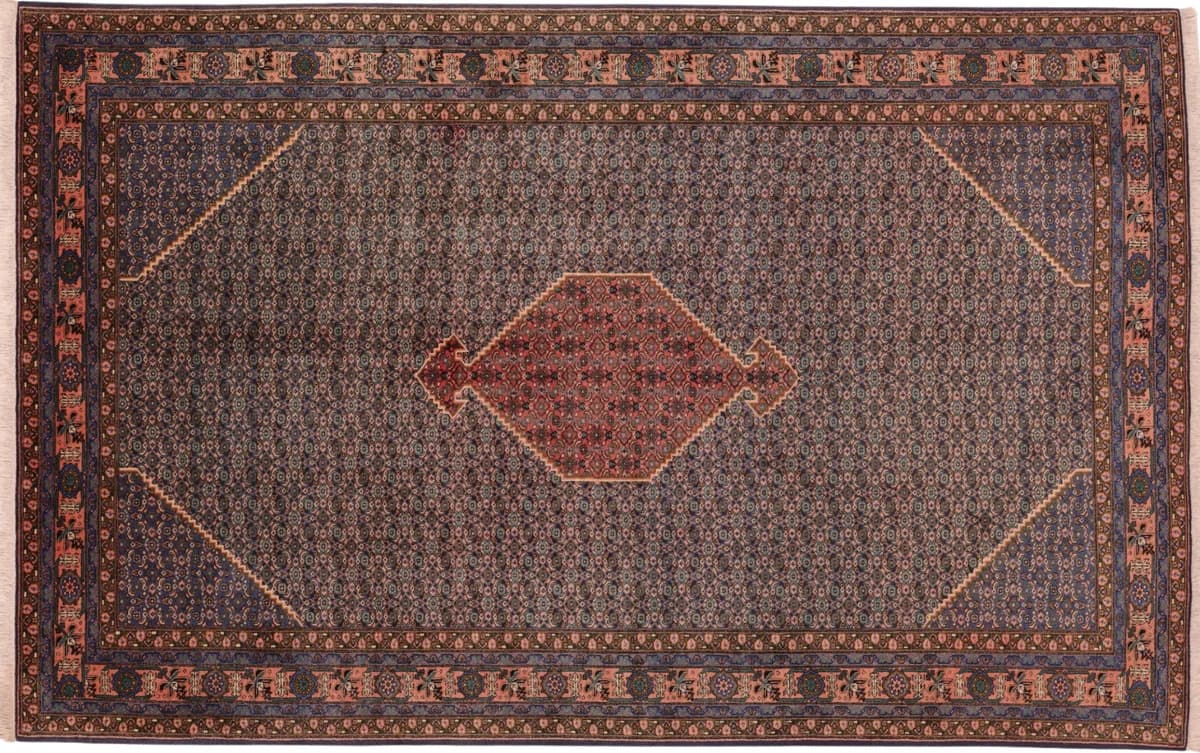
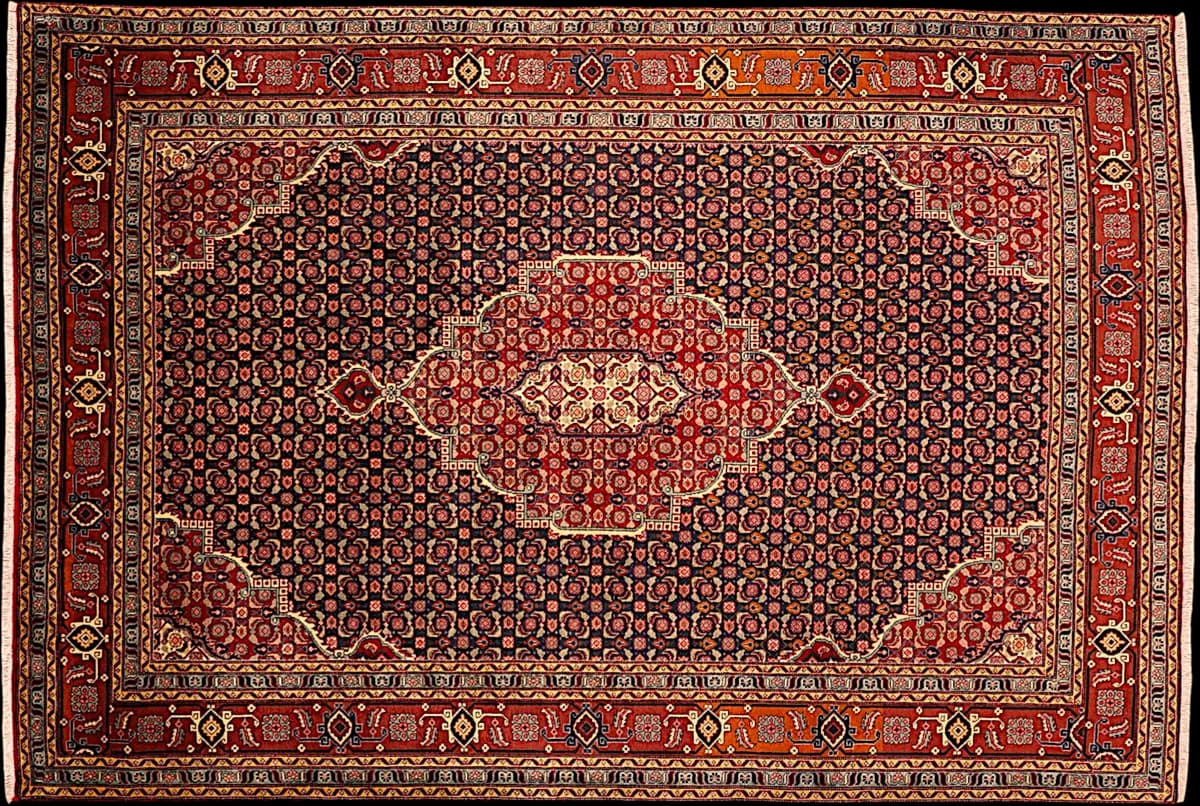
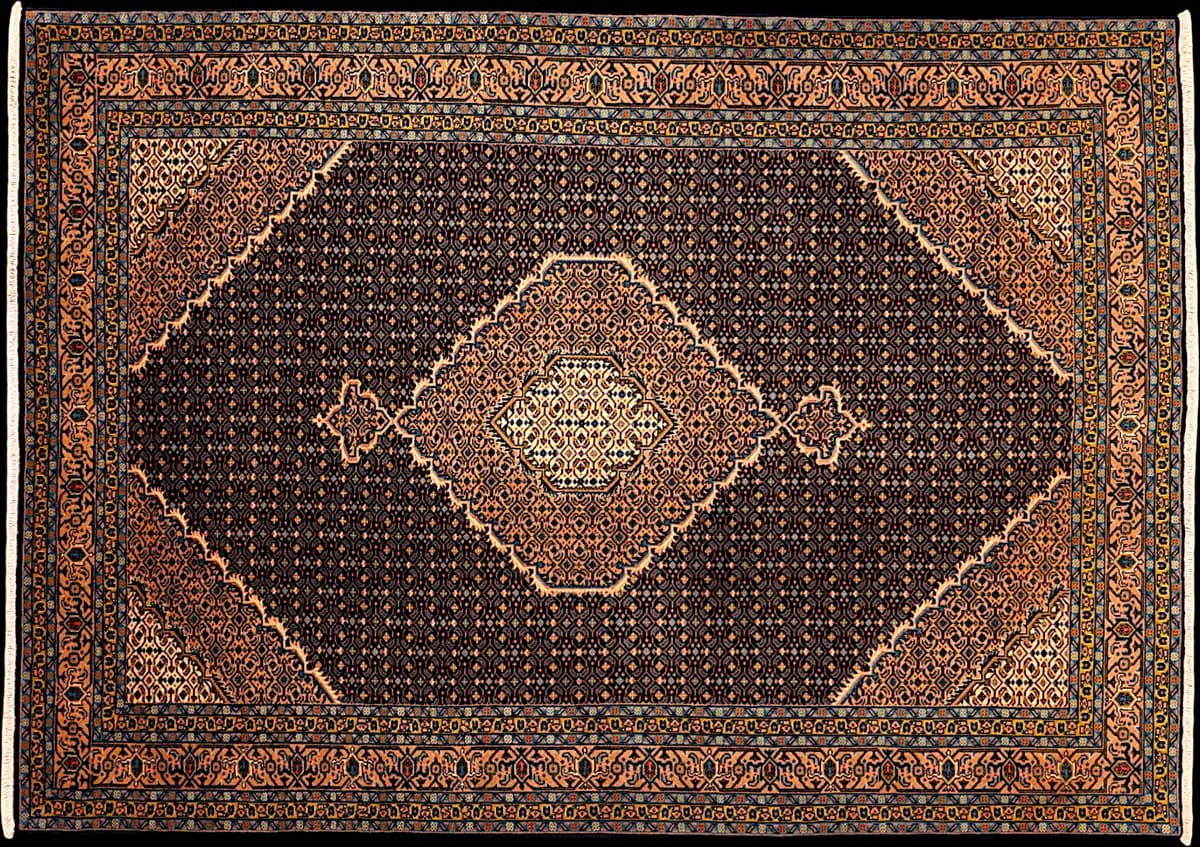
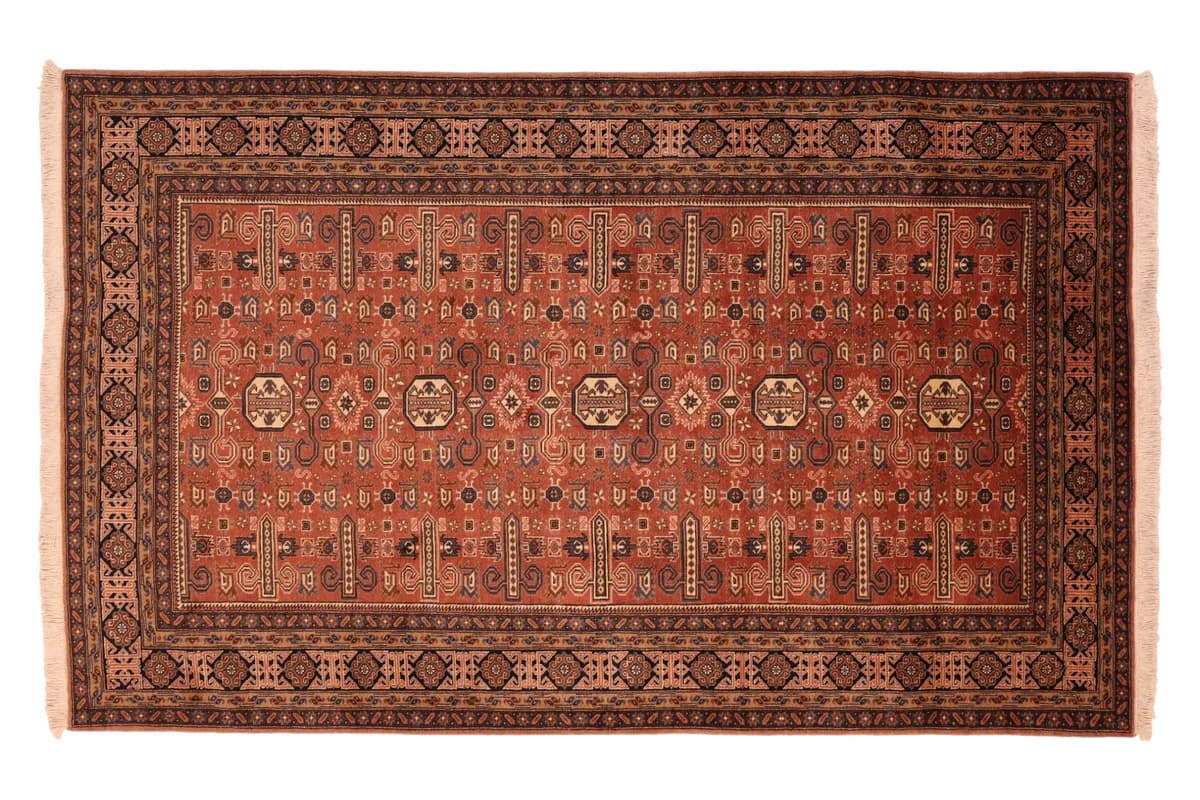
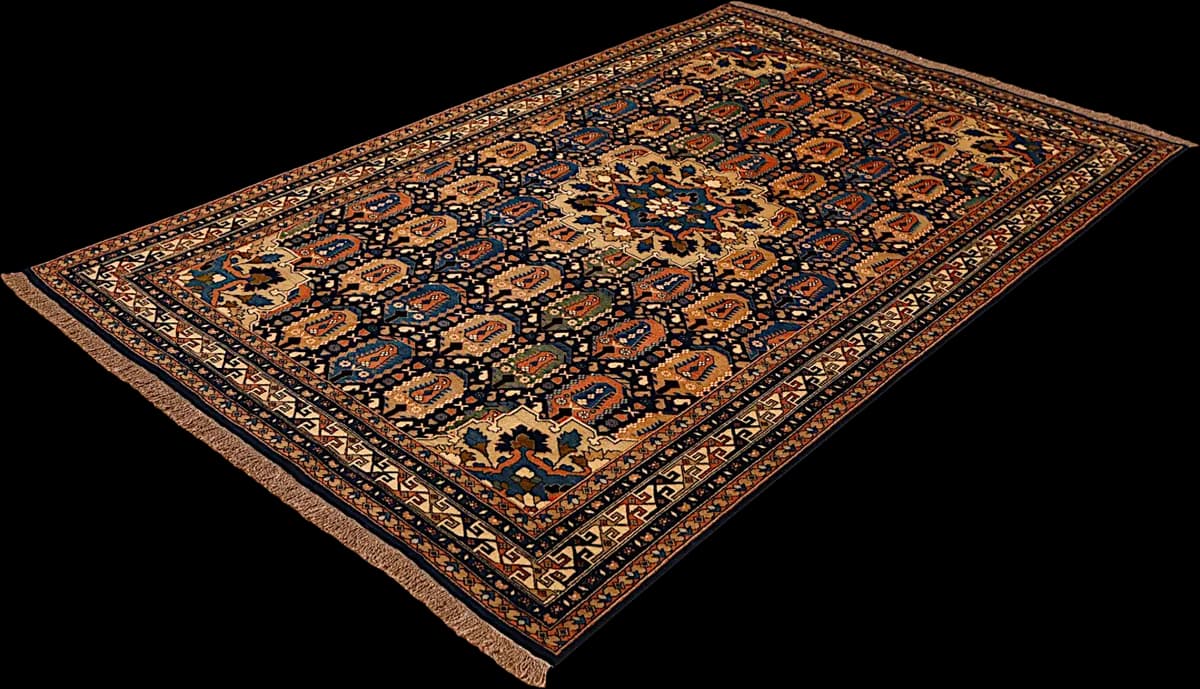
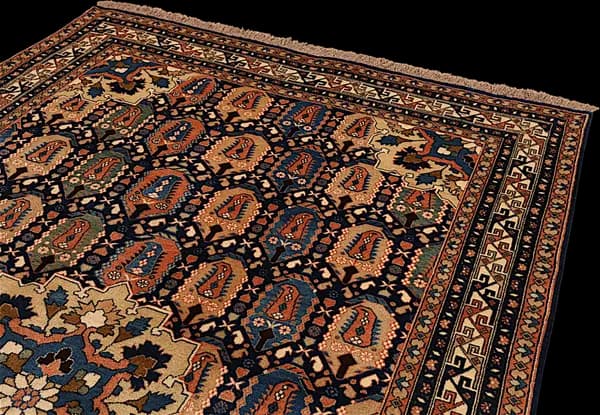
This is a rug from Azerbaijan, also written Azarbayedjan, the northwest Persian province where weaving has been recorded since the thirteenth century, at 304 x 195 cm (9'11" x 6'5"). The province holds seven weaving districts, from tribal work to the refined workshops of Tabriz, and its rugs share one vocabulary: bold geometric medallions, angular arabesque borders, deep saturated grounds. Here that vocabulary centres on a single idea, one medallion set against a field that would otherwise simply repeat itself.
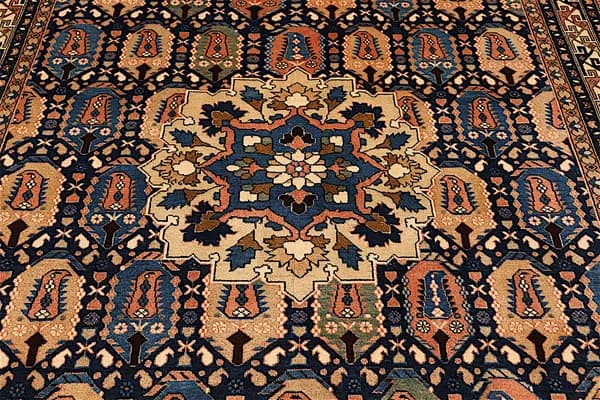
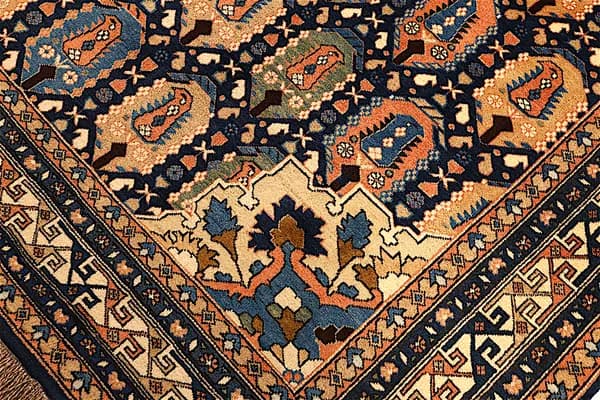
The field is a deep midnight blue, almost black in places, packed edge to edge with small hooked lozenges and boteh-like devices in rust, camel and steel blue. Look longer and one shape breaks that rhythm: a large star-shaped medallion in cream and camel, drawn more openly and at a far greater scale than anything around it, so that it sits forward from the lattice rather than dissolving into it. The eye settles there before returning to the smaller repeat. A broad border in cream, camel and navy runs around the whole field, its meandering key-pattern stripe taking up close to a fifth of the rug's width and giving the dense centre somewhere to stop.
The rug is hand-knotted on a natural wool warp, with a pile of hand-spun wool at a density of 161,000 to 200,000 knots per square metre, enough to keep the small lozenges crisp and distinct rather than letting them blur together, which is exactly what allows the medallion to read so clearly against them. The pile is kept low, at 8 millimetres, giving a tight, slightly flat surface with a light sheen rather than a deep plush one. At twenty to forty years old, the wool has already settled into that surface, the kind of age that firms a rug rather than softening its pattern.
At just over three metres by two, this is a dining room or living room rug, sized for a table setting or a seating group rather than a single chair. Against a pale floor the midnight ground holds its own without darkening the room, and the camel and terracotta in the medallion and lattice carry warmth into a space that dark blue alone would not. Underfoot it is dense and firm, made for a room that sees daily use rather than one kept for best. What stays with you is the medallion itself, cream and camel catching the light differently as the day moves, the one still point in a field built from continuous small repetition.
More on Azerbaijan rugs: origin, making and how to recognise a genuine piece
Traditional weave
At 304 × 195 cm (5.93 m²) this is a large rug. It sits under a seating group with the front legs of sofa and chairs on it, or under a dining table for four. A table for six wants about 80 cm of clearance all round, and needs more.
Yes, knotted by hand — knot by knot on a loom, not machine-made. The density is 161,000 to 200,000 knots per square metre; across 5.93 m² that is roughly 1.0 to 1.2 million individual knots, every one of them tied by hand.
Hand-spun wool still carries its own lanolin, which keeps liquid sitting on the surface for a moment: blot quickly, with clear water and a light cloth, working inwards and without rubbing. Otherwise regular vacuuming along the pile is enough. Turn the rug once or twice a year so light and footfall reach it evenly.
We are in the Hamburg Speicherstadt. Come and see this rug in daylight, or write to us — a person answers.
Certificate included verifying origin, materials, and craftsmanship.
Ref: 551065