Kelim Senneh
164 × 107 cm
394 €






1.422 €
Incl. VAT
In Stock · Ready to Ship
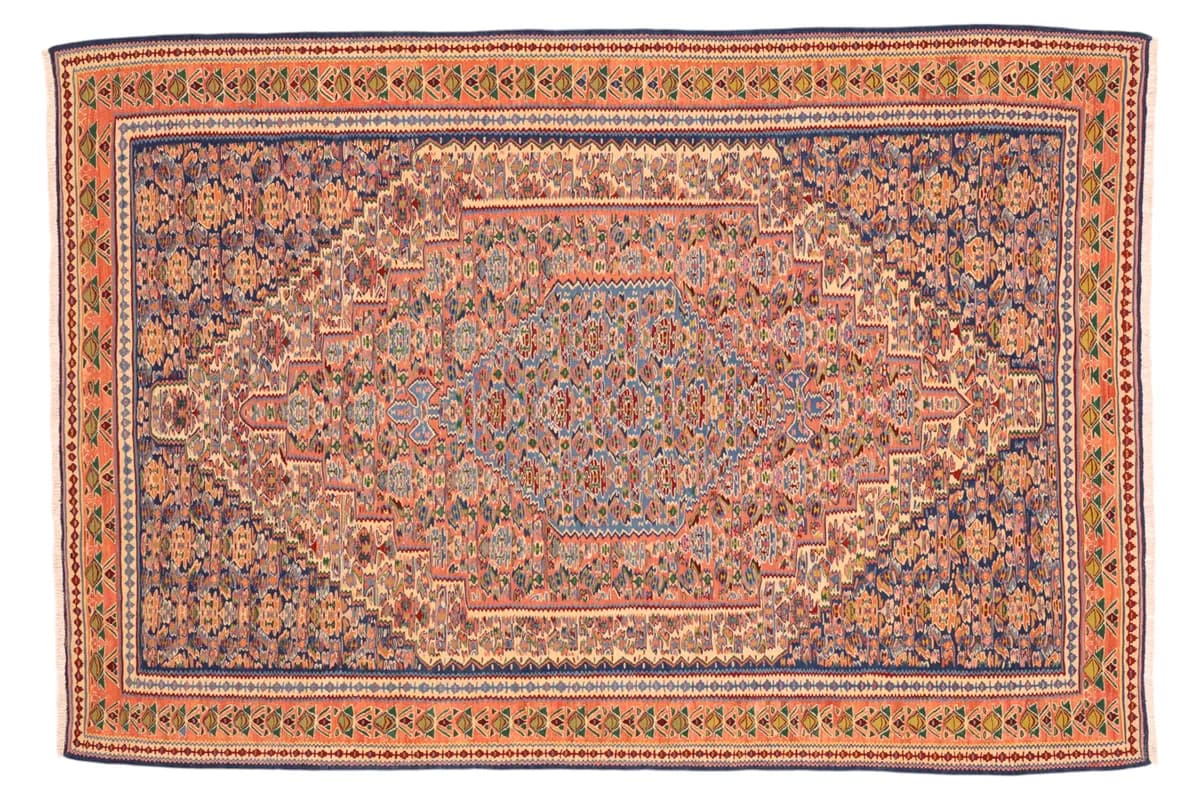
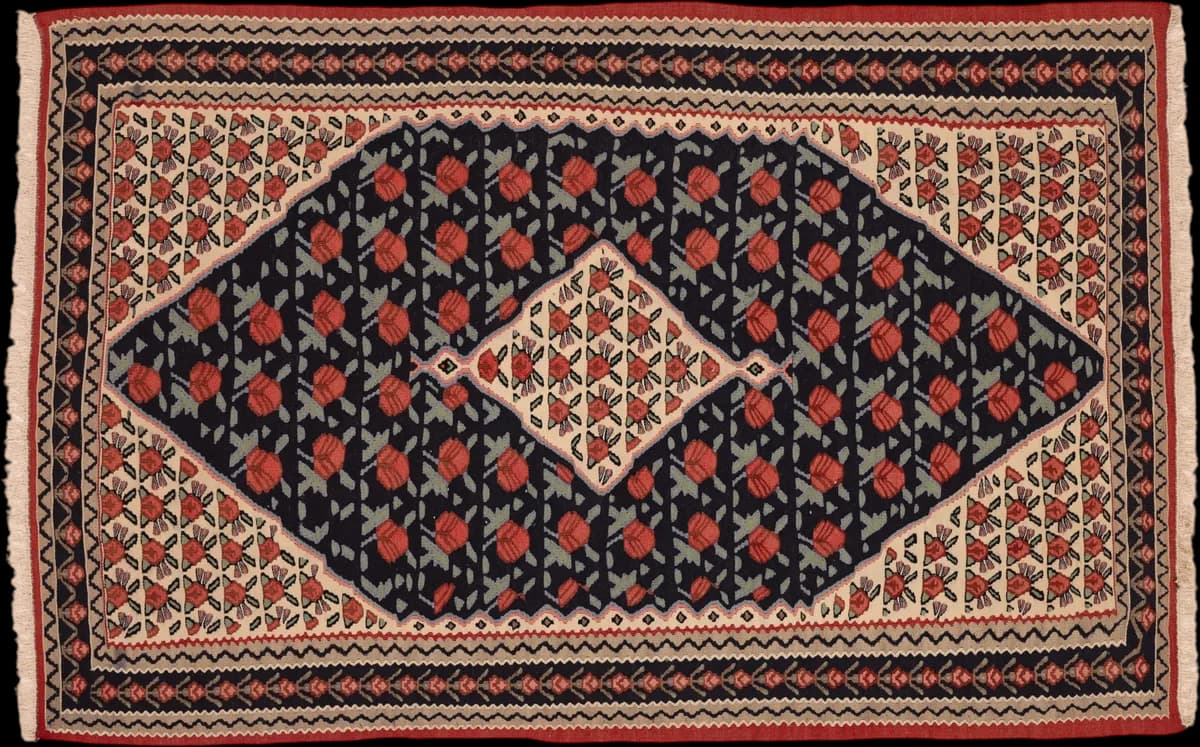
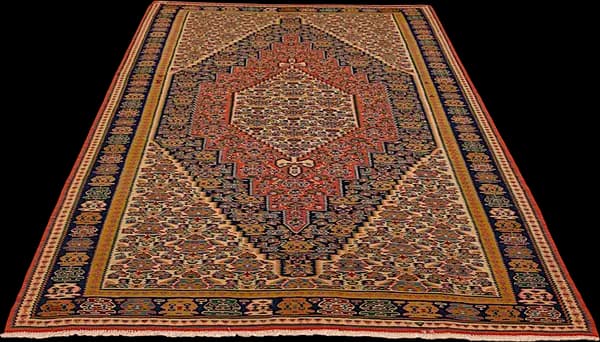
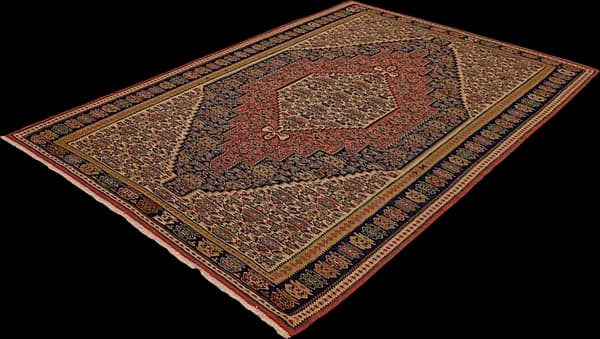
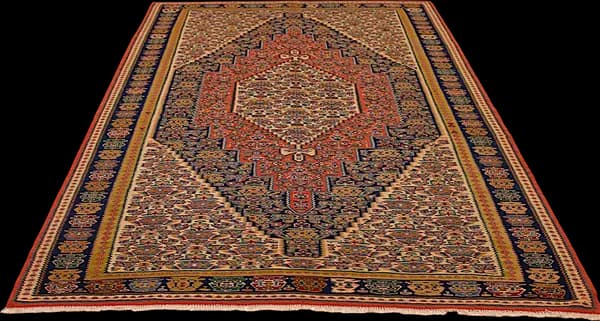
This is a kilim, also spelled kelim, from Kordestan in western Iran, a flatwoven rug measuring 307 x 206 cm (10'1" x 6'9"). Unlike the knotted rugs of the region, a kilim is woven flat, wefts and warps interlocking with no pile at all, which gives it a lightness and a graphic clarity that knotted weaving rarely allows.
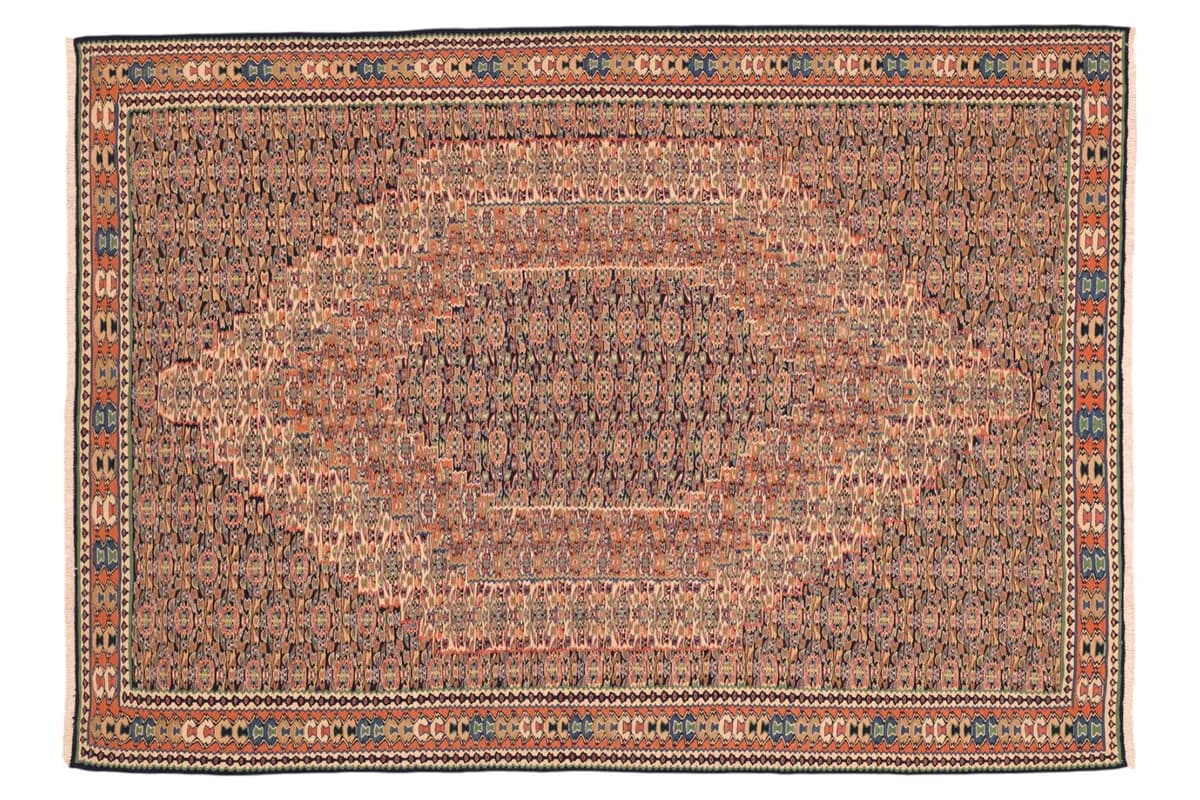
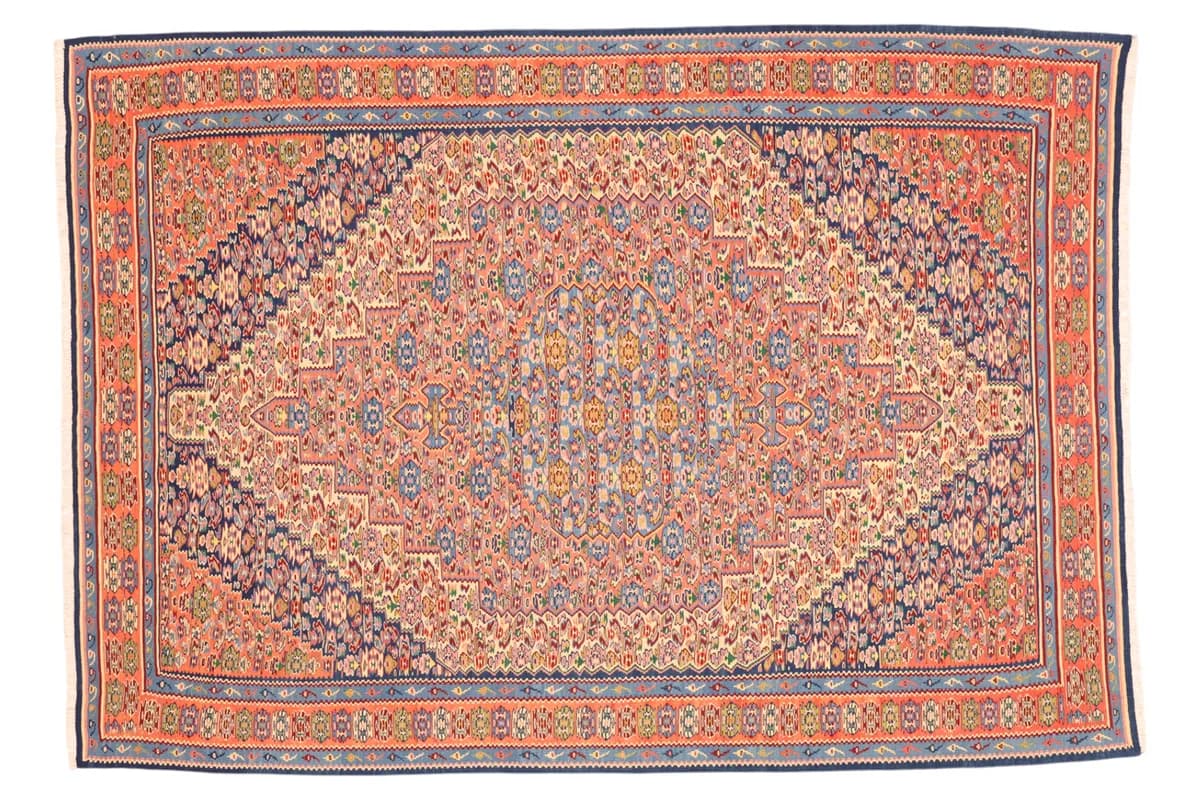
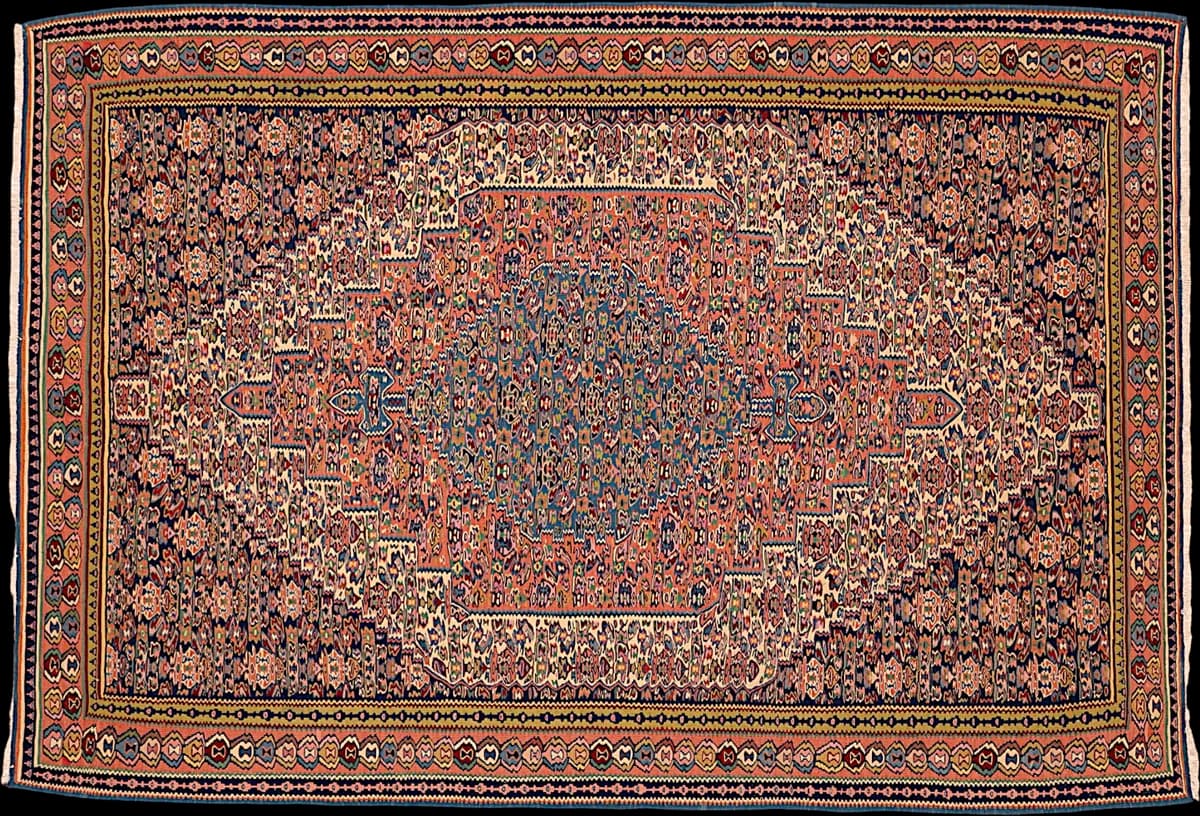
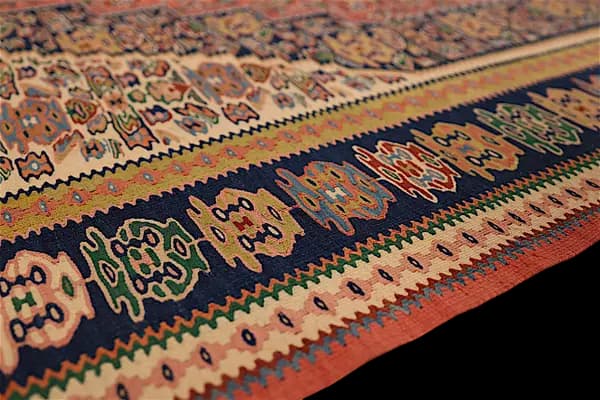
The field opens in a warm salmon-coral, and rising from its centre is a stepped diamond medallion built up in concentric layers of coral and cream, its outline jagged rather than curved. Around this glowing centre runs a dense navy-blue border, packed with small repeating geometric figures, and framed in turn by narrow guard stripes of mustard-gold and cream. Touches of green, sky blue and burgundy sit scattered through the ornament, small notes of colour against the dark ground.
The stepped outline is not decoration alone; it follows from the technique. A kilim is built row by row on straight wefts, and a pattern worked this way naturally steps rather than curves. Handspun wool wefted onto a cotton warp gives the surface its faint ribbing and light sheen. Woven to just 4mm, the rug is thin and supple, and because the pattern is carried through the weave itself, both faces read equally clearly, doubling how long the piece can be used.
Laid under a seating group or dining table, this coral kilim suits a living or dining room, warming a pale floor and holding its own against dark wood or navy upholstery. Underfoot it is thin, flat and cool, made for daily use rather than careful protection, and reversible for years to come. Through the day the coral catches the light, and the stepped medallion seems to shift against its navy ground.
More on Kilims: origin, making and how to recognise a genuine piece
At 307 × 206 cm (6.32 m²) this is a large rug. It sits under a seating group with the front legs of sofa and chairs on it, or under a dining table for four. A table for six wants about 80 cm of clearance all round, and needs more.
No — this piece is hand-woven, not knotted. A flatweave has no pile: the pattern comes from warp and weft alone. That makes it thin, light and usable on both sides, and it is a technique in its own right rather than a simpler version of a knotted rug.
Vacuum regularly, ideally along the weave and without a rotating brush. A flatweave can be turned over, which spreads the wear — flip it once or twice a year. Blot spills at once with clear water and a light cloth, working inwards, and never rub.
We are in the Hamburg Speicherstadt. Come and see this rug in daylight, or write to us — a person answers.
Certificate included verifying origin, materials, and craftsmanship.
Ref: 626406