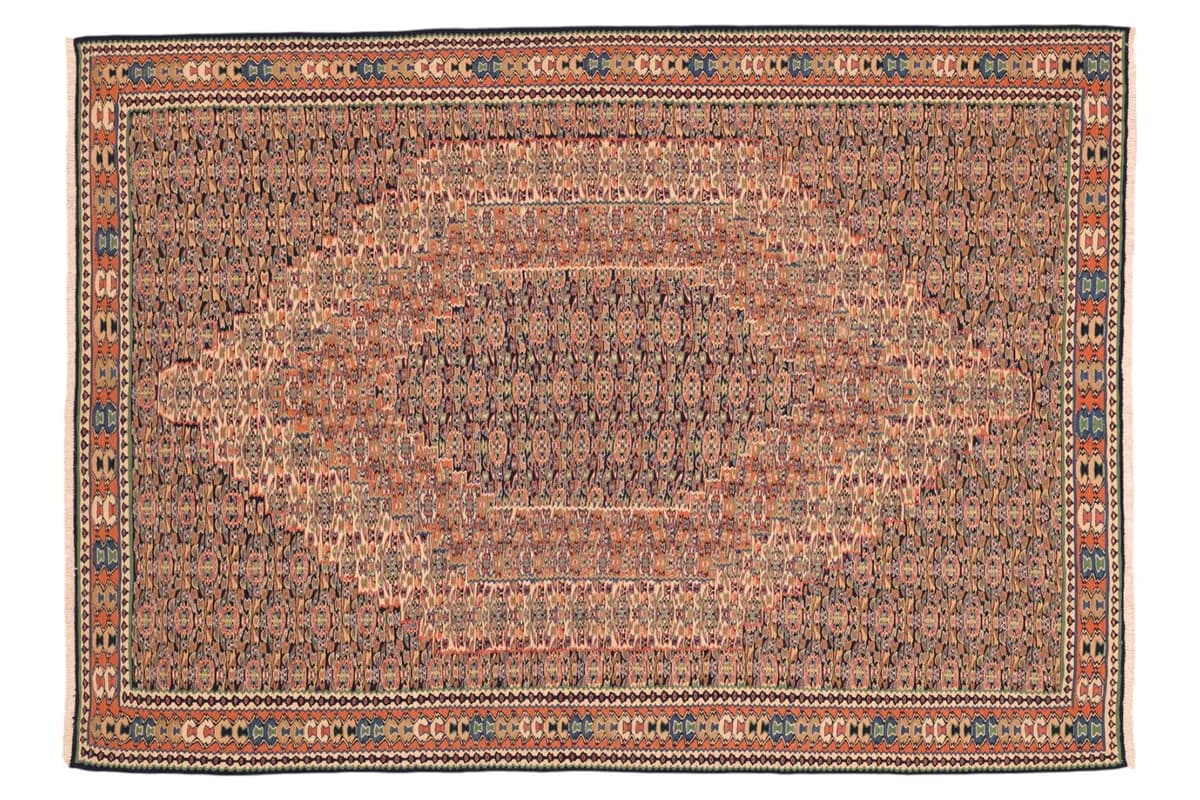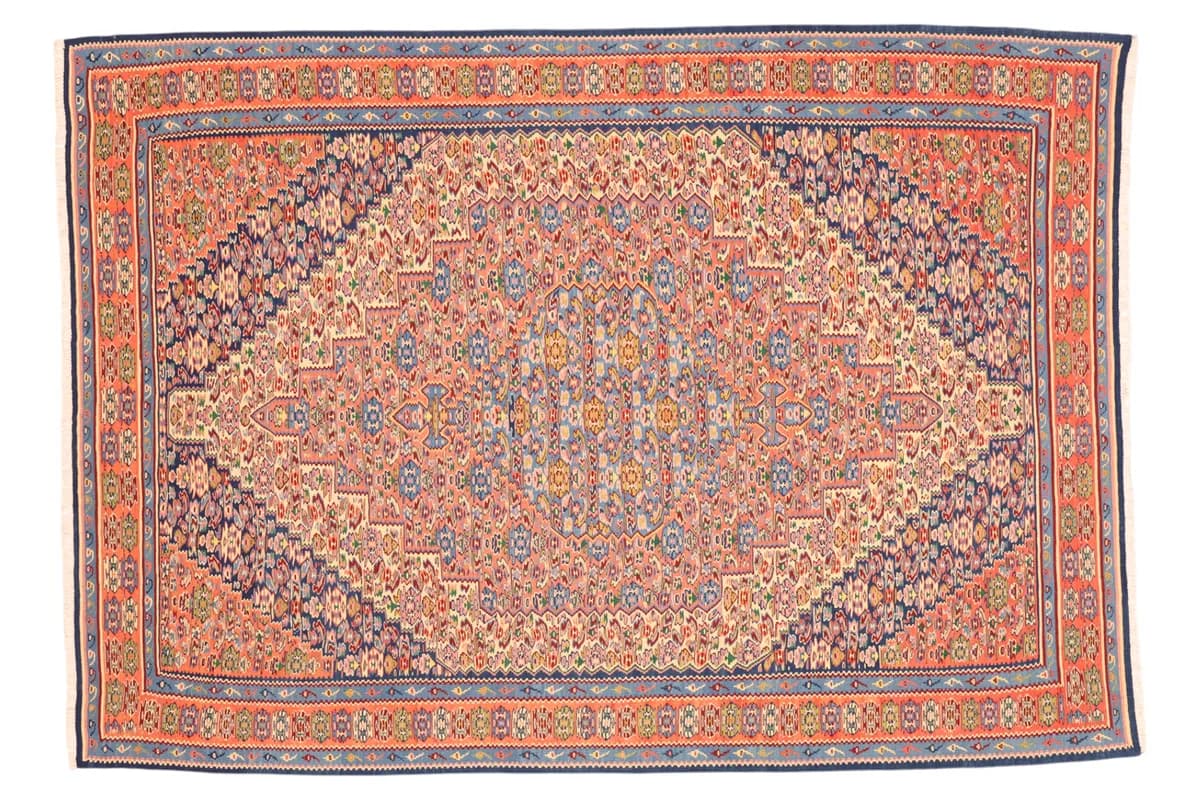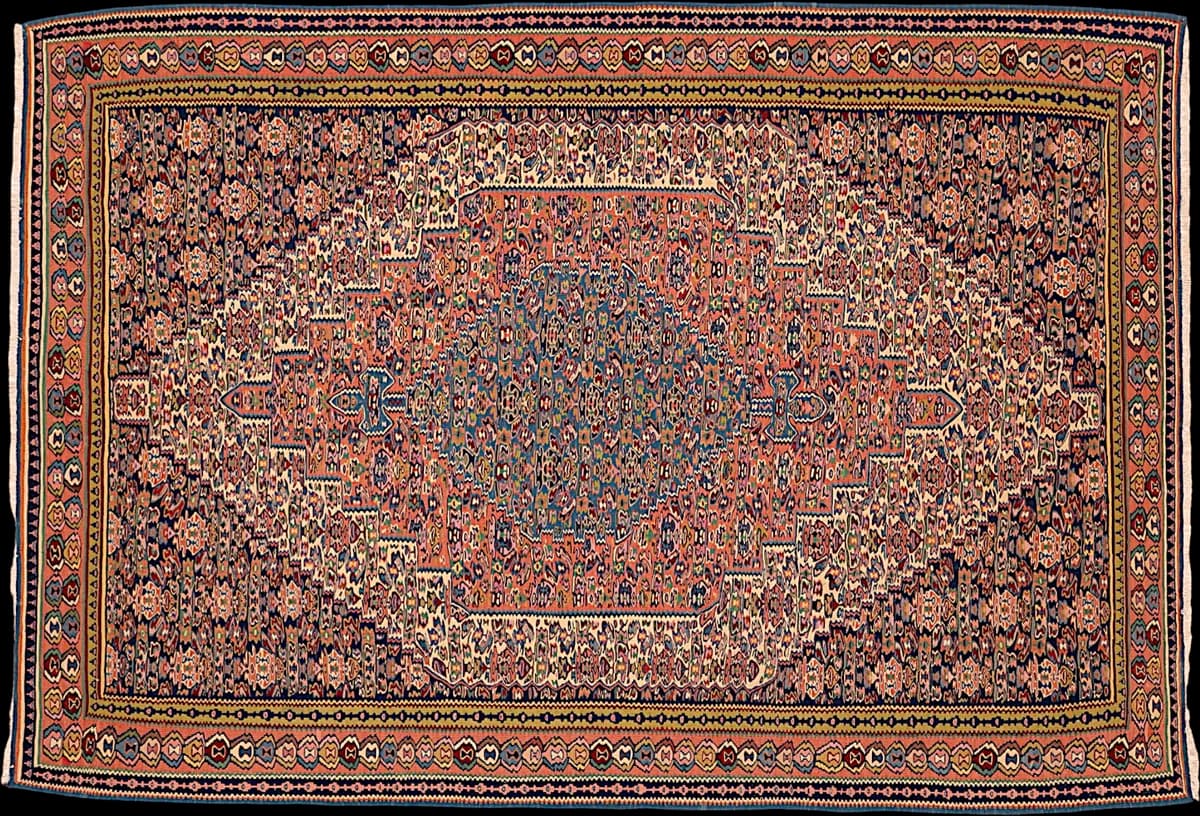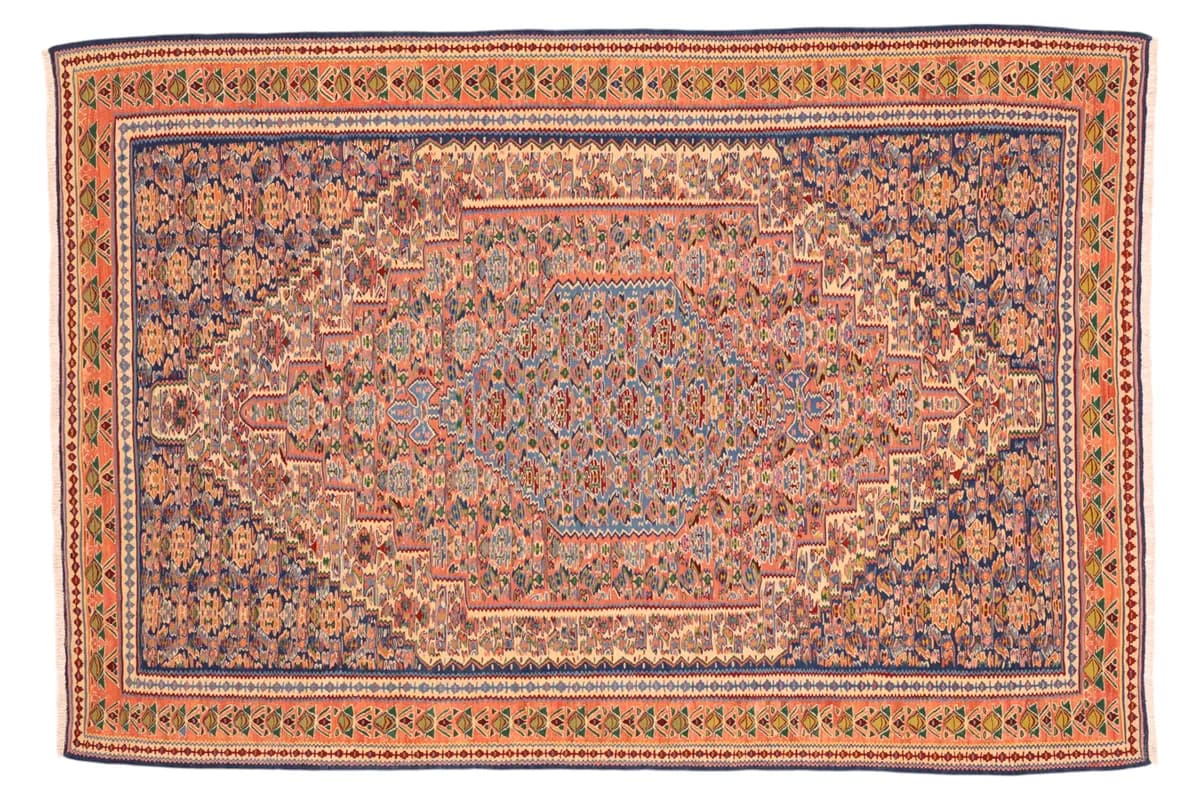
Kelim
301 × 193 cm
1.307 €


960 €
Incl. VAT
In Stock · Ready to Ship
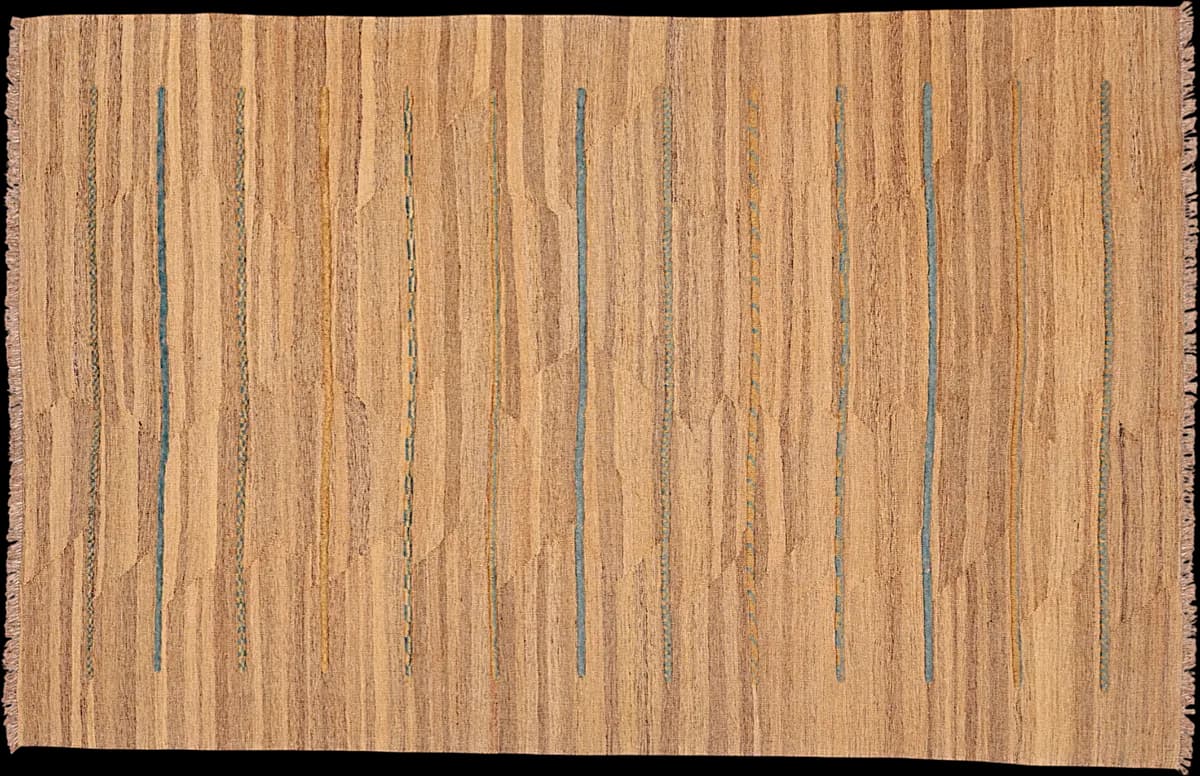
Kilim, 234 x 172 cm (7'8" x 5'8"), a flatwoven rug from the tribal weaving regions of Iran, where kilim work is known for a light, flexible hand and for patterns bold enough to read the same from both sides. This particular piece is not one weaving but several: a patchwork built from older kilim strips, each with its own stripe width and tone, joined into a single rectangular field. What you are looking at is assembly as much as pattern.
The overall impression is a warm, sandy patchwork, beige running into camel across panel after panel. The rug is laid out as a grid of striped rectangles, some wide-banded, some fine, each block separated from its neighbour by a thin ivory line or a darker stripe in brown or charcoal. One or two panels sit slightly cooler, a grey-toned strip breaking the earth palette without disturbing it. A narrow beige border runs around the whole piece, with a single dark brown line set just inside it, holding the patchwork together rather than framing a picture. There is no medallion here and no central motif — the interest is in the rhythm of the seams and the shifting stripe widths, quilt-like rather than symmetrical.
The construction explains this directly. Kilim is weft-faced, the pattern built entirely by the weave rather than knotted into a pile, which gives the surface its ribbing and its flat, matt face with no depth to shear. Here that weaving has happened twice over: once when each strip was first made, on natural wool warp with hand-spun wool weft, and again when a weaver later cut, matched and stitched several such strips into one 5 mm-thick panel. The visible seams are not a flaw in that process — they are the process, the record of several older weavings brought together by hand.
A rug this light and this flat suits a room where it will be walked on rather than admired from the doorway — a study, a den, a casual seating corner in a living room. Against pale floorboards the sandy beige and camel warm the room without weight; against darker furniture the panel seams and ivory lines keep catching the eye and holding it. Underfoot it is thin and supple, easy to fold back or reposition, and being reversible it wears evenly from both faces over years of daily use. Afternoon light moves differently across each strip, and the rug never quite settles into one flat impression.
More on Kilims: origin, making and how to recognise a genuine piece
At 234 × 172 cm (4.02 m²) this is a medium rug. It works in front of a sofa, in front of a bed or in a study. It is too small for a dining table — there you want about 80 cm of clearance so a chair does not tip over the edge when pushed back.
No — this piece is hand-woven, not knotted. A flatweave has no pile: the pattern comes from warp and weft alone. That makes it thin, light and usable on both sides, and it is a technique in its own right rather than a simpler version of a knotted rug.
Vacuum regularly, ideally along the weave and without a rotating brush. A flatweave can be turned over, which spreads the wear — flip it once or twice a year. Blot spills at once with clear water and a light cloth, working inwards, and never rub.
We are in the Hamburg Speicherstadt. Come and see this rug in daylight, or write to us — a person answers.
Certificate included verifying origin, materials, and craftsmanship.
Ref: 659376