Kelim
297 × 204 cm
1.364 €






1.253 €
Incl. VAT
In Stock · Ready to Ship
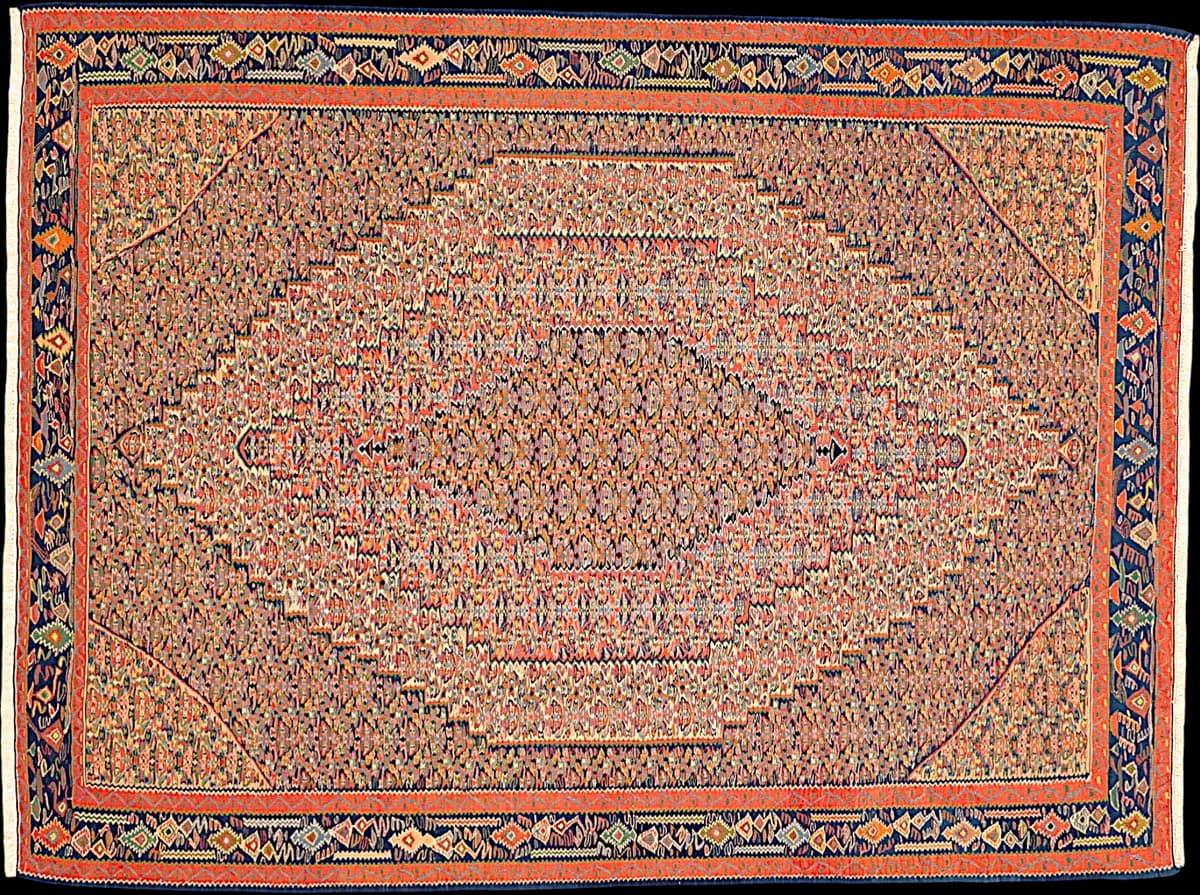
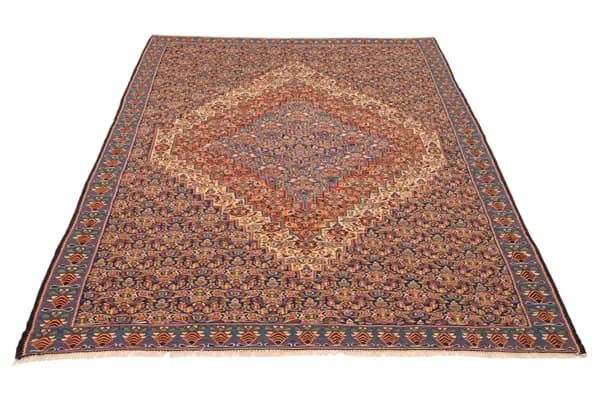
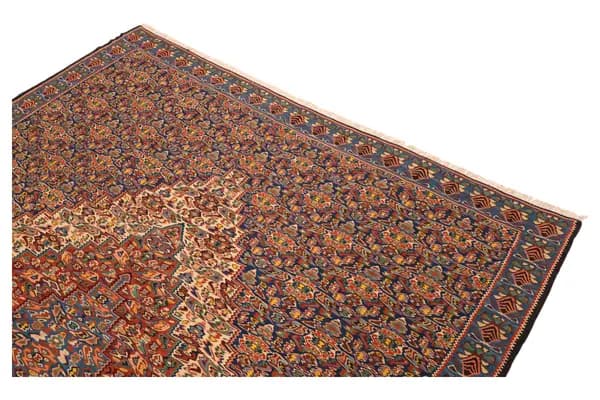
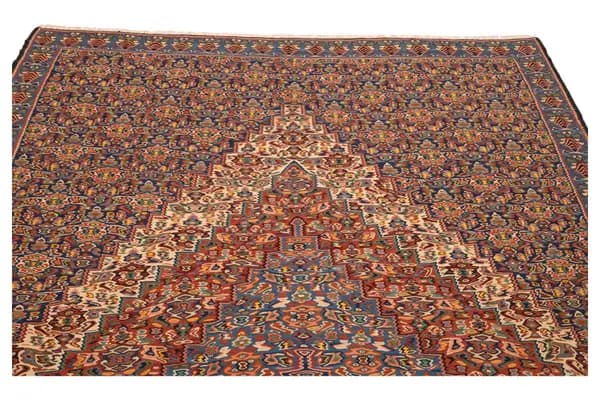
This is a Kilim, also written Kelim, from Kordestan in Iran's Kurdish northwest, woven flat rather than knotted, 287 x 194 cm (9'5" x 6'4"). Kilims from this region are known for bold geometry and a lightness that lets them work equally well underfoot or on a wall. What sets this one apart is a medallion pattern, normally the preserve of finer knotted Senneh rugs, rendered here with real precision.
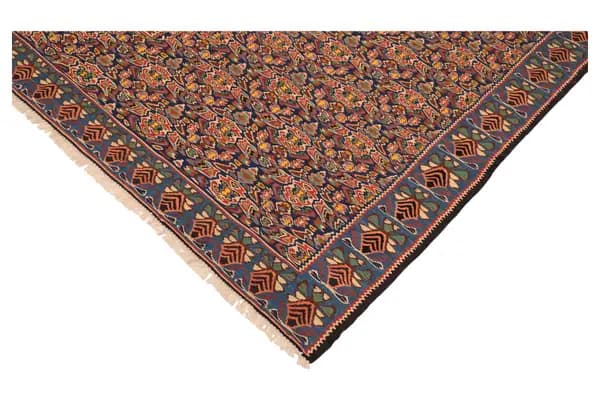
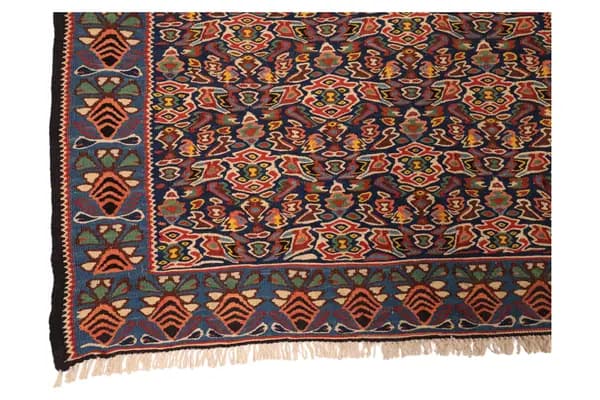
A deep navy ground carries the eye first, filled edge to edge with a dense Mahi lattice of small repeating diamonds. Out of this field rises a large stepped medallion, its outline built from two nested diamonds, cream within red, giving it a layered, pixelated precision. Touches of green, ochre and burgundy sit scattered through the lattice, warming the navy. A narrow border, navy-ground, carries a stylised botteh motif in rust, cream and sage, framing the field.
The weave is entirely flat, with no pile, built from hand-spun wool over a cotton warp at a thickness of just 4 mm. That weft-faced construction is what gives the pattern its crisp edges — with nothing to soften a line, each diamond and each step of the medallion is drawn as sharply as if inked. Because the design is woven through rather than knotted on, it reads with equal clarity on both faces, so the rug can be turned or laid either side up.
This rug suits a living or dining room, large enough to sit under a seating group or table without disappearing. The navy ground holds its own against dark wood, while the red medallion lifts a paler floor. Underfoot it is thin, firm and flat, at home under daily use. As light moves across it, the sharp diamonds of the medallion seem to resettle, never quite the same twice.
More on Kilims: origin, making and how to recognise a genuine piece
At 287 × 194 cm (5.57 m²) this is a large rug. It sits under a seating group with the front legs of sofa and chairs on it, or under a dining table for four. A table for six wants about 80 cm of clearance all round, and needs more.
No — this piece is hand-woven, not knotted. A flatweave has no pile: the pattern comes from warp and weft alone. That makes it thin, light and usable on both sides, and it is a technique in its own right rather than a simpler version of a knotted rug.
Vacuum regularly, ideally along the weave and without a rotating brush. A flatweave can be turned over, which spreads the wear — flip it once or twice a year. Blot spills at once with clear water and a light cloth, working inwards, and never rub.
We are in the Hamburg Speicherstadt. Come and see this rug in daylight, or write to us — a person answers.
Certificate included verifying origin, materials, and craftsmanship.
Ref: 824628