Kelim Senneh
296 × 196 cm
1.305 €





1.364 €
Incl. VAT
In Stock · Ready to Ship
A kilim from the tribal weaving regions of Iran, 297 x 204 cm (9'9" x 6'8"), flatwoven rather than knotted. The type is known for bold, expressive geometry and for being reversible, since the pattern is woven through rather than tied on top — but this piece takes that same tradition and turns the volume down.
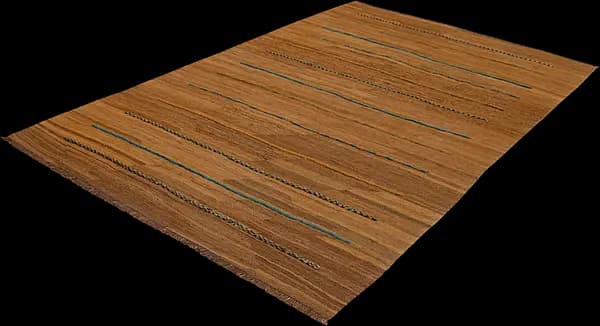
The ground is a warm camel, left plain across most of its width, and a dozen slender stripes cross it in teal-blue and mustard-gold, unevenly spaced, one twisted like a cord, another checked in dark and cream. There is no medallion, no repeating field pattern, and no framing border — the stripes simply run to the edge and stop, leaving the camel ground to do most of the talking. It is a kilim that reads as calm rather than busy, closer to a piece of modern design than to the dense patterning the format is usually known for.
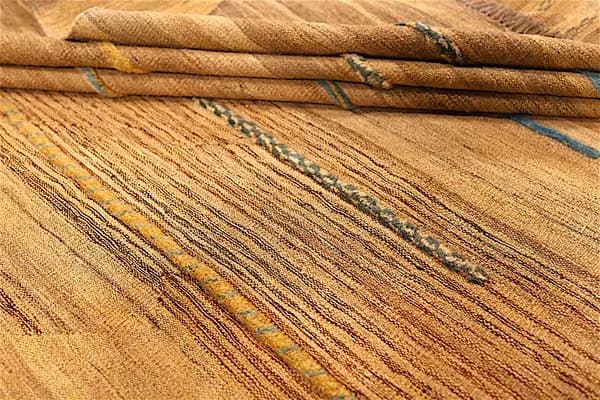
That calm comes directly from the weave. A kilim carries its pattern in the weft threads themselves, woven flat with no pile, which is why the surface here shows a faint ribbed texture and a clearly visible warp rather than any raised design. The wool weft was hand-spun rather than machine-spun, so each stripe varies slightly in thickness and tension as it was worked — which is why the accents shift in width and rhythm rather than repeating evenly, a small unevenness that comes from the hand and not from any fault. At four millimetres thick, the whole rug is light enough to fold, and because both faces are woven equally well, either side can be shown.
At just under three metres by two, this suits a hallway or a seating area as easily as a study floor, and its flatness means it lies without fuss under furniture or on top of another rug. The camel ground will warm a pale wood or stone floor without competing with darker furniture nearby, and the stripes stay legible even in a room with little daylight, since there is no dense pattern that needs sun to read. Underfoot it is smooth and firm rather than soft, entirely suited to daily use and to being walked on rather than kept for best. As the light shifts through the day, the twisted gold stripe catches it first, then settles back into the quiet of the camel ground around it.
More on Kilims: origin, making and how to recognise a genuine piece
At 297 × 204 cm (6.06 m²) this is a large rug. It sits under a seating group with the front legs of sofa and chairs on it, or under a dining table for four. A table for six wants about 80 cm of clearance all round, and needs more.
No — this piece is hand-woven, not knotted. A flatweave has no pile: the pattern comes from warp and weft alone. That makes it thin, light and usable on both sides, and it is a technique in its own right rather than a simpler version of a knotted rug.
Vacuum regularly, ideally along the weave and without a rotating brush. A flatweave can be turned over, which spreads the wear — flip it once or twice a year. Blot spills at once with clear water and a light cloth, working inwards, and never rub.
We are in the Hamburg Speicherstadt. Come and see this rug in daylight, or write to us — a person answers.
Certificate included verifying origin, materials, and craftsmanship.
Ref: 826140