Kelim Senneh
293 × 201 cm
1.325 €




1.393 €
Incl. VAT
In Stock · Ready to Ship
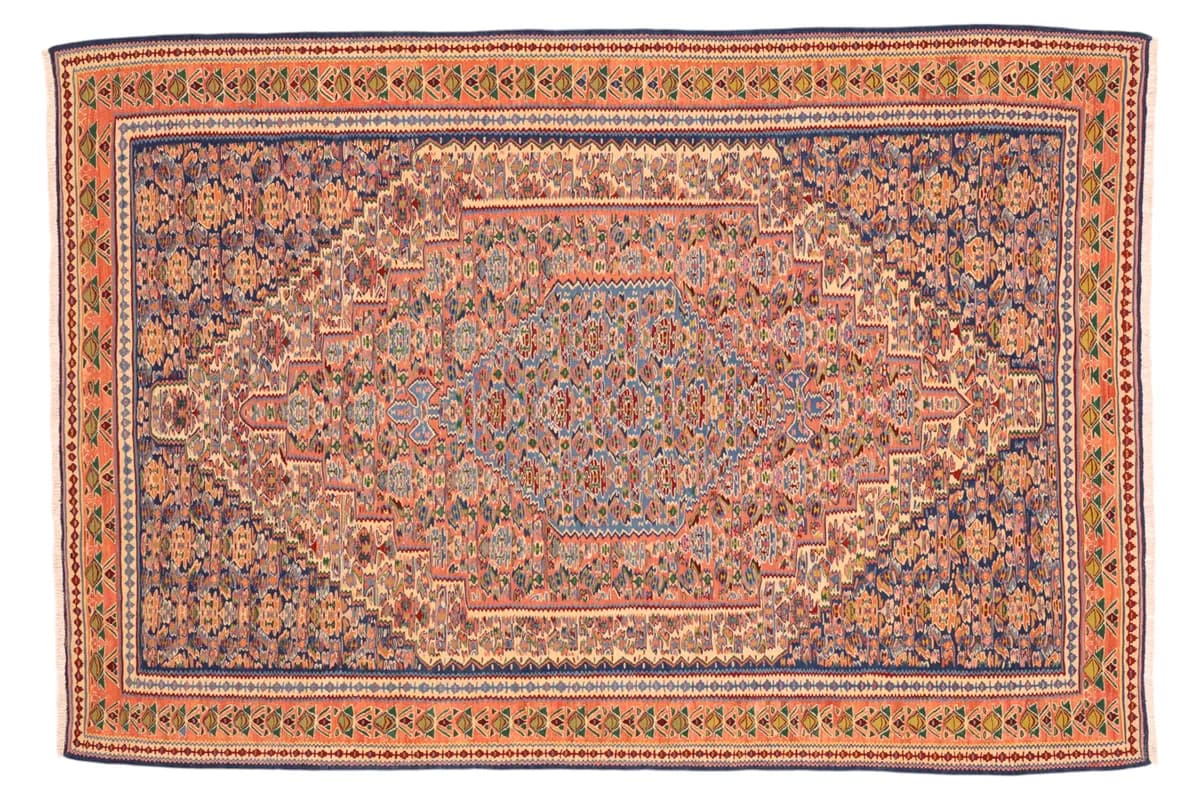
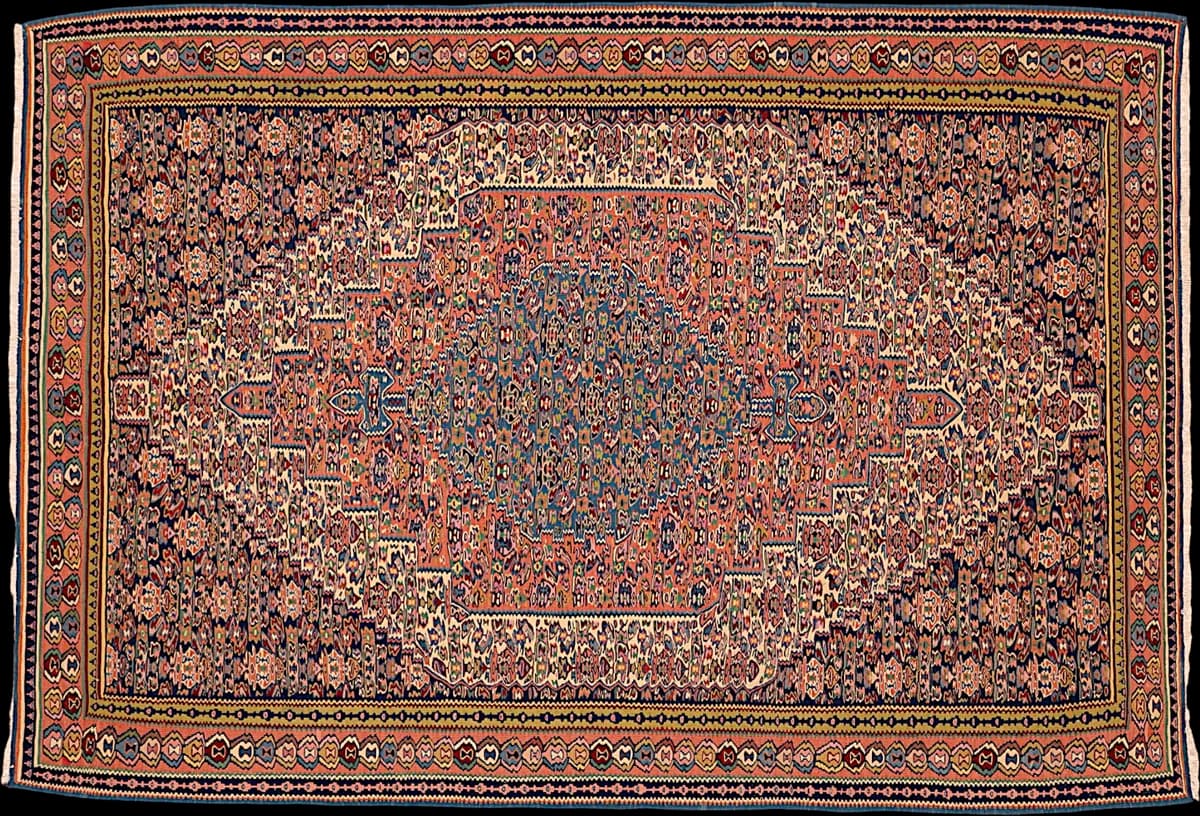
A Persian kilim from the Kurdish region of Kordestan, in western Iran, 299 x 207 cm (9'10" x 6'9"). Kilims are flatwoven rather than knotted, which gives them a lighter, more pliable hand than a pile rug, and they are finished so that both faces read equally well. This piece takes that tradition and gives it something unusual: a fixed centre.
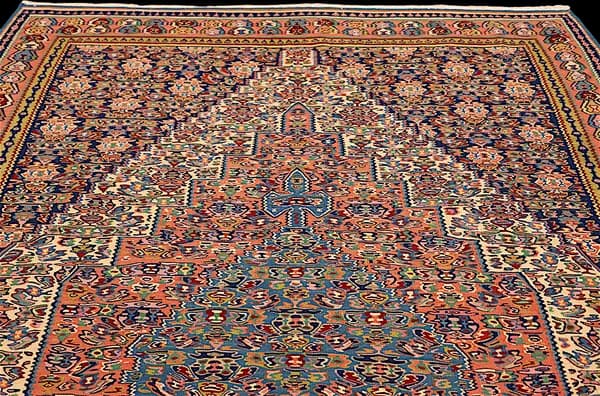
The field is a warm salmon pink, filled edge to edge with the small fish-and-rosette repeat known as Mahi. Set over it is a large diamond medallion in a cool steel blue, its corners resolved in ivory spandrels, so the eye settles on the middle rather than travelling the whole surface. A wide navy border, patterned with small many-coloured boteh shapes, closes the design, framed by narrow salmon and olive guard stripes. Teal, rust, mustard and dark red surface throughout as small accents, keeping the pattern lively without disturbing its new-found centre.
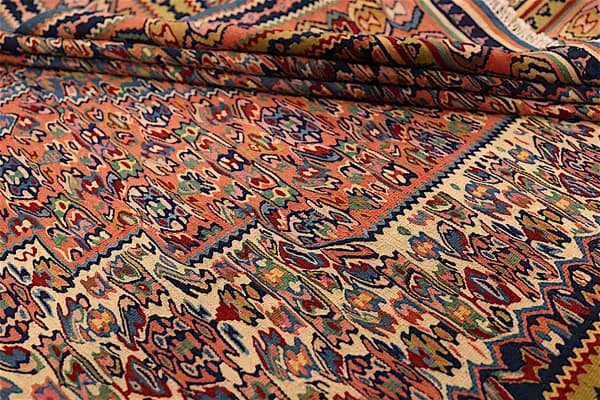
Nothing here is knotted. The pattern is built by interlocking coloured wefts directly into a cotton warp, using handspun wool, which is what gives kilims their flat, graphic clarity and their strength on both sides — a rug that wears from either face effectively doubles its working life. At only 4 mm thick it lies close to the floor and folds easily, yet the weaver has used that plain technique to draw something a kilim rarely carries: a proper medallion, holding a dense allover field to a single point rather than letting it simply repeat.
At just under three metres, it suits a dining table with the chairs pulled out, or a seating group in a living room. The salmon ground warms a pale wooden floor, and the steel-blue medallion gives it enough weight to hold its own against dark furniture. Underfoot it is thin, firm and flat, built for daily use rather than careful preservation, and its reversibility means an uneven wear pattern is never the end of it. Morning light picks out the mustard and teal first; by afternoon it is the blue medallion that holds the room.
More on Kilims: origin, making and how to recognise a genuine piece
At 299 × 207 cm (6.19 m²) this is a large rug. It sits under a seating group with the front legs of sofa and chairs on it, or under a dining table for four. A table for six wants about 80 cm of clearance all round, and needs more.
No — this piece is hand-woven, not knotted. A flatweave has no pile: the pattern comes from warp and weft alone. That makes it thin, light and usable on both sides, and it is a technique in its own right rather than a simpler version of a knotted rug.
Vacuum regularly, ideally along the weave and without a rotating brush. A flatweave can be turned over, which spreads the wear — flip it once or twice a year. Blot spills at once with clear water and a light cloth, working inwards, and never rub.
We are in the Hamburg Speicherstadt. Come and see this rug in daylight, or write to us — a person answers.
Certificate included verifying origin, materials, and craftsmanship.
Ref: 762508