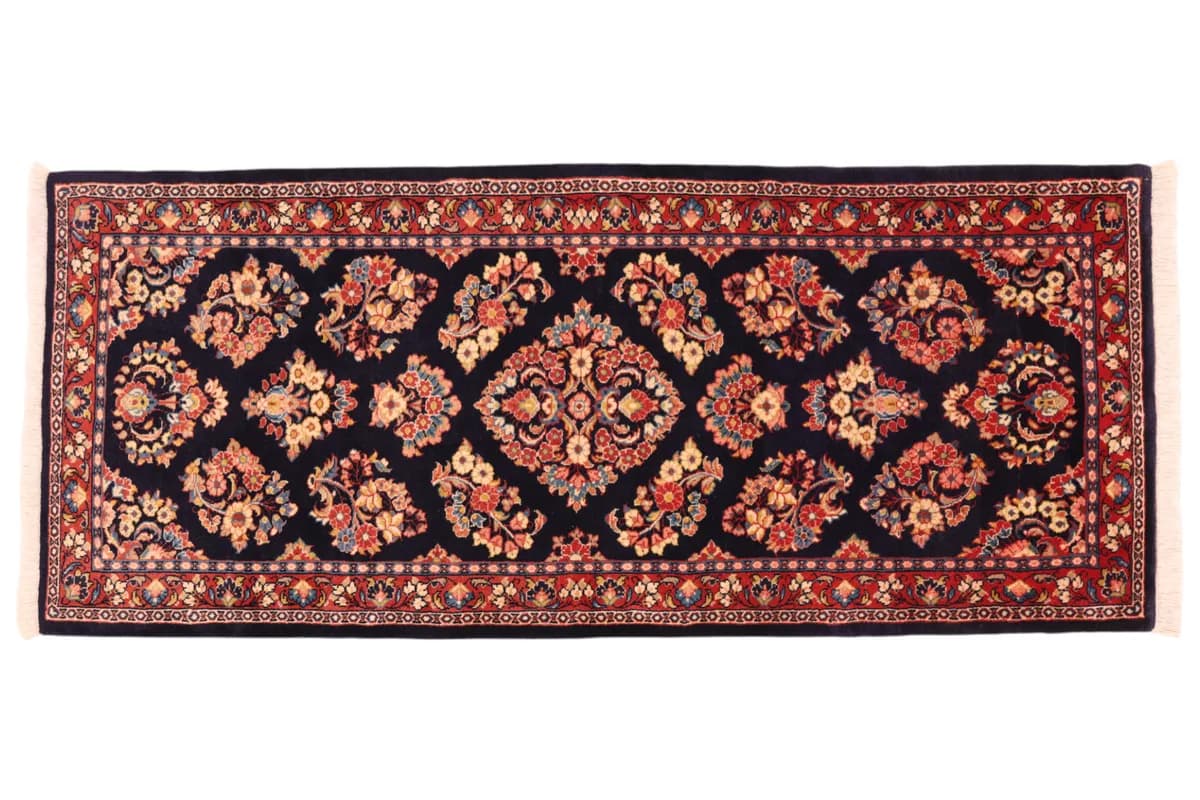
A Kurdish province weaving like a city
Anyone who knows Kurdish rugs expects coarse, robust village work: Bidjar, Koliayie, Kordi. Ilam breaks with that. The province lies in western Iran on the Iraqi border, its population is largely Kurdish — and its rugs are among the finest in the country.
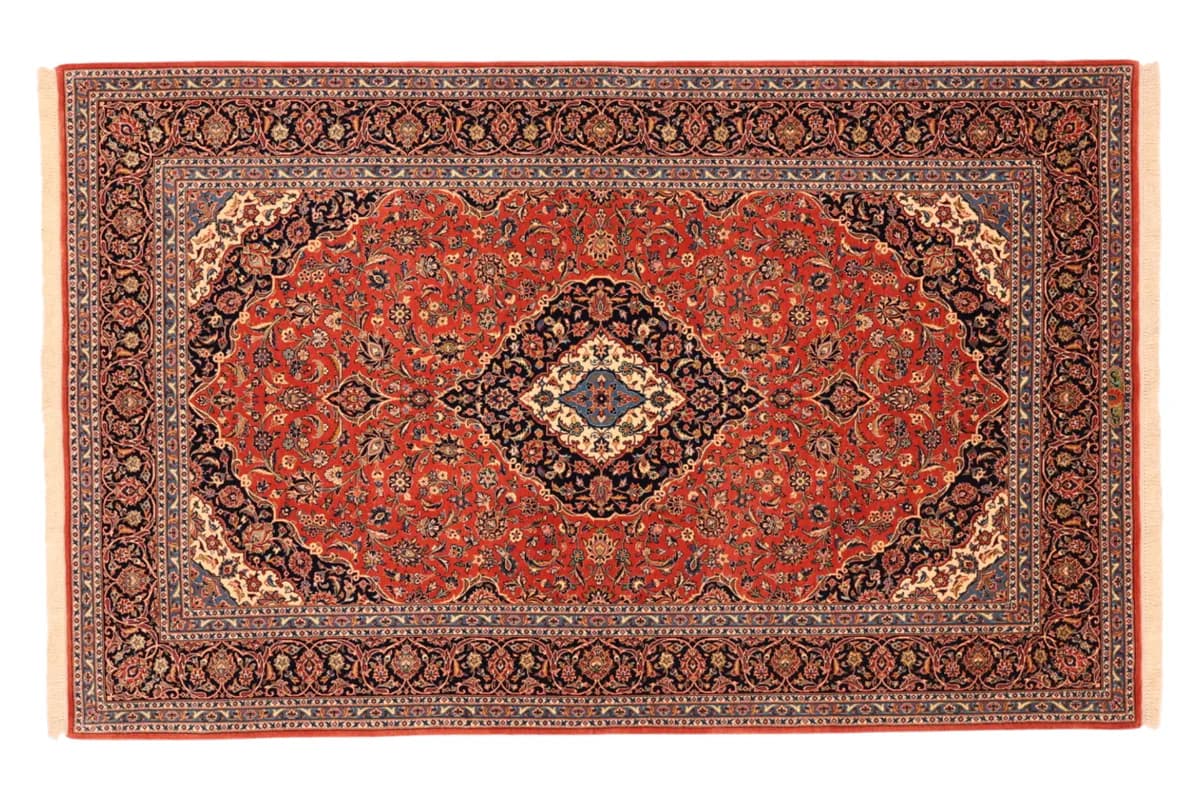
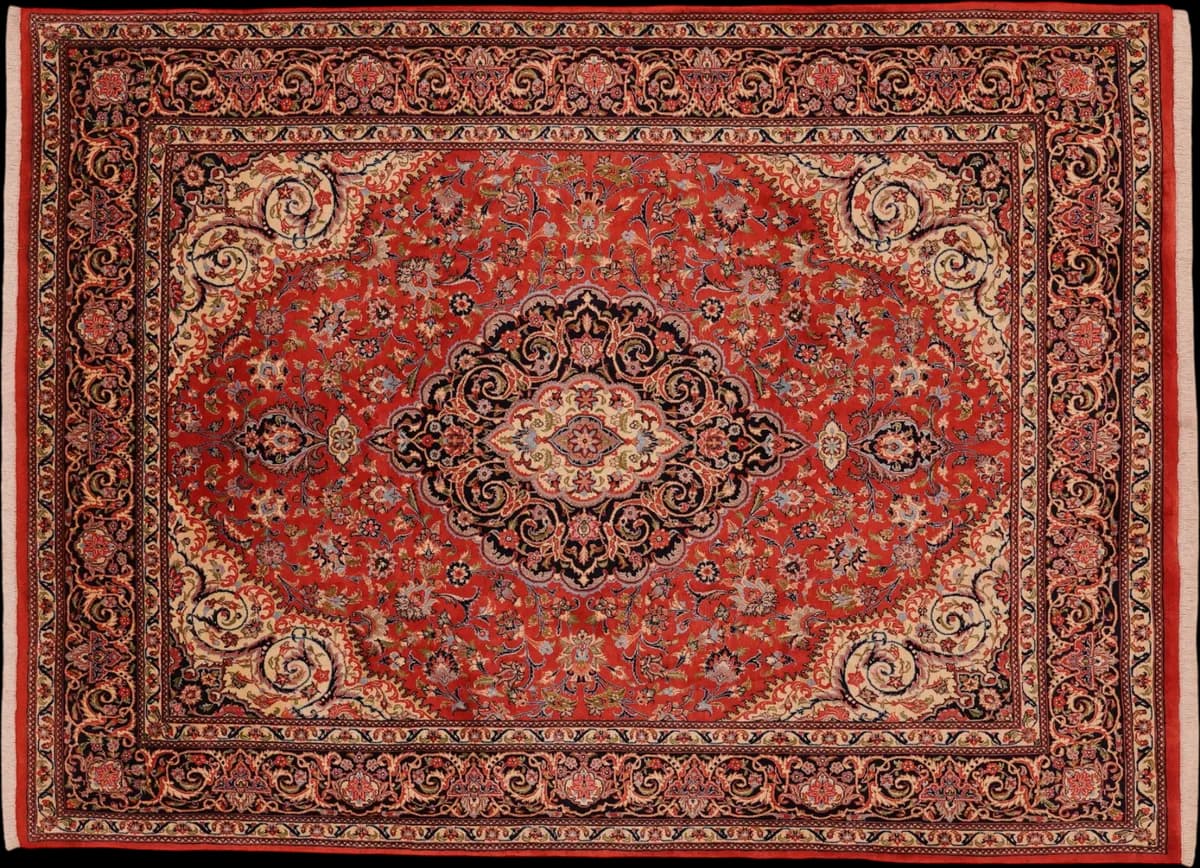
The reason is the form of production. What comes out of Ilam is workshop weaving to a drawn cartoon, not freehand village knotting. The technical equipment matches that of the great manufacturing cities: silk warp, graded silk content in the pile, a short-sheared surface.
This is not a contradiction but a recent development. Fine weaving is not a question of ethnicity but of workshop organisation, material and training — and that has established itself in Ilam over the past few decades.
What 800,000 knots actually mean
At eight hundred thousand to a million knots per square metre there are roughly nine hundred to a thousand rows of knots side by side. Each knot is tied by hand around two warp threads. A rug of three square metres carries between two and a half and three million knots.
This density is not a number for its own sake. It is the precondition for small-scale drawing standing sharp: curving vines without visible steps at the edges, fine contour lines, leaf forms with legible internal drawing. At a quarter of the density the same pattern would blur.
The short pile belongs to it. Six millimetres is little — half what Kurdish village rugs leave standing. Only that keeps the contours sharp at the surface instead of losing them in the depth of the pile.
- Silk fringes as the extended warp — thin, lustrous, cool to the touch.
- Back with a very fine knot pattern and the design fully drawn through.
- Short pile of around 6 mm, smooth surface.
- Exact symmetry — workshop work to a cartoon, not freehand drawing.
- Shifting lustre wherever silk lies in the pile.
Which room an Ilam suits
Formats between about 2.5 and 5.5 square metres cover more than an Isfahan does: from a seating corner to a smaller living room. The same limitation applies as for every fine weaving, though.
A pile containing silk does not take constant traffic. It belongs where it is seen — in front of a sofa, in a study or bedroom, in a reception area. A hallway in daily use is the wrong place.
The medallion composition also wants an open middle. A sofa covering half the rug takes from a medallion rug exactly what defines it — unlike an all-over field, which continues identically at any point.
Care
Vacuum without a rotating brush, along the pile. On a silk-containing pile the brush is not a matter of caution but excluded: it pulls the fine fibres out.
Do not beat it, and keep it out of permanently direct sun. Silk fades faster than wool, and a fine construction takes mechanical shock worse than a dense wool rug.
Blot spills at once, never rub. For a deep clean a silk-containing rug belongs in expert hands.
Ilam or Isfahan?
Both are fine workshop weavings on a silk warp with a wool-and-silk pile. The differences are small and lie mainly in format and price.
| Criterion | Ilam | Isfahan |
|---|---|---|
| Region | Ilam province, western Iran | Esfahan, central Iran |
| Knot density | 800,000 – 1,000,000 / m² | 640,000 – 1,000,000 / m² |
| Typical size | 2.5 – 5.5 m² | 2.5 – 3.5 m² |
| Pattern | almost always medallion | medallion and all-over |
| Recognition | less established in the market | a classical name with long tradition |
Common questions
Is an Ilam a Kurdish rug?
Geographically yes — Ilam province is largely Kurdish. By construction it is a fine workshop weaving to a drawn cartoon and has technically little in common with coarse Kurdish village work such as Koliayie or Kordi.
Why is Ilam less known than Isfahan or Tabriz?
Because the fine production there is younger. Isfahan and Tabriz have carried their reputation for centuries; Ilam established itself as an address for high-quality weaving only in recent decades. For a buyer that often means a better ratio of fineness to price.
How do I recognise the silk warp?
By the fringes: silk is thinner, smoother and more lustrous than cotton and feels cool. Since the warp is the load-bearing structure of the rug, it cannot be changed afterwards.
Does an Ilam suit underfloor heating?
Yes. A short-sheared rug with a thin construction insulates little and lets the heat through. What matters more is that the floor is evenly tempered and the rug does not lie over a locally very hot spot.
Is the high knot density worth the premium?
It is the precondition for the fine drawing — without it the same pattern would blur. Whether that is worth the premium depends on the picture you want: small-scale precise ornament needs the density; a strong geometric drawing is available at a quarter of it for a fraction of the price.