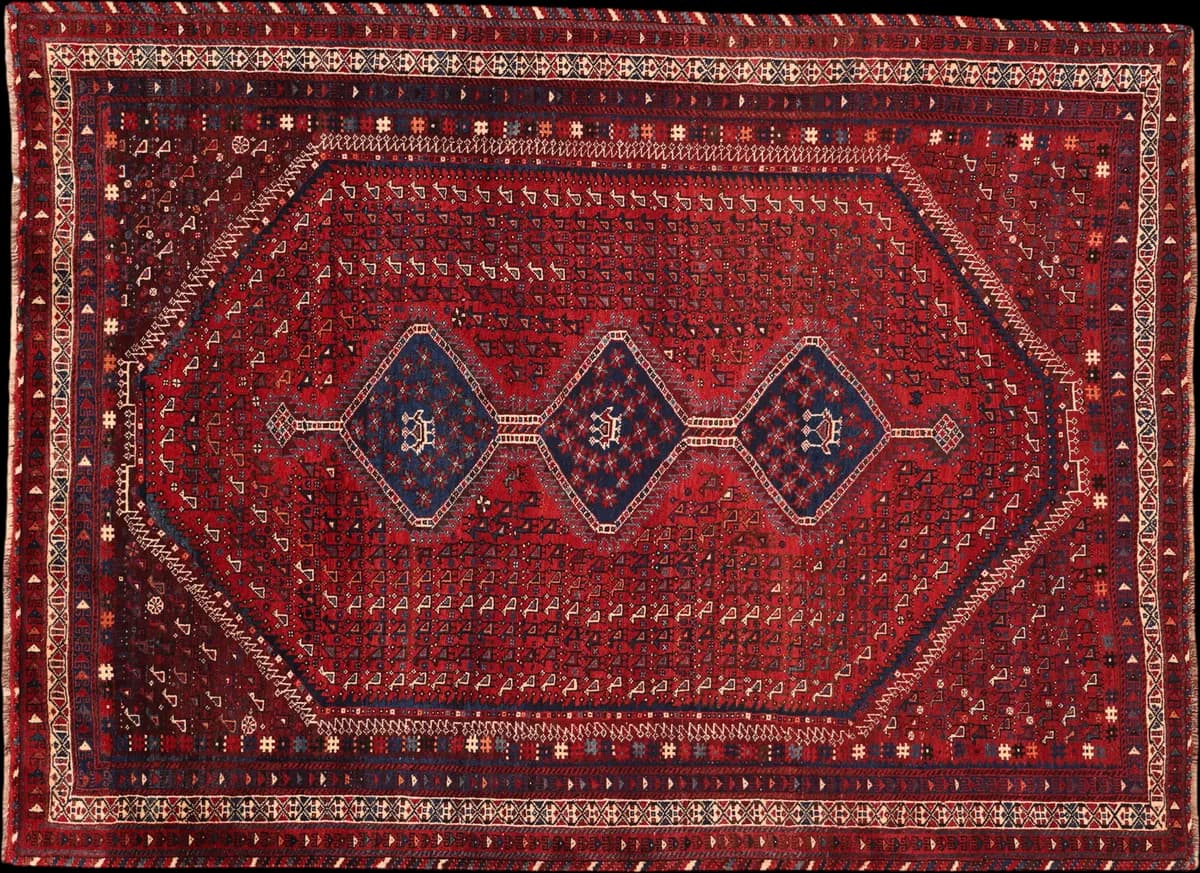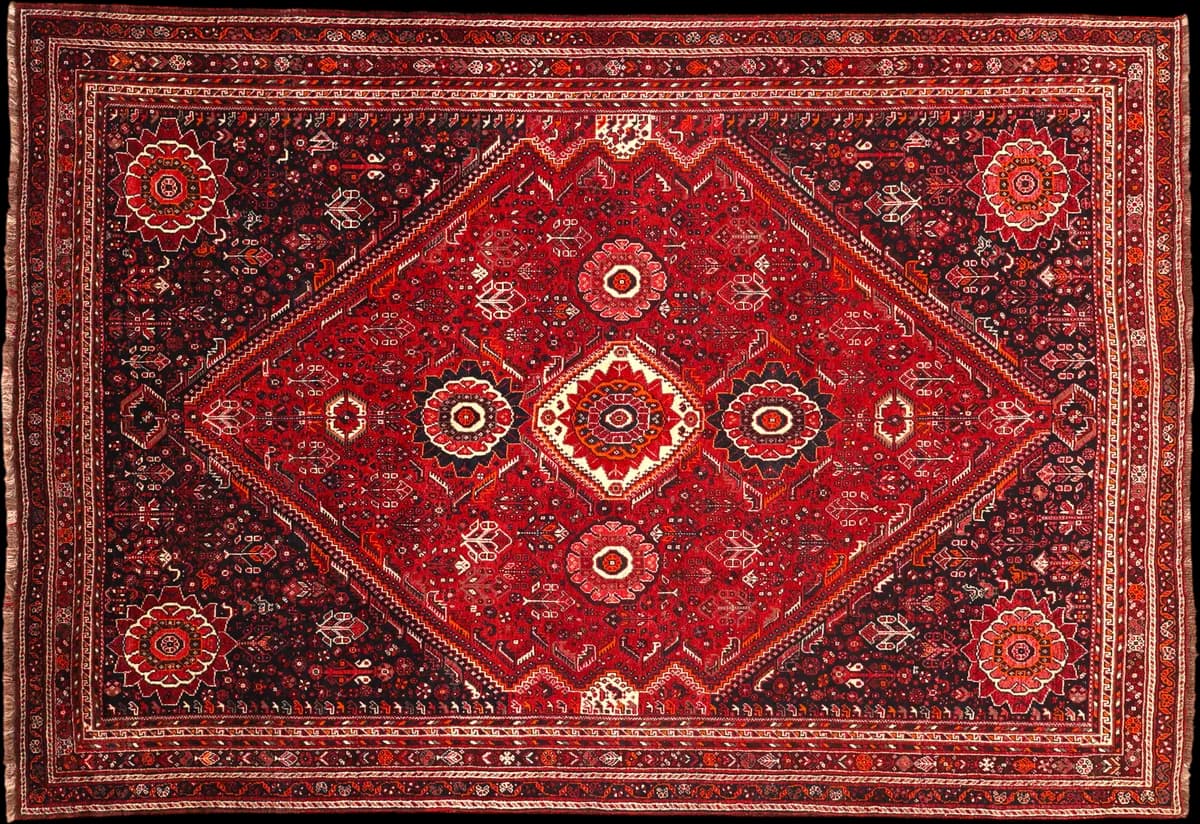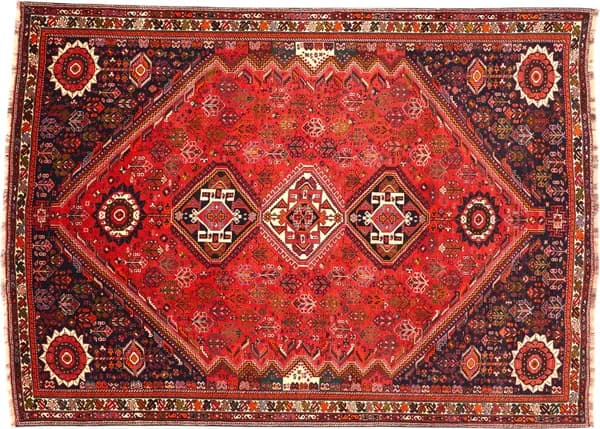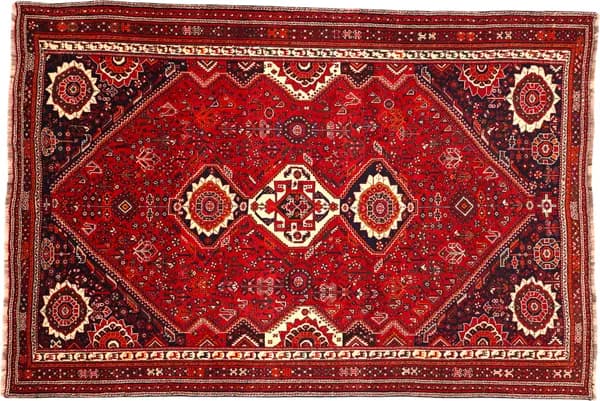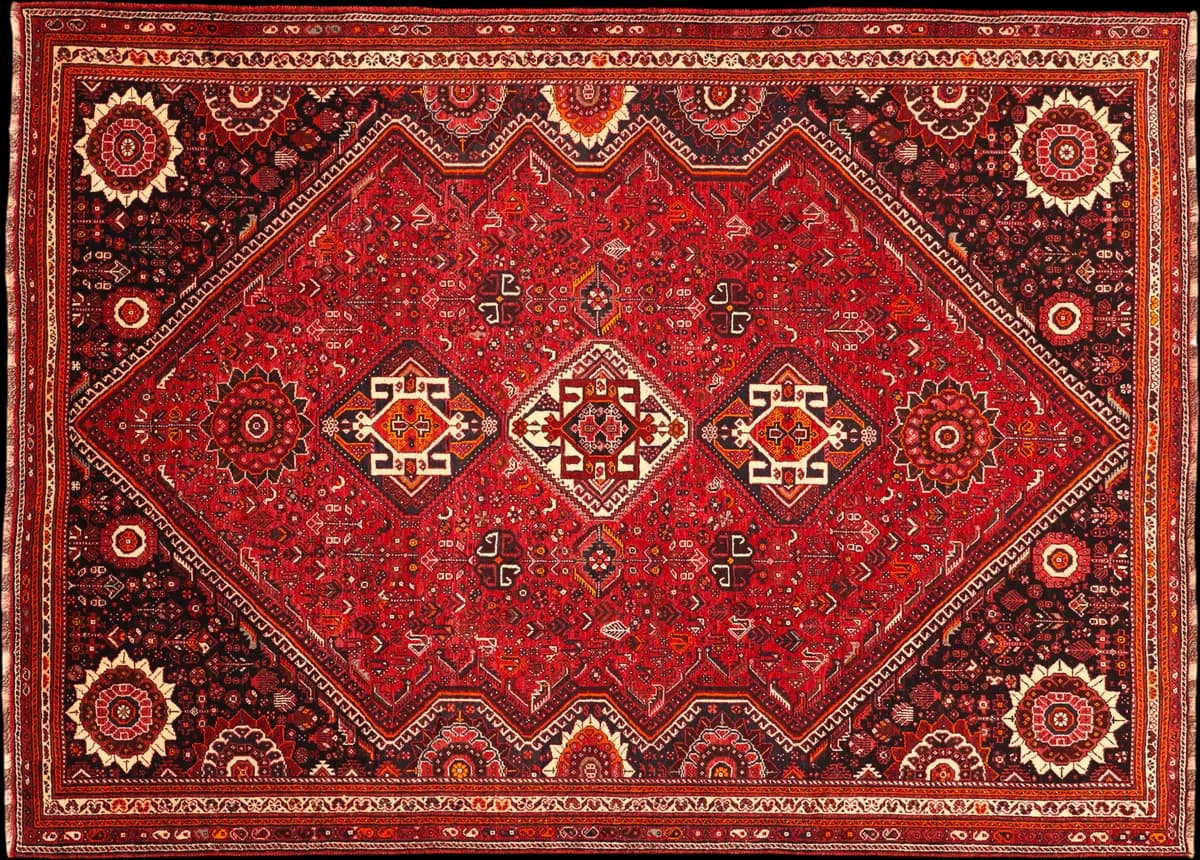
Who the Qashqai are
The Qashqai are a Turkic-speaking tribal confederation in southern Iran and one of the largest in the country. They migrate seasonally: to the Zagros highlands in summer, down to the warmer plains near Shiraz in winter. That migration shapes how their rugs are built.
A loom that has to go on a pack animal twice a year is horizontal, demountable and narrow. That limits the width of the rug and explains why formats rarely reach the dimensions of city workshop pieces. It also explains the warp: wool is elastic and survives repeated tensioning, where cotton would be too brittle.
The weaving is done without a cartoon. The weaver knows the patterns of her family and sets them from memory. What emerges is never exactly symmetrical — and that is precisely what separates a tribal weaving from a rug worked to a drawn plan.
How to recognise a Qashqai
The fringes first. Wool fringes are matt, slightly crimped and softer than the smooth, light cotton fringes of a city rug. They are the extended warp and structural, so they cannot be swapped afterwards — which makes them a reliable mark.
Then the drawing. Everything is geometric: stepped diamond medallions, angular borders, stylised animals and plants scattered freely across the field. Rounded floral forms barely occur, and at 160,000 knots they could not be set cleanly anyway.
Then the colour. The Qashqai dye with madder, indigo and weld; red, navy and ivory carry most pieces. Soft shifts within one field are abrash, produced when a new dye bath was mixed mid-work. They are a mark of authenticity.
- Wool warp — matt, slightly crimped fringes.
- Consistently geometric drawing, set freehand.
- Slight asymmetry and abrash instead of exact mirroring.
- Substantial pile of around 12 mm.
- Rugs traded as Shiraz come from the same weaving country.
Qashqai or Shiraz — the same rug?
Shiraz is the capital of Fars province and the trading city at the heart of the tribal weaving country. What reaches the market as a Shiraz rug was knotted in the villages around the city, by settled tribal weavers whose vocabulary draws on several traditions: Qashqai, Khamseh, Luri.
A Shiraz is therefore not a city rug but a collective name for the weaving landscape around Shiraz. The overlap with Qashqai work is considerable, and the trade uses both names for very similar pieces.
Practically: if you are looking at one, look at the other. The construction is the same — wool warp, handspun wool pile, geometric drawing, comparable density.
Care
Vacuum along the pile, without a rotating brush. On a wool warp the brush is particularly worth avoiding because it pulls at the fringes.
Blot spills at once with clear water and a light cloth, working from the outside in, and never rub. The lanolin in the handspun mountain wool buys a moment.
Never comb or brush wool fringes — they are the structural warp, not a decorative edge.
Qashqai or Lori-Pars?
Both are southern Persian nomadic weavings on a wool warp from the same country. The difference is fineness and design language.
| Criterion | Qashqai | Lori-Pars |
|---|---|---|
| Knot density | around 160,000 / m² | typically 201,000–250,000 / m² |
| Drawing | geometric, traditional | modern and pared back |
| Warp | wool | wool |
| Typical size | around 5 m² | around 3.8 m² |
| Character | strong, colourful, classically nomadic | quiet, flat, contemporary |
Common questions
Qashqai, Ghashghai or Gashgai?
All three transliterate the same confederation name. Qashqai is the usual English form and Ghashghai the German one; it is worth searching both.
Is a Shiraz the same as a Qashqai?
Almost. Shiraz is the trading city of Fars province, and rugs sold as Shiraz come from the surrounding villages — some woven by Qashqai, some by Khamseh or Luri. Construction and technique are very similar, which is why this guide covers both.
Why is the knot count so much lower than a city rug?
Because the weaving is done from memory on a portable loom rather than to a cartoon in a workshop. Around 160,000 knots gives a substantial pile and a geometric vocabulary — fine floral drawing is neither possible nor the aim.
How do I recognise the wool warp?
By the fringes: matt, slightly crimped and softer than the smooth, light cotton fringes of a city rug. The warp is the structural core of the rug and cannot be changed afterwards.
Are the irregularities a fault?
No. A medallion slightly off-centre, differing corner ornaments, or a colour shift halfway up are the normal result of freehand work over months. On a tribal weaving they are the opposite of a fault.