The diamond lattice and what it achieves
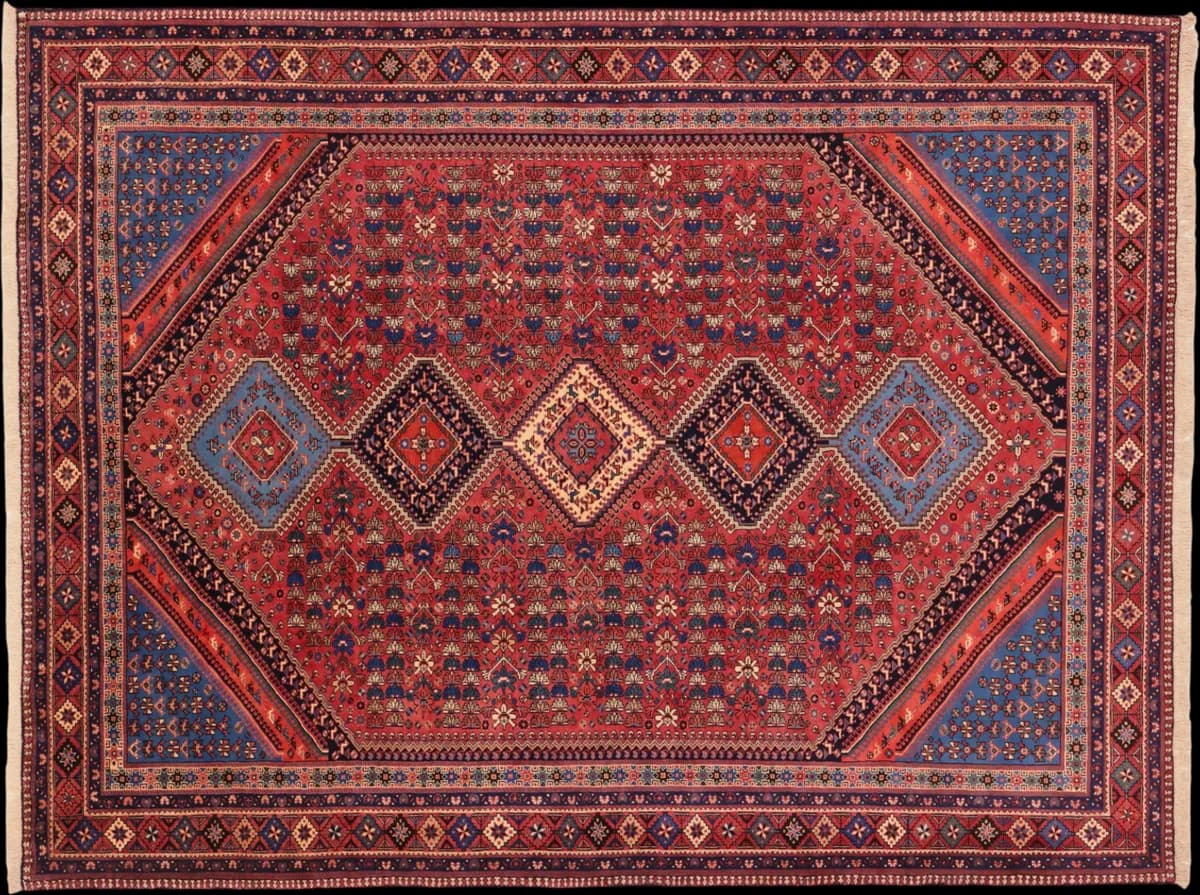
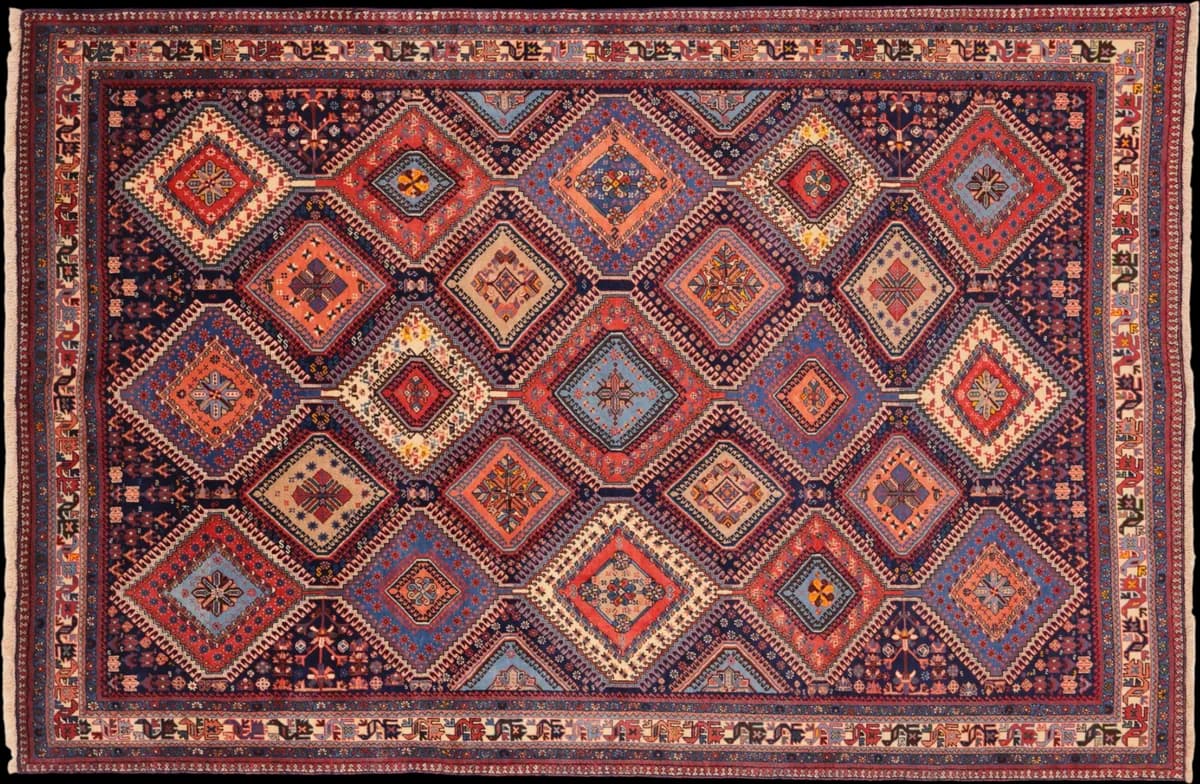
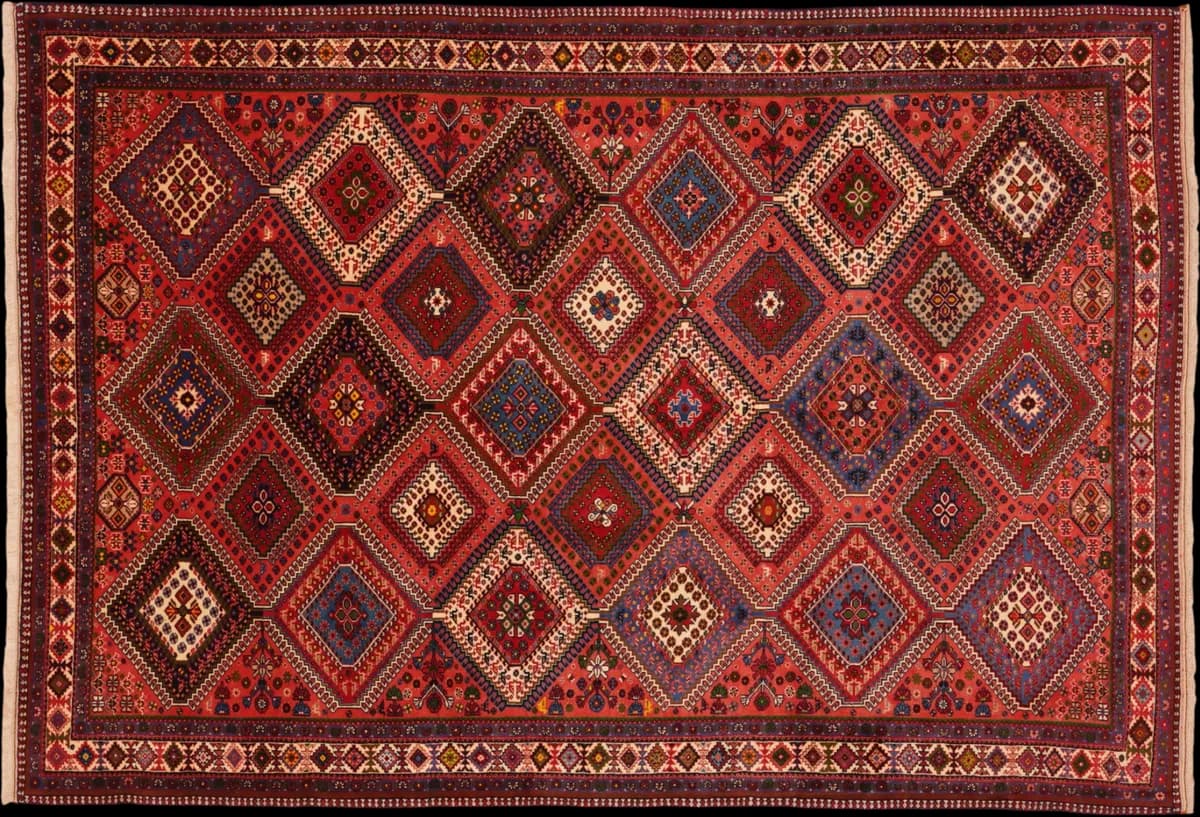
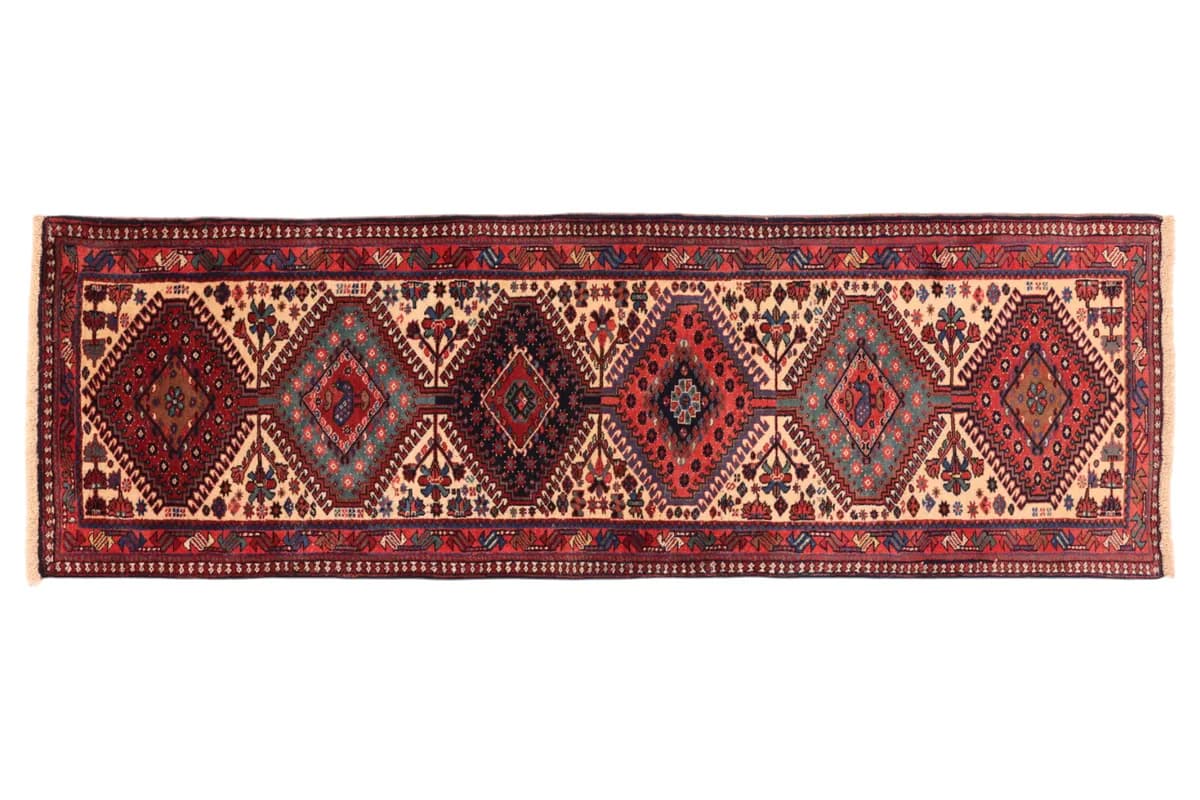
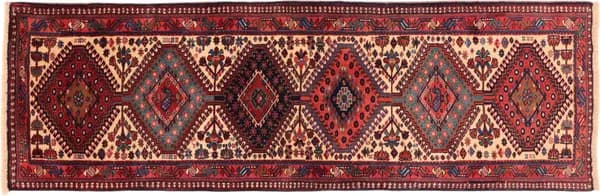
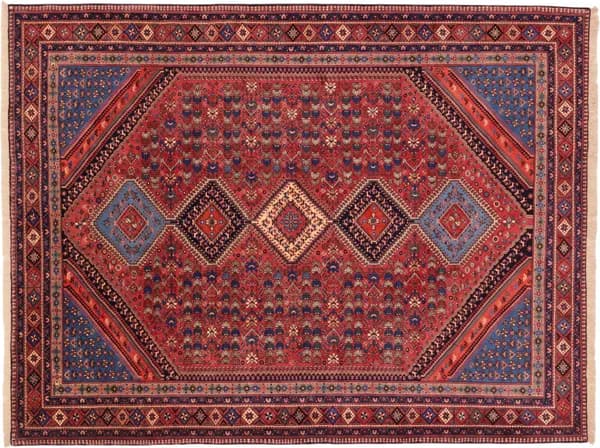
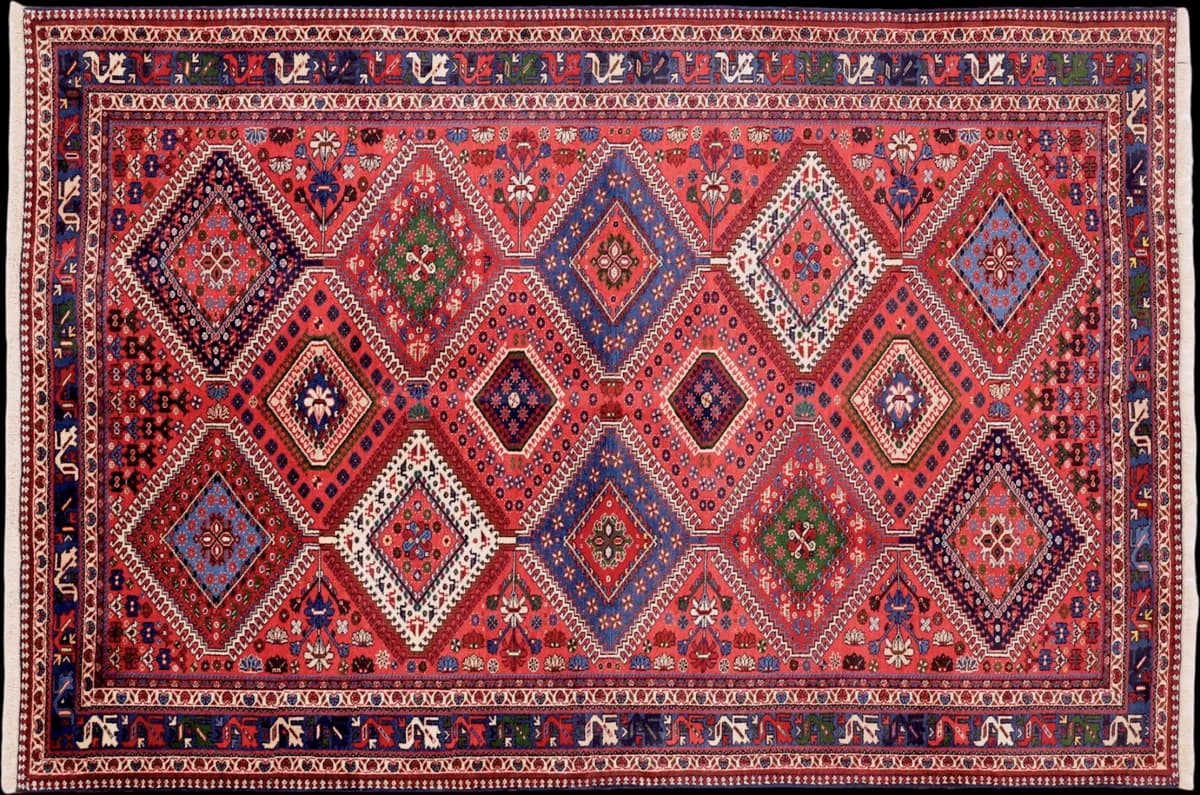
The identifying mark of a Yalameh is the diamond. Usually several sit inside one another, stepped, with small motifs distributed between them — stars, hooks, stylised animals. The result is a rhythm that reads as lively without becoming restless.
That drawing demands precision. A stepped diamond with clean edges needs enough knots for the steps to read as form rather than as accident. At around 287,000 knots per square metre that is comfortably met — well above the nomadic neighbours at 160,000.
The cotton warp belongs to it. Less elastic than wool, it holds tension more evenly, which is what makes a regular lattice possible. It is also how you tell that a Yalameh is village work rather than a weaving from a portable nomadic loom.
The colour
Southern Persian tribal rugs are usually dark: deep red, navy, brown. Yalameh go the other way. The palette is light and clear, with a great deal of ivory, bright red, turquoise and yellows rarely seen in the neighbouring types.
In a room that is a practical difference. A light rug swallows less light and makes a small space read as larger, where a dark tribal rug draws it in.
Natural dyes age differently from synthetic ones: they do not go pale but shift slightly warmer. A twenty-year-old piece therefore reads as settled rather than washed out.
- Interlocking stepped diamonds with small scattered motifs.
- Lighter palette than the neighbouring nomadic types.
- Cotton warp — light, smooth fringes.
- Around 287,000 knots — high for village work.
- Formats around three square metres.
Which room a Yalameh suits
Three square metres is the size for a seating corner, a bedroom or a study — in front of a sofa, beside a bed, under an armchair with a side table.
For a dining table the format is usually too small: there you need around 80 centimetres of clearance beyond the table edge so a chair does not tip over the edge when pushed back.
The bright palette makes a Yalameh one of the few traditionally patterned types that does not feel heavy in a light, modern room.
Care
Vacuum along the pile, without a rotating brush.
Blot spills at once with clear water and a light cloth, working from the outside in. On a light ground acting quickly matters more than on a dark rug, because a mark stays visible longer.
Turn the rug once or twice a year so light and footfall reach it evenly. Light rugs show one-sided fading more clearly than dark ones.
Yalameh or Qashqai?
Both come from southern Iran and both work geometrically. The difference is village against nomadic camp — visible in warp, density and colour.
| Criterion | Yalameh | Qashqai |
|---|---|---|
| Type | village weaving | nomadic tribal work |
| Warp | mostly cotton | wool |
| Knot density | around 287,000 / m² | around 160,000 / m² |
| Palette | light, lively | strong, darker |
| Typical size | around 3 m² | around 5 m² |
Common questions
Is a Yalameh a nomadic rug?
No, a village weaving. The most reliable mark is the warp: it is mostly cotton, whereas genuine nomadic work on a portable loom needs a wool warp. The design vocabulary is tribal; the construction is village.
What does the diamond pattern mean?
The stepped diamond is an old protective and fertility sign in southern Persian weaving, though today it functions mainly as a compositional device. For a buyer it is first of all an identifier: interlocking diamonds with small scattered motifs means Yalameh.
Why are Yalameh lighter than other tribal rugs?
It is a characteristic of the type. Where the neighbours work in deep red and navy, Yalameh use ivory, clear red and turquoise. For a light room that is a practical advantage.
Does a Yalameh fit under a dining table?
Usually not. The typical size around three square metres does not leave the 80 centimetres of clearance beyond the table edge that a chair needs when pushed back, and without it the chair catches on the edge.
How do I recognise natural dyes?
By slight colour shifts within a single field. No two dye baths match exactly, and when a weaver mixes a new one mid-work the transition shows as a soft band. This abrash argues for natural dyes and against uniform synthetic tones.