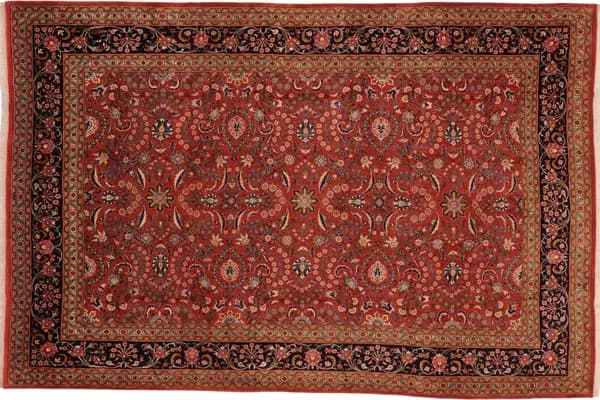
ExclusiveSigned
Kashmar | Signedwith silk
358 × 248 cm
13.500 €

Soulful Geometry from the Borderlands
Baluch rugs (also written Belutsch, Beluch or Balouch) are the knotted pile rugs of the Baluch tribes and of the neighbouring groups who live alongside them in Khorasan, the province of north-eastern Iran around Mashhad and towns such as Torbat-e Heydarieh and Torbat-e Jam, and across the border in western Afghanistan. The name points to Baluchistan in the far south-east, but most rugs sold as Baluch are woven further north, in Khorasan. Traditionally they were made by nomadic and semi-nomadic families on horizontal ground looms, as floor rugs, prayer rugs and bags for their own use.
Traditional Baluch rugs were made entirely of wool, sometimes with goat hair at the sides. Many newer pieces are knotted on a cotton warp: in this collection most Baluch rugs have a cotton warp and the rest a wool one, always with a pile of hand-spun wool. The knot is usually the asymmetric (Persian) one. The fabric is thin and supple rather than stiff, and the knotting is moderate; the pieces in this collection typically sit around 128,000 to 160,000 knots per square metre. The sides are commonly overcast in dark wool or goat hair, and many pieces have a flatwoven band at both ends before the fringe.
The palette is the quickest way to recognise one: deep madder red and rust, dark blue and aubergine to brown, with small accents of ivory or white that make the drawing sparkle. Designs are geometric and repeat across the field, such as small octagons, lattices and stepped diamonds; this all-over layout is the most common arrangement. Prayer rugs show a niche (mihrab), often with a tree of life. Formats are mostly small, and a typical Baluch measures around two square metres.
When choosing a Baluch, look at the wool first: good Baluch wool has a natural lustre that makes the dark colours glow rather than look flat. Check that the rug lies flat and the sides run straight, that the side and end finishes are complete, and turn it over: the knots on the back should be even and the colours as clear as on the front. In older pieces, dark brown and black areas can sit slightly lower than the rest of the pile, because the iron-based dyes used for these shades weaken the wool over time. This is a known property of those dyes and is found across the type.
Also known as
Belutsch, Baluch, Baloutsch, Baloch, Beluch
Turkmen · Zabol · Kalathe · Khorasan
More to Explore